10.
HAND
LIFTER
(Fig.16)
Fig.16
1
11.
PRESSER
FOOT
PRESSURE
(Fig.17)
I
Fig.17
12.
ADJUSTING
THE
FEED
TIMING
(Fi
g.18
)
Fig.18
4)
To
delay the feed timing
in
order to increase
stitch tightness, move the feed eccentric cam
in the opposite direction from the arrow.
5)
if
feed eccentric cam adjust too much, it will
cause the broken
of
needle.
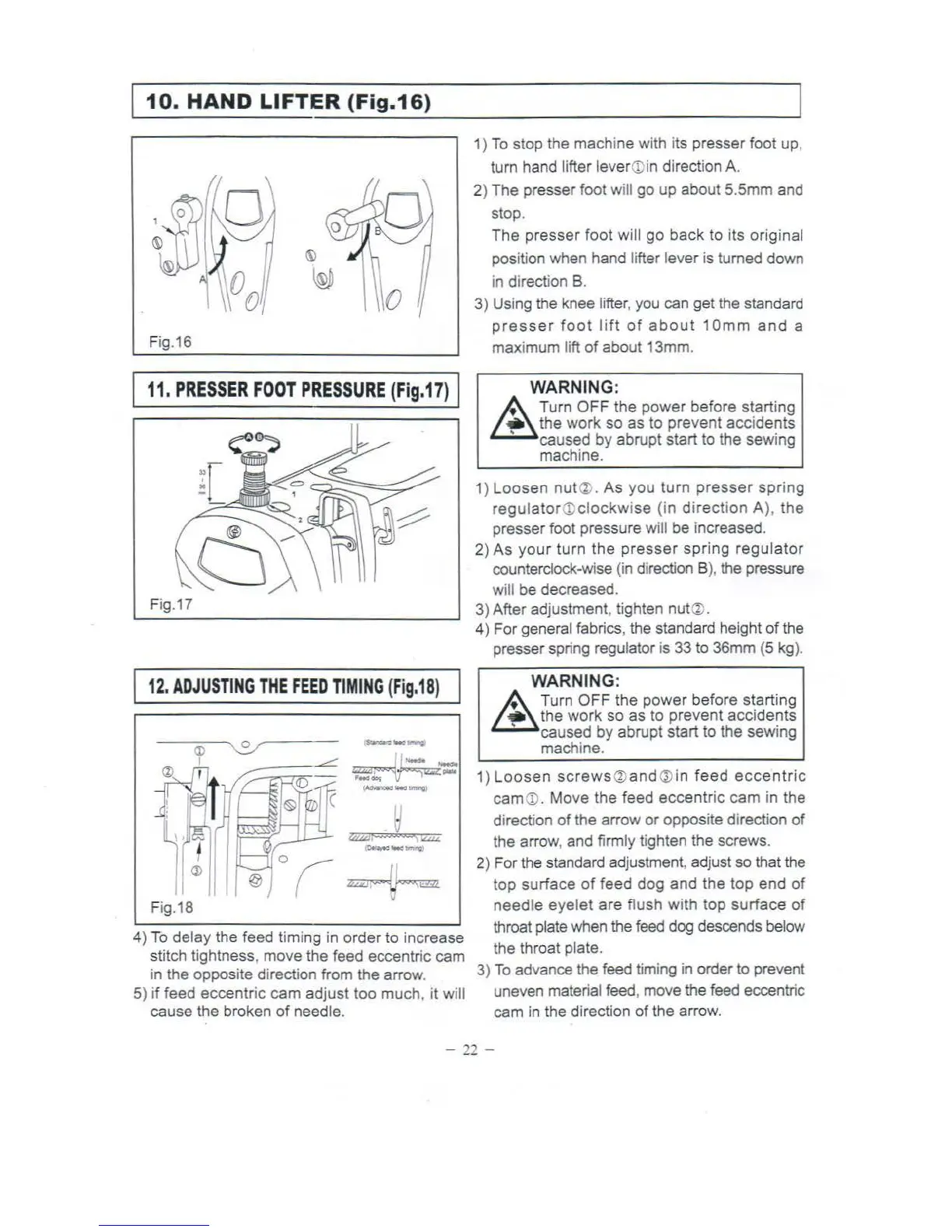
1)
To
stop the machine with its presser foot up,
turn hand
lifter lever
<D
in direction
A.
2) The presser foot will
go
up about 5.5mm and
stop.
The presser foot
will
go
back to its original
position when hand lifter lever
is
turned down
in
direction
B.
3) Using the knee lifter,
you
can get the standard
presser
foot
lift
of
about
1 Omm
and
a
maximum
lift
of
about 13mm.
WARNING:
A Turn OFF the power before starting
~
the
work
so
as to prevent accidents
caused by abrupt start to the sewing
machine.
1)
Loosen
nut
Q)
.
As
you turn
presser
spring
regulator
<D
clockwise
(in
direction
A)
,
the
presser foot pressure will
be
increased.
2)
As
your turn the
presser
spring regula
tor
counterclock-wise
(in
direction B
),
the pressure
will be decreased.
3) After adjustment, tighten
nut@.
4) For general fabrics, the standard height
of
the
presser spring regulator
is
33 to 36mm (5 kg).
WARNING:
A Turn OFF the power before starting
~
the
work so as to prevent accidents
caused
by
abrupt start to the sewing
machine.
1)
Loosen
screws
a>
and
O)
in
feed
eccentric
cam
<D
. Move the feed eccentric cam in the
direction
of
the arrow or opposite direction
of
the arrow, and firmly tighten the screws.
2)
For the standard adjustment, adjust so that the
top surface
of
feed dog and the top end
of
needle eyelet are flush
with
top surface
of
throat plate when the feed dog descends below
the throat plate.
3)
To
advance the feed timing in order to prevent
uneven material feed, move the feed eccentric
cam
in
the direction of the arrow.
-
22-
From the library of: Superior Sewing Machine & Supply LLC


 To Next Page