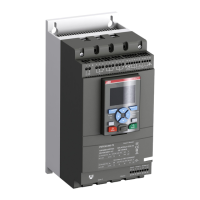
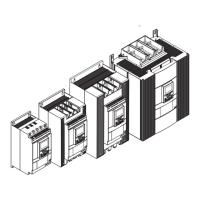
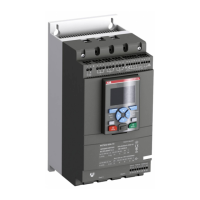
14 PSTX ENCLOSED SOFT STARTER
provide short circuit protection for the starter
along with short circuit and overcurrent protection
for the motor. In “soft starter” mode of operation,
the fuses only provide short circuit protection due
to the fact that the starter has inherent overcurrent
protection. In “bypass” mode of operation, the
fuses provide both short circuit and overcurrent
protection for the motor.
Power fuses are not supplied with the enclosed
panels. UL listed Class J time-delay fuses are
recommended for disconnect panels. These fuses
should be sized in accordance with NEC section
430-52. The NEC states fuses of this type are to
be sized at 175% of motor full-load amps (FLA).
Due to the fact that actual motor FLA along with
starting current requirements vary among
manufacturer and motor types, the fuses provided
are based on standard NEC motor data. Verify that
the input fuse amp rating is less than or equal to
the actual motor FLA x 1.75. In a case where the
actual motor FLA x 1.75 is less than the provided
fuses’ amp rating, then smaller fuses may need to
be installed to comply with NEC section 430-52.
Please review NEC section 430.52(c)1(a), which
states that where the calculated fuse amp rating
does not correspond to a standard fuse size,
the next higher standard fuse size may be used.
In cases where the fuses provided are not sufficient
for the starting current requirements of the motor,
please review 430.52(c)1(b), which states that
rating of a time-delay fuse may be increased
but shall not exceed 225% of the motor FLA in
any case. In the case where a larger or smaller
fuse is required, the fuse holder in the panel
may be a limiting factor.
Coordinating the fuses for the solid-state PSTX
panel is the overcurrent protection coordination
between the Class 10/20/30 overload relay and the
fuse’s overcurrent protection. This coordination is
to avoid nuisance blowing of fuses. Coordination
between the soft starter short circuit rating and
the fuse’s RMS let-through currents during a short
circuit condition has also been closely evaluated.
Changing the main input fuses may impact one or
both of the above coordination issues. Therefore,
if it is necessary to change the input fuses, refer
to UL short circuit document 1SFC132423M0201.
Circuit breaker trip level
The optional circuit breaker in the solid-state PSTX
is a solid-state Tmax® XT series molded case circuit
breaker from ABB. The purpose of the circuit
breaker is to provide short circuit protection and
overcurrent protection for the panel components,
field wiring and motor. The breaker uses a solid-
state sensing element, which calculates the true
rms value of the current every cycle, resulting in
very fast tripping action. For this reason, the NEC
allows the trip level to be set at 700% of the motor
FLA to allow for the high locked rotor current, which
the motor draws during across-the-line starts (see
NEC section 430-52). Because instantaneous trip
circuit breakers are so fast acting, the NEC actually
allows trip level settings up to 1300% of motor FLA
if it can be shown to be required by engineering
evaluation. A motor started across the AC line can
draw a very large peak current for the first half-
cycle, which can result in nuisance tripping in
instantaneous trip breakers set at 700%. The ABB
Motors and Electrification businesses have
conducted analyses that show that certain models
can require this 1300% trip level to avoid nuisance
tripping on across-the-line starts. Generally, trip
level will need to be higher for premium-efficiency
motors than for standard-efficiency ones.
The adjustable breakers are set to minimum
settings from the factory and must be set
appropriately in the field by the installer.
The ratings for the circuit breakers in solid-state
PSTX panels have been chosen to allow trip level
settings up to 13 times the current ratings of the
panel. If the trip level is set at 13 times the motor
FLA and the circuit breaker still trips, it is probably
due to the fact that your motor has very high
efficiency and, therefore, exhibits the highest
inrush currents. Refer to chapter 5 of this document
section for troubleshooting assistance
Motor overload trip level
The overload relay in your solid-state PSTX panel
is an EF series electronic overload relay, Class 10,
20 or 30 type from ABB, and is panel/starter
mounted. The overload relay carries all motor
current when it is running in BYPASS mode.
Whereas the panel circuit breaker or input fuses
are intended to provide short circuit protection for
the panel components, field wiring and motor, the
overload relay’s function is to provide continuous
long-term overload protection against loads that
draw current in excess of the motor’s rating.
Refer to 1SBC100214C0202 for technical data
on contactors and overload relays.
03


 To Next Page
 Loading...