15OPERATING AND TROUBLESHOOTING INSTRUCTIONS
The trip level dial on the contactors should be set
as follows.
• Motors with service factor of 1.15 or greater —
Adjust OL relay dial to the motor nameplate FLA.
• Motors with service factor less than 1.15 —
Adjust OL relay dial according to this formula:
FLA x service factor x 0.90
Example: 30 A motor with 1.00 service factor
Set OL dial at 30 x 0.90 = 27.0 A
The overload relay dial should never be set higher
than the panel’s rated current even if allowed
by the above formula.
For all PSTX normal and heavy duty panels, the
overload relay dial should never be set higher
than the panel’s rated current even if allowed by
the above formula, because the overload relay
protects panel components such as the
contactors in addition to the motor.
If the overload relay dial is set correctly but trips
in normal running situations, your motor is
probably undersized for your load. Possible
corrective actions are:
1. Make sure there is no unintended additional
loading on the motor resulting in excessive
current.
2. Try another overload relay. Possibly, the
tolerances on the one included with your
panel are unfavorable.
If the overload relay dial is set correctly but tripping
occurs on across-the-line starts, it is probably due
to a large load inertia that results in high starting
current being applied for a longer time to
accelerate the motor from a stopped to full speed
condition. Traditionally, the problem of starting
motors with high inertia loads across the line has
been solved by a number of methods falling into the
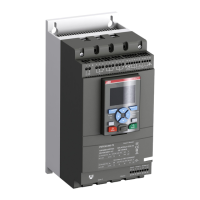
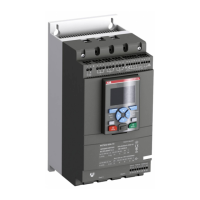
category of soft starters. The PSTX soft starter is a
“soft starter” because it applies a very low voltage
to the motor when it is stopped and gradually
increases to full voltage at full speed. Recognizing
that this problem can only occur during full voltage
across-the-line starts (in other words, starting in
bypass mode), refer to chapter 5 of this document
section for troubleshooting assistance.
The overload relay should not be turned to a
higher setting than allowed by the rules above to
allow starting the motor across the line without
tripping. Doing so will compromise the overload
protection, which could lead to component
damage or fire that could threaten personnel
safety. Refer to the NEC for further information.
03



 To Next Page