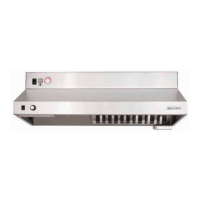
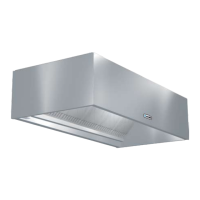
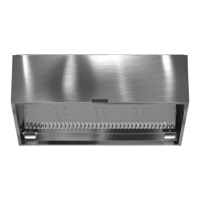
Fire Ready Hood 9
Hood
1. Remove hood from crating. Remove the grease filter.
2. Carefully lift it onto the lower hood tabs on the wall mounting bracket.
2. While holding the hood up, hook the safety cable to the chain link on the mounting bracket and screw nut to close
the link. The hood is now in the service position.
3. To put the hood into operation position, lift the hood up, and one at a time re-hook the clamps and pull the clamps
tight until they lock. Make sure the safety bolt lever is located inside the notch in the hood mounting bracket. See
page 22 for pictures and more information.
4. When all construction is complete, remove protective plastic sheeting from hood stainless steel. Clean (using
alcohol and rag) and polish (using stainless steel polish) the hood. When cleaning or polishing, be sure to wipe
with the grain and not against it.
Ductwork (if applicable)
Running ductwork will be required for hoods configured for external fans. A small rectangular piece of duct spanning
the width of the wall will be required for integral fan – rear discharge configurations (discharging through the back
wall). Check the individual hood drawings to see what fan type is provided with your system.
Hood Length
(in.)
NFPA 101
Compliance
Ventilation
External Fan
Type
CFM
Duct Size
(Minimum)
Duct Length
(Maximum)
30
No Integral Fan – Front Recirculating Not applicable 250 Not applicable Not applicable
No Integral Fan – Rear Discharge Not applicable 250 5 x 12 in. 2 ft.
No External Fan - Top Discharge Inline 250
10 in. round
(diameter)
35 ft.
No External Fan - Top Discharge Fan by Others 250
10 in. round
(diameter)
External fan by others should be sized
based on hood and duct static pressure
Yes Integral Fan - Rear Discharge Not applicable 500 5 x 12 in. 2 ft.
Yes External Fan - Top Discharge Inline 500
12 in. round
(diameter)
35 ft.
Yes External Fan - Top Discharge Fan by Others 500
12 in. round
(diameter)
External fan by others should be sized
based on hood and duct static pressure
36
No Integral Fan – Front Recirculating Not applicable 300 Not applicable Not applicable
No Integral Fan – Rear Discharge Not applicable 300 5 x 12 in. 2 ft.
No External Fan - Top Discharge Inline 300
10 in. round
(diameter)
35 ft.
No External Fan - Top Discharge Fan by Others 300
10 in. round
(diameter)
External fan by others should be sized
based on hood and duct static pressure
Yes Integral Fan - Rear Discharge Not applicable 500 5 x 12 in. 2 ft.
Yes External Fan - Top Discharge Inline 500
12 in. round
(diameter)
35 ft.
Yes External Fan - Top Discharge Fan by Others 500
12 in. round
(diameter)
External fan by others should be sized
based on hood and duct static pressure
All ductwork will need to be provided in the field. Installing ductwork must be done by qualified person(s) in
accordance with all applicable codes and standards, including fire-rated construction. All ductwork, per IMC Section
505 should be constructed of sheet metal, have smooth inner walls, be air tight, and be independent of all other
exhaust ductwork systems.
To minimize static pressure losses and promote adequate airflow, minimize duct run lengths where possible.
For external fan configurations, duct should be connected to the 8 inch collar adapter on the hood mounting bracket.
Transitions should be utilized to expand duct to duct size minimum requirements noted in table above.


 To Next Page
 Loading...