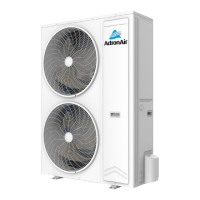
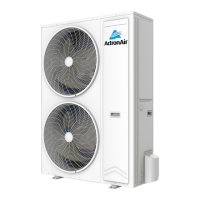
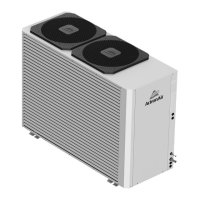
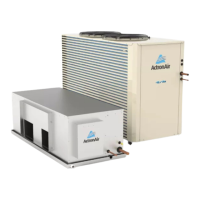
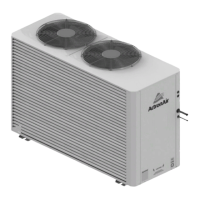
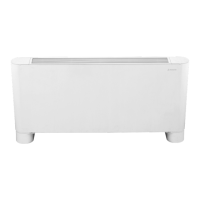
The ActronAir UltraSlim Ducted Split System Air Conditioner is designed to provide optimal air conditioning and maximum energy efficiency for residential and commercial applications. This owner's manual covers models LRC-071CS/LRE-071CS, LRC-100CS/LRE-100CS, URC-125CS/LRE-125CS, URC-140CS/LRE-140CS, and LRC-170CS/LRE-170CS.
Function Description:
This air conditioning unit operates as a split system, meaning it consists of an indoor unit (ducted) and an outdoor unit. It is designed to cool, heat, and dehumidify indoor spaces, maintaining desired temperature and humidity levels. The ducted design allows for discreet installation within ceilings or walls, distributing conditioned air through a network of ducts to various rooms. The system utilizes R-32 refrigerant, which is classified as A2L (mildly flammable).
Important Technical Specifications:
- Refrigerant: R-32 (CLASS A2L)
- Operating Temperature Ranges:
- COOL Mode:
- Room Temperature: 17°C to 32°C
- Outdoor Temperature: -0°C to 50°C
- HEAT Mode:
- Room Temperature: 0°C to 30°C
- Outdoor Temperature: -20°C to 24°C
- DRY Mode:
- Room Temperature: 17°C to 32°C
- Outdoor Temperature: 0°C to 50°C
- Compressor Protection: The compressor has a 3-minute restart delay after stopping to prevent overloading.
- Hot Start Feature: Prevents cold air from blowing during HEAT mode startup, defrost cycles, or low-temperature heating until the indoor heat exchanger reaches the set temperature.
- Defrosting: Automatic defrosting occurs on the outdoor unit during heat cycles when outdoor temperature is low and humidity is high, lasting approximately 4 to 10 minutes.
- Auto-Restart: In case of a power failure, the unit automatically restarts with its last programmed settings once power is restored.
Usage Features:
- Optimal Operation:
- Adjust temperature for comfort, avoiding excessive levels.
- Close blinds or curtains during cooling to avoid direct sunlight.
- Keep doors and windows closed to maintain conditioned air.
- Utilize ON/OFF TIMER and SLEEP/ECONOMY features for energy efficiency.
- Avoid placing objects near air inlets or outlets to prevent reduced efficiency or unit stoppage.
- Troubleshooting: The manual provides a comprehensive troubleshooting guide for common issues such as the unit not turning on, changes in operating mode, white mist emission, noises, dust emission, bad odors, and outdoor fan operation. It also lists possible causes and remedies.
- Error Codes: The system displays specific error codes (e.g., E2, E3, EF, EE, E5, ED, E4, EB) to indicate issues such as sensor errors, low refrigerant, high water level, or inverter module problems, aiding in diagnostics.
- Normal Display Codes: The unit also displays normal operation codes (e.g., dF for defrost, on(3s) for Timer ON, OF(3s) for Timer OFF, CL for active clean, nF for filter replacement reminder, FP for heating in room temperature under 8°C, FC for forced cooling, AP for Wi-Fi connection mode, CP for remote switched off) to inform the user of its status.
Maintenance Features:
- General Maintenance: All general maintenance, repairs, and decommissioning must be performed by a licensed HVAC technician qualified to handle R-32 refrigerant. Filter cleaning can be performed by the product owner.
- Safety Precautions:
- Always turn off power from the main isolator and observe LOCK-OUT/TAG-OUT (LOTO) procedures before any service or maintenance work to prevent electric shock.
- Do not operate the unit in wet rooms or with wet hands.
- Do not insert fingers or objects into air inlets/outlets due to high-speed fan rotation.
- Avoid using flammable sprays near the unit.
- In case of abnormal situations (e.g., burning smell), turn off power and contact an HVAC technician.
- If refrigerant leaks, turn off the unit and any combustible devices, ventilate the room, and call an HVAC technician immediately.
- Preparation for Periods of Non-Use:
- Run the unit in FAN mode for 12 hours in a warm room to dry components and prevent mold formation.
- Turn off the appliance and main power isolator.
- Clean and dry the air filter before storing; reinstall before re-use.
- Pre-Season Inspection:
- Wipe off dust from the rear air intake grille.
- Check that the air filter is installed.
- Check for blocked air outlets or inlets.
- Turn on the main power isolator at least 12 hours prior to operating the unit.
- Annual Maintenance Checklists (Electrical and Indoor/Outdoor Units):
- Electrical: Visual inspection of printed circuit boards, checking and tightening electrical terminals, mains, communications, and magnetic contactors.
- Indoor Unit: Visual check for damage, rust, and dust on casing/panels/frames; insulation conditions; fan run-out and dust; motor wiring and insulation resistance (annually); heat exchanger clogging/leaks; drain pan/condensation line obstructions; filter clogging (clean/replace as required); and temperature readings (air on & air off).
- Outdoor Unit: Visual check for damage, rust, and dust on casing/panels/frames; insulation conditions; fan run-out and dust; motor wiring and insulation resistance (annually); heat exchanger clogging/leaks; condensate drain line obstructions; compressor high/low pressure, insulation resistance, and noise/vibrations; variable drive compressor operation (hertz range, fan operation); drive fresh air path clearance; refrigeration operational readings (pressures, super heat, sub-cool values); safety device calibration; and previous fault history.
- Coil Cleaning Procedures (Condenser Coils):
- Clean coils at least once a year, or more frequently in dusty environments, using a soft brush and water spray (low-pressure nozzle).
- Disconnect power, remove louvered panels, remove dirt/debris, straighten bent fins, spray detergent solution (alkaline level no higher than 8.5) at a 90° angle (minimum 15° spray angle, 1800mm distance, 600 psi pressure), allow to stand, rinse with clean water, inspect, clean/wipe dry, ensure drain lines are not blocked, reinstall panels/covers/guards, and restore electrical power.


 To Next Page

 General