Electrical installation
GasEye Cross Duct
45
Electrical installation
Electrical connections
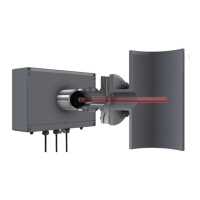
The GasEye Cross Duct gas analyzer consists of a cross-duct sensors - a
central/transmitter unit and a receiver unit. The transmitter unit emits laser radiation
directly through the process containing the constituents of interest. The receiver unit
collects the radiation on the other side of the process duct. The receiver unit is
connected to the central unit by means of a hybrid loop cable.
Standard connections (included) needed for analyzer commissioning are as follows:
Customer cable – used for power supply and analog/digital IO. Customer cable
is an electrical cable with 12 x 0.5 mm
2
wires. Standard length is 5 meter (other
lengths on request).
Hybrid loop cable – used to connect the receiver unit with the central unit. The
hybrid loop cable consists of a fiber optic cable for communication between
receiver and the central unit as well as an electrical cable for powering and
synchronization with the receiver unit. Standard length is 10 meter (other
lengths on request).
Ethernet cable – used for connection of the analyzer with a computer via
WebServer. Standard length is 10 meter (other lengths on request).
The connections are shown in Figure 44.
Additional connections for analog or digital signals, as well as Modbus RTU or Add-
on module functionality are available depending on the customer requirement.
Electrical characteristics:
24 VDC nominal (19 – 30 VDC)
max. 15W
Available interfaces:
4 x analog output 4 – 20 mA (isolated, easy user selection via DIP switch
between active/passive mode)
4 x analog input 4 – 20 mA (easy user selection via DIP switch between
active/passive mode)
8 x digital output (isolated)
8 x digital input (isolated)
Human Machine Interface (HMI) – LCD backlight display located on the central
unit housing lid
Ethernet port:
a) WebServer – system configuration and data acquisition via web browser,
b) Windows based program – GasEye logger for real time data acquisition,
c) remote service and diagnostics
d) USB port – service and diagnostics port
Optional: Modbus (TCP/IP), Modbus RTU, Profinet, Profibus


 To Next Page