Residential HRV/ERV
35
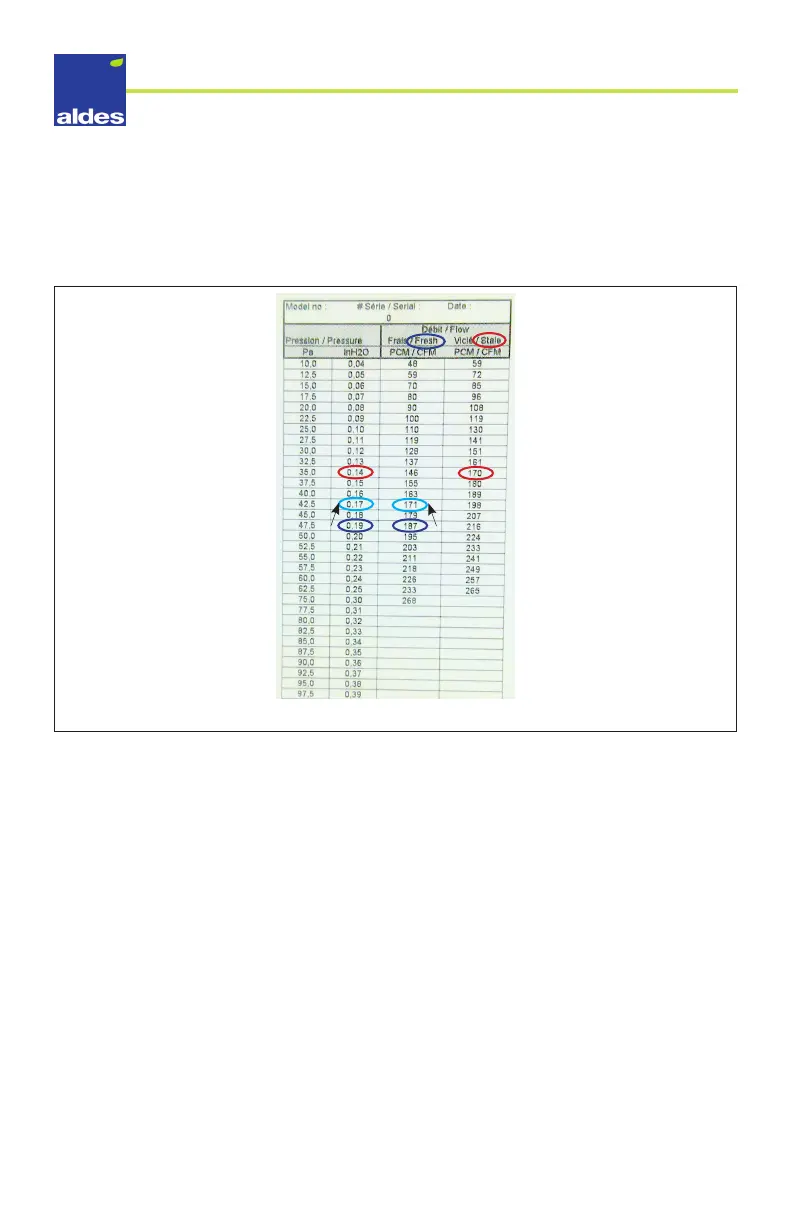
Sample Door-Port Balancing Example
The static pressure reading across the fresh air is 0.19 in. w.g., indicating an airow of 187
CFM. The reading for the stale air is 0.14 in. w.g., indicating the exhaust airow is 170 CFM.
The supply airow should be adjusted to about 170 CFM (see section “Balancing Airow and
Adjusting Motor Speed” on page 32) until the pressure reading is about 0.17 in. w.g.
Example 1: Balancing using the provided airow chart
In-Duct Balancing
In-Duct Balancing consists of finding the average velocity in the duct, then multiplying
by the area to obtain airflow.
Applicable models: You would use this method with higher eciency lters.
There are three in-duct balancing methods:
1. Pitot tube and manometer or digital differential pressure gauge to measure the
velocity.
Note: Pitot tubes are not recommended for velocities below 400 FPM.
2. Airflow station or probe in the supply and exhaust ducts to measure the average
pressure, then use a conversion chart (provided by the flow station manufacturer)
to convert to velocity then to airflow. Aldes supplies an Airflow Balancing Kit (sold
separately).
Note: Compared to a pitot tube measurement, the airflow station or airflow probes
provide a higher pressure reading, making it possible to read very low airflows.
To get the most accurate results, select a differential pressure gauge that will give



 To Next Page