11
OPEN
CLOSED
BALL VALVE POSITION
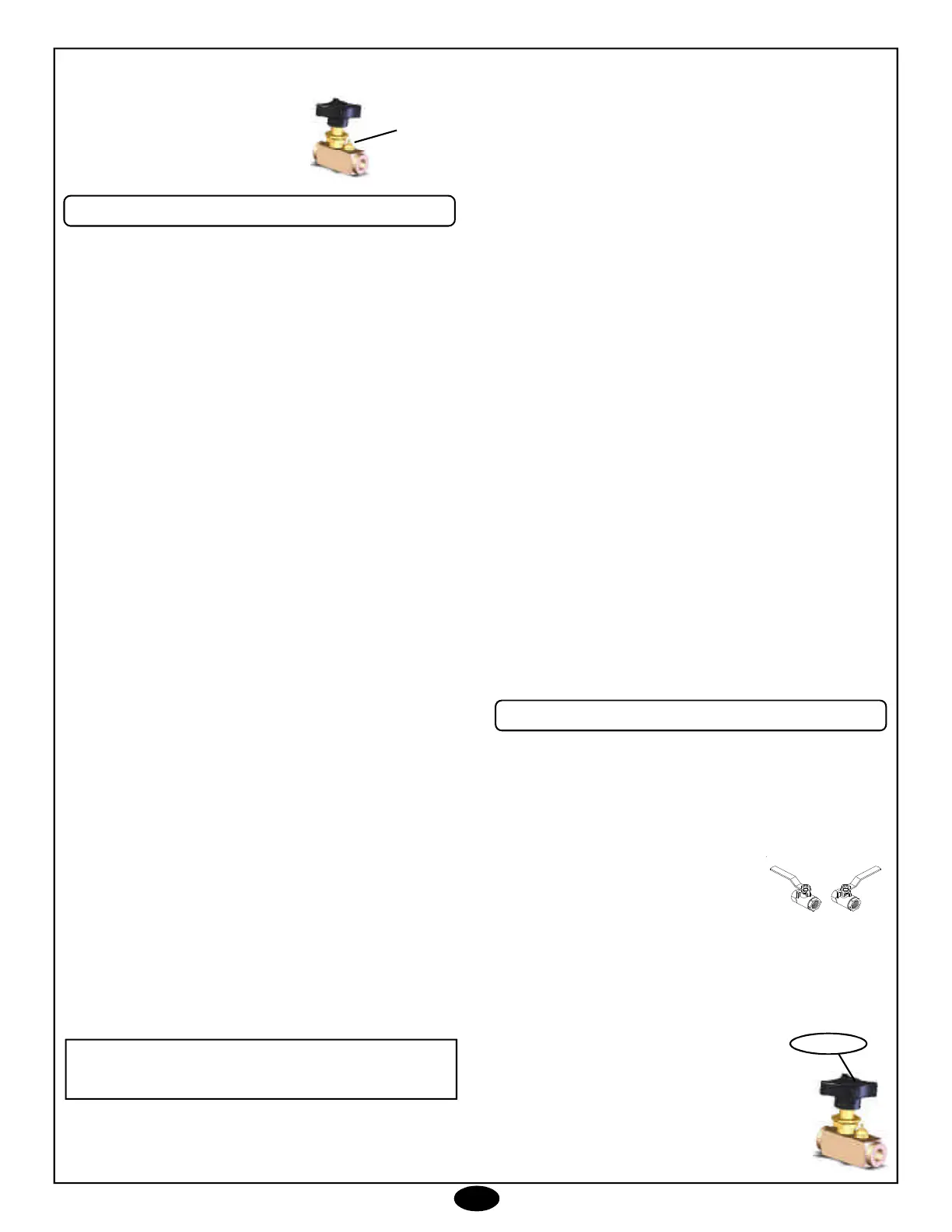
3. With a small common screw driver turn the screw
on the metering valve (if so equipped) counter
clockwise to DECREASE the
temperature and clockwise to
INCREASE the temperature.
1. Install the open gun assembly.
2. With the gun assembly in hand (on trigger gun models
hold the trigger gun valve in open position) and with a
good flow of water, turn the switch to “pump” position.
CAUTION: A good flow of water must be flowing from
the end of a gun for 30 seconds, before proceeding.
Lack of water can cause damage to the water pump
and like components.
CAUTION: On a machine equipped with a trigger gun
valve, if the trigger gun valve remains in the closed
position for more than 3 minutes, water pump damage
may occur.
3. Turn the switch to the “burner” position
CAUTION: Do not run the machine with the burner
switch in the on position when the fuel tank is empty
or with tank valves closed. This will cause damage to
the fuel pump and void warranty.
CAUTION: Do not operate with the trigger gun valve
closed for more than 3 minutes or water pump damage
may occur.
4. To CLEAN:
A. Start on the lower portion of the area to be cleaned
and work up using long, even, overlapping strokes.
B. Dirt is generally removed easily if grease and/or oil
is not present. However if grease and/or oil are
present, hot water and chemical will accelerate in the
cleaning process.
5. TO APPLY CHEMICAL:
CHEMICAL: Use factory recommended chemicals for
best cleaning action and for extended pump life.
Contact your dealer for chemicals available. Follow
instructions on chemical container.
Note : If the valve is open without the chemical line
in a source the water pump will draw air causing the
system not to pressure up.
Mix chemicals per label instructions. Use necessary
safety percautions.
When chemical is desired, the system must be
switched over to the low pressure nozzle to draw
chemical.
A. Insert chemical screen into chemical container.
B. If your system is hot water turn the burner switch
to the off postion. There will be air in the soap line.
Air heats very quickly and needs to be eliminated
before the burner can be turned on. Open, counter
clockwise the soap metering valve to up the chemical
line. Once the chemical line is completely full trigger
control gun. Soap should begin moving up the
chemical line. Once the chemical line is completelyfull
trigger, the gun on and off numerous times to break
any possible air locks. Turn burner system switch to
“on” position if equipped.
C. Adjust metering valve or injector. Install your
injector tip.
D. If the gun assembly is equipped with variable or
multiple nozzle assembly, adjust to low pressure .
5. To Rinse: (For cold water rinse, turn the burner
switch off.)
A. If the machine is equipped with a panel mounted
metering valve, close the chemical metering valve.
NOTE: It is advisable to dip the chemical screen in a
container of clean water and open the valve 1 minute
to clean the valve of any remaining residue.
B. If the gun and wand is equipped with variable or
multiple nozzle assembly, open and close to clean
nozzle of any remaining residue.
C. After a clear flow of water is noted from the end of
the wand, start from the top, working downward using
long, overlapping strokes.
1. Turn the burner switch to the “off” position. (If not
already done so in the cold water rinse.)
2. After cool, clear water is coming from the end of the
wand, turn the switch to “off” position.
HIGH VOLUME COMBI:
A. Close the water bypass ball
valve (if so equipped) on the coil
inlet assembly.
LOW VOLUME COMBI:
A. Completely Close the water bypass metering valve
(if so equipped) handle turning it clockwise found on
the pump assembly.
3. Turn off the water supply.
4. If freezing conditions may exist,
refer to STORAGE in the section
of MACHINE MAINTENANCE.
5. Replace stack cover (if so
equipped)
05-26-06 Z08-05465A
SHUT-DOWN
OPEN g g
CLOSED g g
START-UP
g
DECREASE
TEMPERATURE
g
g
INCREASE
TEMPERATURE
SCREW
CAUTION: You cannot draw an abrasive product such
as an aluminum brightner. It will cause an
non-warrantable premature pump failure.


 To Next Page
 Loading...