FMI-B
FMI-S
Bedienungsanleitung
Operation manual
Notice d’utilisation
Instrucciones de servcio
Istruzioni per l’uso
www.alluris.de
Page 8 of 34
3.0 Starting Operation
3.1. Preparing the Measurement
The internal sensor works bi-directional, i.e. compression and tensi-
on. By default the instrument is attuned to display a positive value if
compressive force is applied at the measurement axle, and a negative
value if tensile force is applied. You may change this setting (see p.
17 chapter 4.2.2 Changing +/- prefix for push or pull operations
(P12)).
Select an appropriate attachment for compression forces or use the
hook to apply tension forces. An extension rod should be used only
if the accessibility of the object cannot be achieved without. Special
adapters for specific applications can be found on www.alluris.de.
Mount attachements by hand only. Do not use tools to screw adapters
onto the instrument`s threaded axle. Radial and side forces can da-
mage the instrument.
As gauges are often used in the scope of destruction-tests or for
appraising security-relevant thresholds you should always first be-
come familiar with the potentially resulting risks – broken fragments,
sudden change of force, crush risk – and, if necessary, take counter
actions.
3.2. Turning the instrument ON/OFF
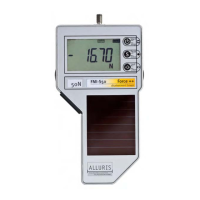
Switch the instrument on by pressing the I-key. Aer a self-test roune
three sets of informaon are shown to inform you about the model
number, the recommended date of next calibraon and the nominal
measuring range (Fn). Once the roune is completed the instrument is
ready for use (idle).
With each start of the measurement an automatic taring (auto-tara-
function) is performed to eliminate the gravitation force influence of
the weight of measuring axis and other installed attachments which
model
recalibration due
yy.mm
measuring
range
idle
self-test
N
On
Information sequence as shown when starting the instrument


 To Next Page
 Loading...