5 / 44
NL
EN
Take sufficient measures against environmental factors
that will help to ensure safe working on the tower.
Use guardrails when this is required from a safety or
legislative point of view.
Never leave the tower unsupervised. Make sure that
unauthorised individuals cannot gain access to the tower.
The mixing of scaffolding parts of different brands /
manufacturers is not permitted, as this endangers safety
because no strength and stability calculation has been
made for that mix configuration.
The workplace around the tower has to be cordoned off
using cones and/or marking tape.
If required, attach the stabilizers. Use the correct stabilizers
with the corresponding platform height. It is not
obligatory when less than 2.5m but it is recommended
for work which involves significant horizontal forces.
Make sure that safe working with the tower is always
given priority.
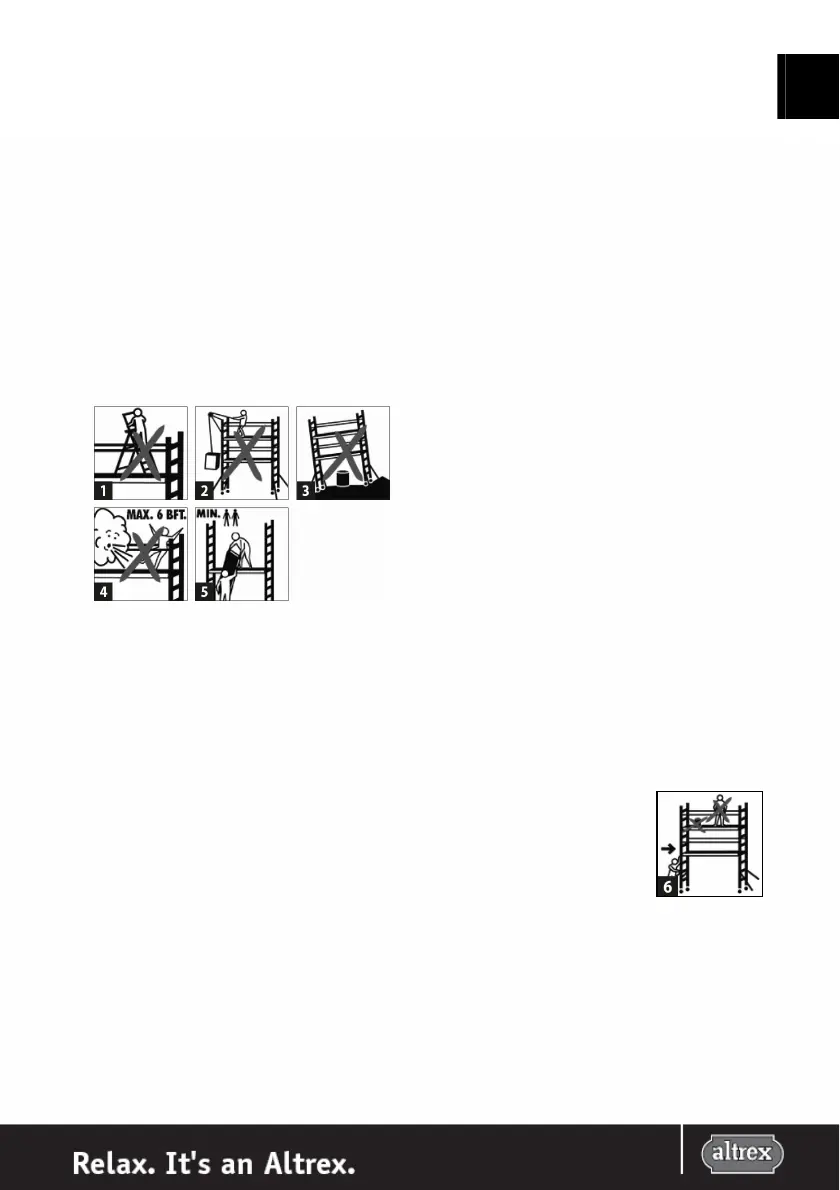
A minimum of 2 people should always be used to
assemble a tower, see figure 5.
II.III
Checklist for the use of towers
When an assembled tower is (re)used, the following should
always be checked:
1.
that the tower is the correct one for the intended use;
2.
that the immediate vicinity in which the tower is
assembled allows for safe use;
3.
that the tower can still be used safely;
4.
that the quality of the surface is horizontal, flat and
sufficiently load bearing;
5.
that the environmental factors, such as opening doors,
automatically working sun blinds, aboveground electrical
cables, traffic and/or passers-by, etc., do not lead to
dangerous situations;
6.
that there is sufficient free space to be able to assemble
and use the tower safely;
7.
that all required parts and safety tools are available at the
workplace;
8.
that no damaged parts or parts other than those
prescribed are used;
9.
that the tower is assembled in accordance with this
manual and in conformity with the configuration and
ballast table;
10.
that the maximum assembly height is not exceeded;
11.
that it is easy to climb up the inside of the tower;
12.
that the wheels are properly attached, aligned, and that
the brake is applied;
13.
that the frames are properly assembled and secured;
14.
that the horizontal and diagonal braces are assembled
and secured in the correct position;
15.
that the stabilizers that correspond with the permitted
platform height are assembled correctly;
16.
that the tower is perpendicular(check using a spirit level);
17.
that the tower is stable;
18.
that the platforms are situated in the correct position and
the wind security lock is secured in place;
19.
that there is a rest platform at least every 4 meter;
20.
that the tower configuration is inspected frequently (see
inspection sticker);
21.
that all locking pins are in place in the construction and
that these are locked.
II.IV Inspection, Care and Maintenance
1.
Tower parts must be handled and transported with care,
in order to avoid damage.
2.
Storage should be organised in such a way that only
undamaged parts, in the correct amounts, are available
for assembly of the tower.
3.
Check all moving parts for correct functioning and to
ensure that these are not contaminated.
4.
Check all parts for damage. Damaged or incorrect parts
may not be used.
5.
Damaged parts have to be returned to the manufacturer
for inspection.
6.
Towers for professional use must be inspected annually
for any defects by an expert.
7.
The tower must be inspected again before use and in the
case of an emergency such as a storm etc.
II.V Disassembly of the tower
The tower should be disassembled following the instructions
for assembly but in reverse order.
II.VI Relocating the tower
In order to relocate the tower the height has to be
reduced to a maximum of 6.2 meter.
In order to relocate the tower, the stabilizers have to be
raised to a maximum of 10 cm.
The wheel legs are released by pressing the brake pedal.
When the tower is being
relocated, persons and/or
materials may not remain on the
tower (figure 6).
Beforehand, checks should be
made that the environmental
factors, such as opening doors,
canopies, pits, automatically functioning sun blinds,
aboveground electrical cables, traffic and/or passers-by,
etc. do not pose the risk of dangerous situations while
the tower is being relocated.
Only relocate a tower in the lengthways direction or in the
diagonal direction, manually, over a flat, horizontal and
sufficiently load-bearing surface. Make sure that the
tower does not start to slant during relocation.
Immediately after relocating the tower, the wheel legs
have to be applied and locked, by pressing the brake
pedal.
GENERAL



 To Next Page