Amprobe Europe GmbH AT-2000
- 16 -
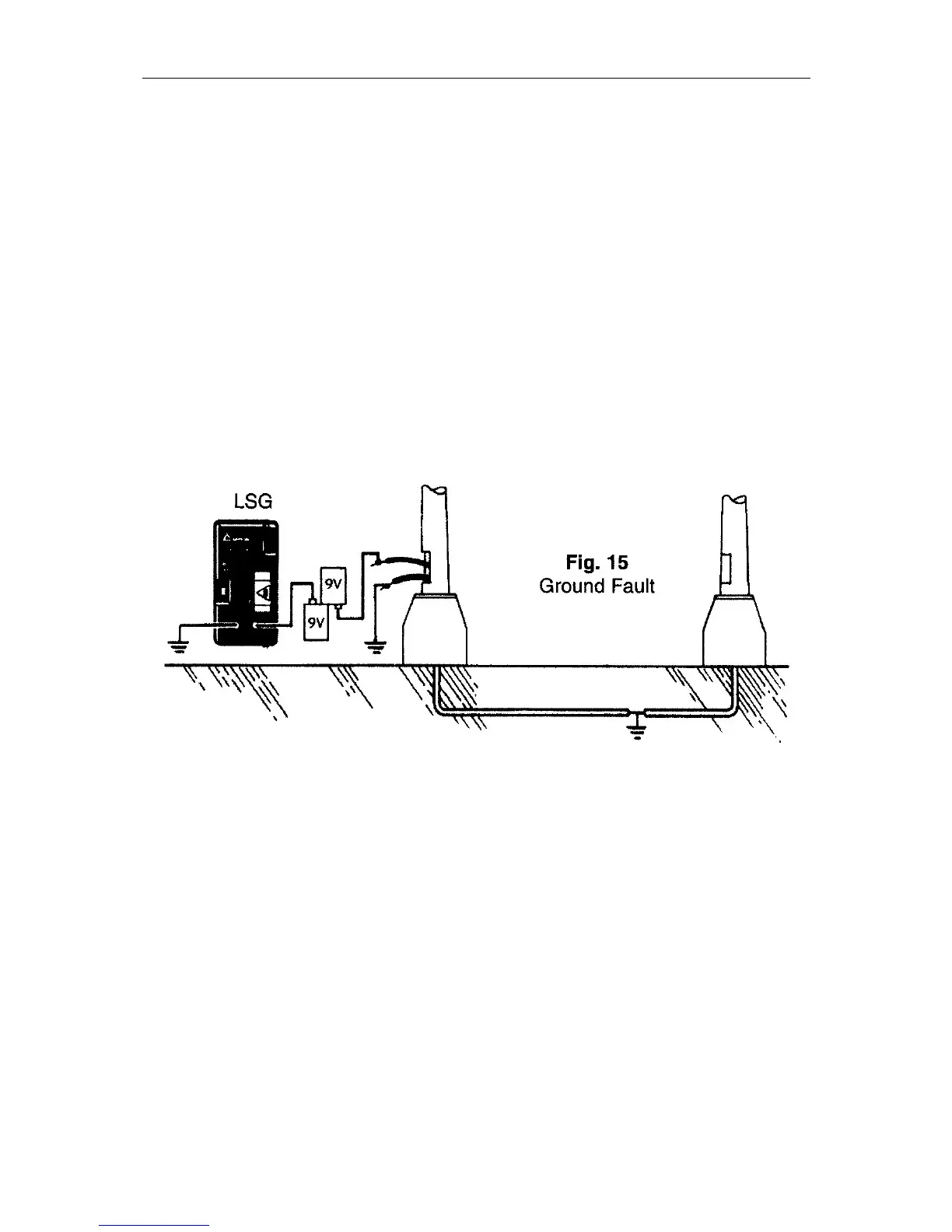
Also, you can use line voltage as the power source by connecting the
LSG across the breaker.
1. Plug the alligator clip cordset into the LSG.
2. Attach one clip to the faulted wire and the other to one terminal of a
battery (minimum 9V), or the hot side of the breaker.
3. If using a battery, connect the other battery terminal to ground.
4. The light on the LSG should blink indicating a complete circuit. If
possible, ground all adjacent conductors.
5. The R2000 receiver can then be used to trace the wire. The signal
should remain relatively constant until you pass the ground fault. At
the fault, the signal from the LSG will pass from the wire and disperse
into the ground. For this reason, the signal strength will decrease
gradually (within 2-3 feet) so you will have to watch the LED's carefully
in order to get within a few inches.
Tracing Wires in Conduit
When seeking a ground fault within metal conduit, the 'ground' is the
conduit. Connect the battery to the conduit to complete the circuit.
Steel conduit will tend to attenuate the signal strength so tracing will
require higher sensitivity levels and access to within a few feet of the
conduit. Aluminum conduit will severely attenuate the signal sometimes
blocking all the signals from the wire. In this situation, steel couplings
and junction boxes will transmit a signal. It may be necessary to
periodically access the wire in the conduit to confirm signal presence.


 To Next Page