- 7 -
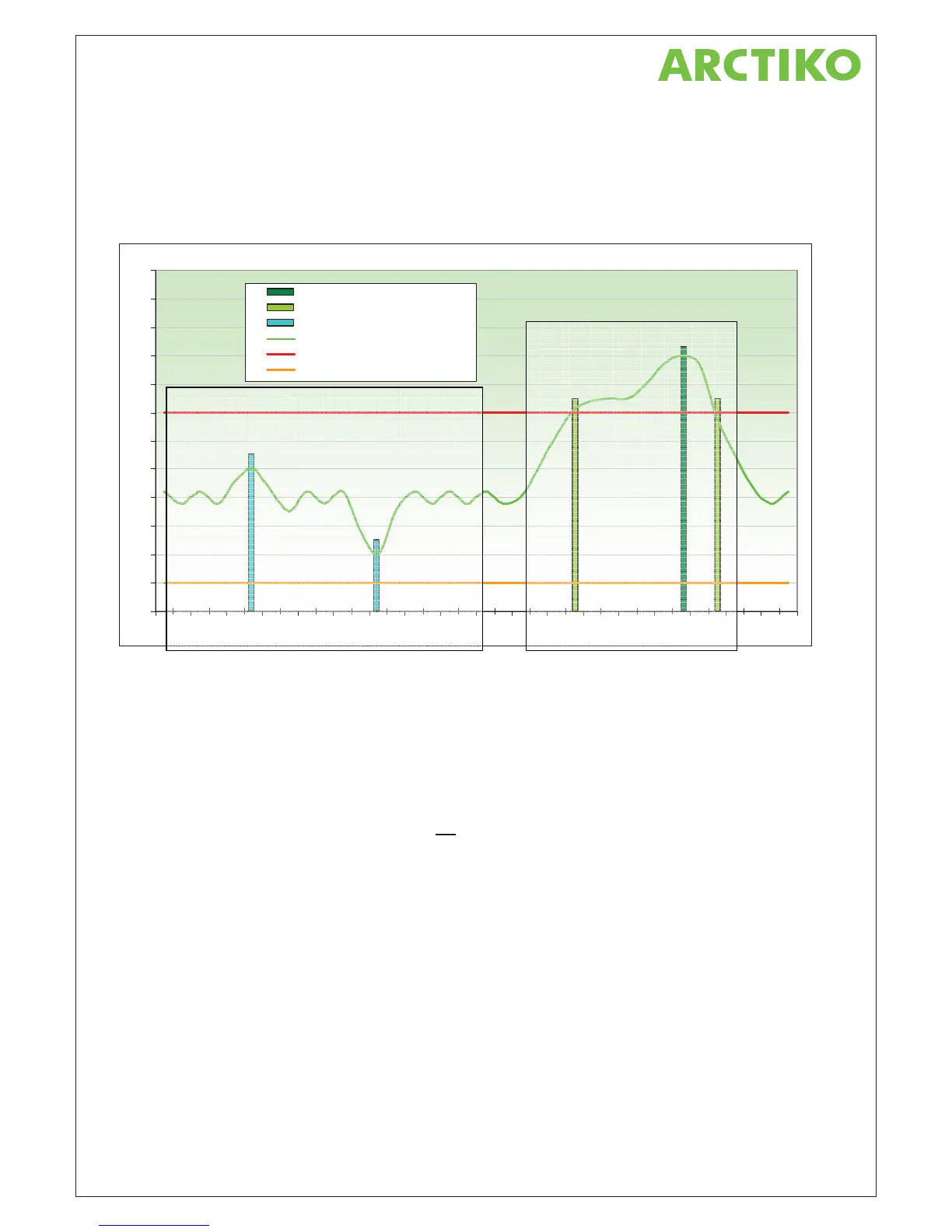
The alarm historic explained with several examples.
In the following examples it’s explained how the controller memory and alarm historic is saving data like
temperatures and the time where the temperature has exceeded an alarm limit.
One example is made under normal conditions, while another is with a fault.
Example 1 – Max and min temperatures and later an exceeded alarm limit
Temperature historic
0
1
2
3
4
5
6
7
8
9
10
11
12
1357911131517192123252729313335
hours
[ °C ]
Max imu m me a s ur ed temp.
Temp. exceeds the alarm limit
Temperature peaks in memory
Temperature in cabinet
High alarm limit at +7 °C
Low alarm limit at +1 °C
Here above is given a graph which is an example how the temperature had been the last 36 hours. (Could be
made over a weekend, and we are studying the graph Monday morning).
The cabinet set point is set to +4 °C. The upper alarm limit is set to +7 °C and the lower limit is set to +1 °C.
Situation 1 – under normal conditions.
For 31 hours ago, the warmest temperature was found to +5 °C and for 24 hours ago the coldest temperature
was found to +2 °C. Both temperatures is now stored in the controller memory. To study them it’s easy by using
the key pad on the cabinet.
When studying the stored data for 19 hours ago, the controller would present the respectively two temperatures
of +5 °C and +2 °C. At this moment the display is not
flashing.
Situation 2 – a fault appears.
Unfortunately the situation become more badly. For 13 hours ago the temperature exceeded the upper alarm
limit. The acoustic alarm sounds, but the user wasn’t there to interrupt the fault.
Later the temperature even rises to +9 °C.
4 hours later or for 5 hours ago the temperature again exceeded the upper alarm limit and then became stabile
and acceptable. The display is still flashing.
The complete log picture will now be converted to two values or information.
The first information is the coldest temperature of +2 °C which were found for 24 hours ago. The controller
remembers also the warmest temperature, but not in the first moment the +5 °C, but the new temperature of +9
°C from the faulty period which appears for 7 hours ago.
Together with the warmest temperature of +9 °C, the alarm historic remembers also the total time the
temperature had exceeded the upper alarm limit. In this case it was 8 hours.
Situation 1
Situation 2



 To Next Page