15
3.0 Setup and Power Check
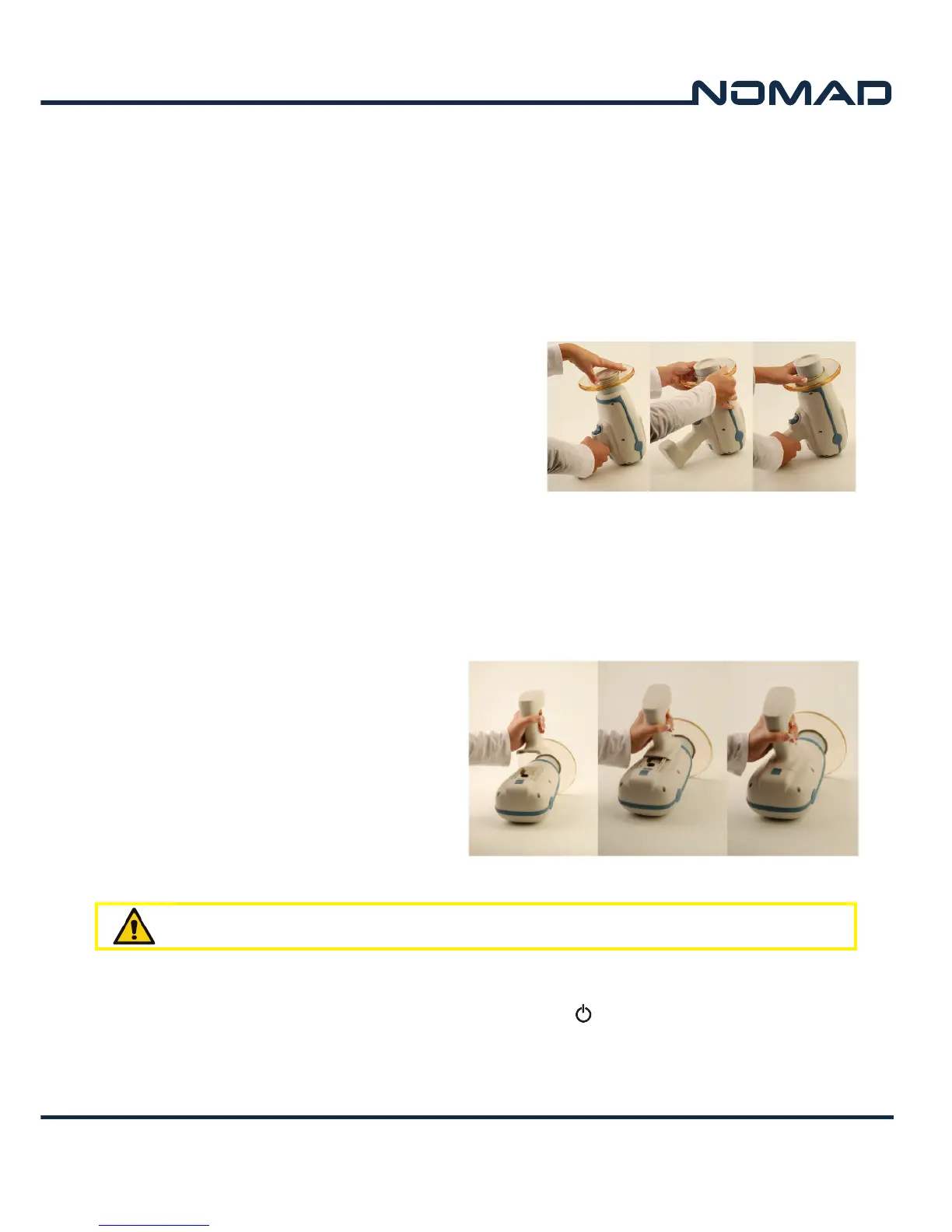
3.1 The Backscatter Shield
In addition to the radiation shielded cone, the backscatter shield provides additional
protection to the operator and can be adjusted to permit exposures made at various
angles.
nIdeally, the shield should remain fully extended to the outer edge of the cone, as close
to the patient as possible during each image
taken (see
Section 2.1 Radiation Safety).
oYou may find that the backscatter shield
needs to be adjusted to accommodate
sensors or angled exposures. If adjustments
are needed, gently glide the shield up or
down along the cone using equal pressure to
maintain a perpendicular alignment and to
avoid binding.
pTo keep the shield securely on the cone, a cap is permanently attached at the
outer cone end. Do not attempt to remove this cap or to remove the backscatter shield.
Attempting to do so will result in damage to your device.
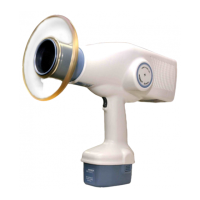
3.2 Attaching a Charged Handset
nWith the NOMAD Pro 2 placed
bottom up on a secure surface,
properly orient and carefully slide
the charged handset onto the base
of the NOMAD Pro 2. (A properly
oriented handset should click into
place with firm pressure.)
oThe clicking sound ensures the
locking mechanism has secured
the NOMAD Pro 2 to the handset.
To verify this lock, apply slight
pressure in the release direction.
There are electric voltages present at the handset terminals. Protect the handset from
damage; do not probe with fingers or conductive objects.
3.3 Checking for Power
nAfter locking a handset in place press the Power button.
oThe display panel will activate with a battery power level icon in the upper right
corner. Five bars is an indication of a fully charged handset.


 To Next Page