Arrival Procedures • 33
TIP: Develop the habit of applying full, proper crosswind control
inputs as the airplane slows during every landing rollout and
all taxi operations, regardless of how light the winds. Resist
the tendency to release the control inputs to neutral after
touchdown.
TIP: During windy conditions, adjust turns in the trac pattern
as necessary to maintain the correct ground track and distance
from the runway. For example, a strong tailwind during the
downwind leg will blow the airplane too far from the runway if
the pilot waits until the 45˚ point to turn base. Instead, plan the
base turn early to remain the correct distance from the runway.
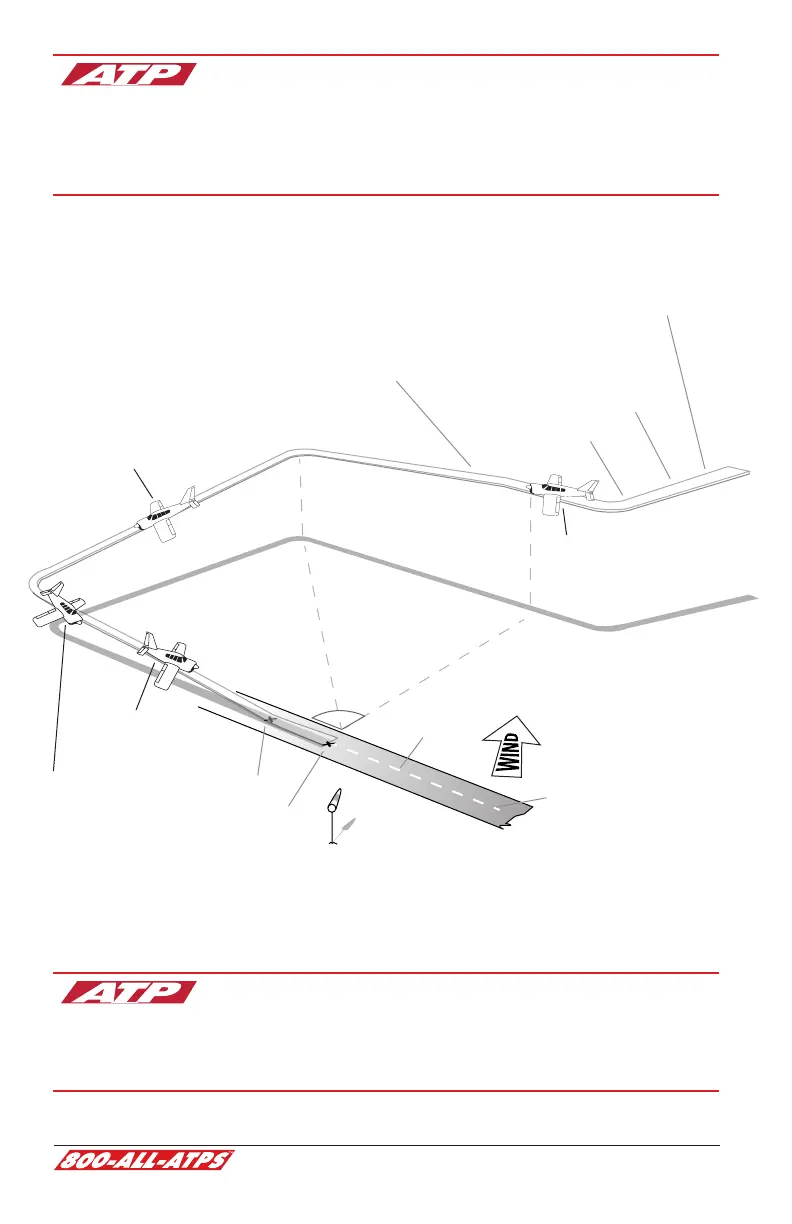
Crosswind Approach & Landing Prole
No Later Than 15 Mi. from Airport
• "Approach Checklist"
• Verify Traffic Pattern Altitude
(Usually 1,000’ above field elevation)
Touchdown
• On intended touchdown point
• Within the first 1,000' feet of the
runway
• At minimum controllable airspeed
Approx 10 Mi. from Airport
• Begin Slowing to 90 KIAS
• Plan Descent to Enter Traffic Pattern in
Level Flight at TPA (or Overflight Altitude
as Appropriate)
Approx 5 Mi. from Airport
• Maintain 90 KIAS
When Established on Downwind
• Crab as necessary to maintain
consistent ground track
When Ready to Descend Out of Pattern
Altitude
•
"
Before Landing Checklist"
• Reduce Power
• Select flaps 25˚ (as required)
• Descend out of TPA at 70-80 KIAS
On Base
• Maintain 70 KIAS
• Crab as necessary to maintain
consistent ground track
On Final
• Crab as necessary to maintain
extended centerline until
200’ AGL
• Maintain 70 KIAS +
1/2 gust factor until 10'
to 20' above the runway
90°
45°
Aiming
Point
Touchdown
Point
Increase Crosswind
Control Inputs as Airplane
Slows
By 200' AGL
• Transition from crab to
wing-low sideslip technique
Maintain Centerline
Until Taxi Speed


 To Next Page