32 • Arrival Procedures
8
200'
AGL
Crosswind Approach & Landing
Carefully planned adjustments must be made to the normal approach and
landing procedure to safely complete a crosswind approach and landing.
Planning
Before entering the trac pattern, brief how your approach and landing will be
dierent by acknowledging the wind direction, crosswind component, planned
ap setting, and how your trac pattern ground track will dier as a result of
the winds.
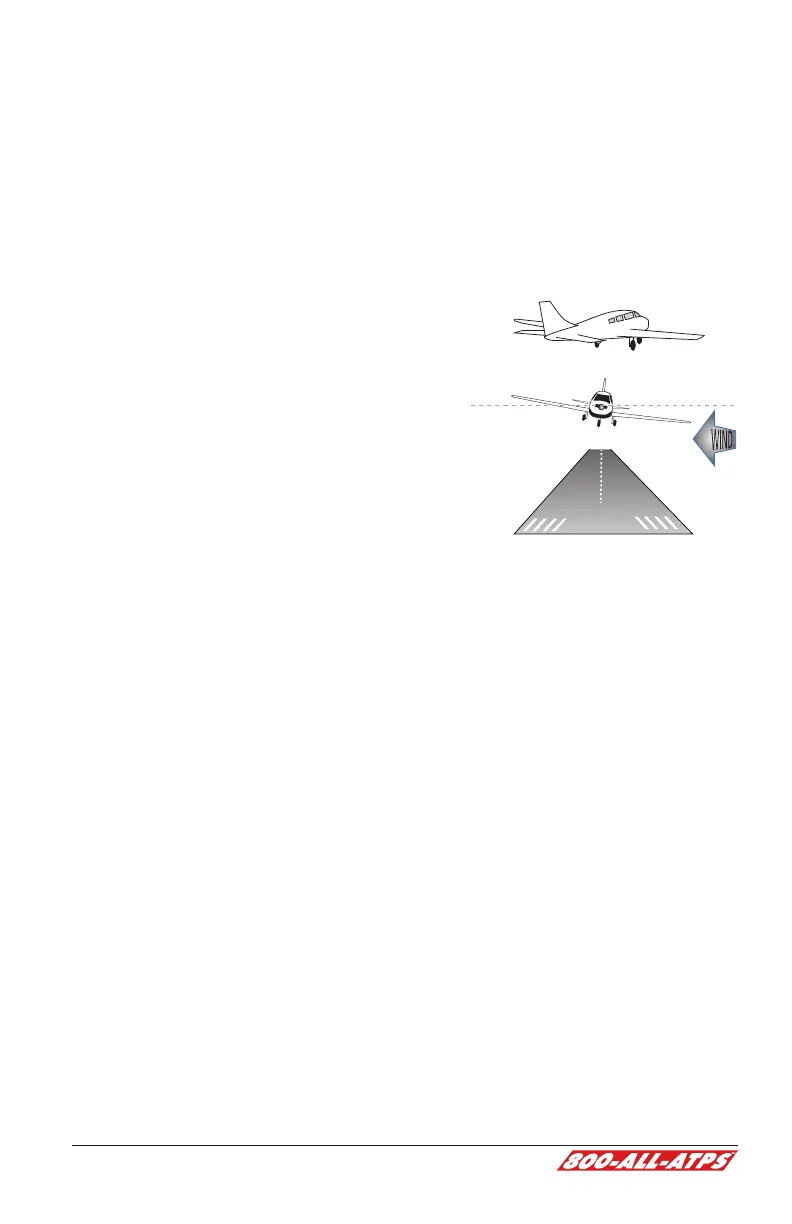
Ground Track
Plan a crab angle on downwind to maintain
a uniform distance from the runway. Begin
the base turn so the airplane is established
on base at the appropriate distance from
the runway. Do not allow the winds to blow
the airplane o the intended ground track.
Turning nal, adjust for the winds to not
over or undershoot the runway centerline.
Control Technique
Establish a crab angle to maintain the proper ground track on nal, then
transition to the wing-low sideslip technique by no later than 200' AGL and
below. Maintain the wing-low technique until touchdown and throughout the
landing roll. After landing, increase aileron input into the wind as the airplane
slows to prevent the upwind wing from rising, reduce side-loading tendencies
on the landing gear, and minimize the risk of roll-over accidents due to the
upwind wing lifting.
Judgment
The demonstrated crosswind component in the PA28 is 17 knots. Regardless
of reported winds, if the required bank to maintain drift control is such that
full opposite rudder is required to prevent a turn toward the bank, the wind is
too strong to safely land the airplane. Select another runway or airport and go-
around any time the outcome of an approach or landing becomes uncertain.


 To Next Page