2 • Aircraft Systems
From the Archer POH, in regards to carburetor heat usage during approach:
"Carburetor heat should not be applied unless there is an indication of carburetor
icing, since the use of carburetor heat causes a reduction in power which may be
critical in case of a go-around. Full throttle operation with carburetor heat on can
cause detonation."
Oil
Acceptable range for oil in the Archer is 6–8 quarts. Never depart with the oil
indicating below 6 quarts.
ATP policy states any time a full quart of oil can be added to the
Archer oil system, a full quart should be added. Never add less
than a full quart.
Propeller
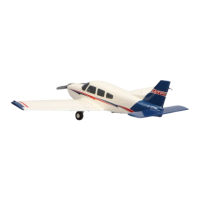
The Archer is equipped with a Sensenich two-bladed, xed pitch, metal
propeller. Propeller diameter is 76 inches. Maximum RPM (red line) is 2700 RPM.
Landing Gear
The landing gear is a xed, tricycle type gear, with oleo (air/oil) struts providing
shock absorption for all three wheels. The nose wheel contains a shimmy
dampener, which damps nose wheel vibrations during ground operations and
centers the nose wheel in the air. The nose wheel is linked to the rudder pedals
by a steering mechanism which turns the nosewheel up to 20° each side of
center.
Brakes
The Archer is equipped with hydraulically actuated disc brakes on the main
landing gear wheels. Braking is accomplished by depressing the tops of the
rudder pedals. Both toe brakes and the parking brake have separate braking
cylinders, but share a hydraulic reservoir. The brake uid reservoir is installed
on the top left front face of the rewall. To set the parking brake, pull back on
the brake lever, depressing the knob attached to the left side of the handle,
then release the brake lever. To disengage the parking brake, pull back on the
brake lever to disengage the catch mechanism, then allow the handle to swing
forward.
The parking brake is not to be used in training or ight checks
with ATP.


 To Next Page