to the backrest on the vehicle seat. Ad-
just the rear seat head restraint if it is
difficult to install the child seat with the
head restraint in place
c::> page 139. Driv-
ing with head restraints that are not
properly adjusted increases the risk of
serious or fatal neck injury dramatically.
- Always read and heed all WARNINGS
whenever using a child restrained in ave-
hicle is being used
c::> page 145, Safety
belts,
c::> page 153, Airbag system and
c::> page 177, Important things to know.
_& WARNING
If exceptional circumstances require the
use of a forward-facing child restraint on
the front passenger's seat, the child's safe-
ty and well-being require that the follow-
ing special precautions be taken:
- Make sure the forward-facing seat has
been designed and certified by its manu-
facturer for use on a front seat with a
passenger front and side airbag.
- Always follow the manufacturer's in-
struct ions provided with the child safety
seat or infant carrier.
- Always move the front passenger seat in-
to the rearmost position of the passen-
ger seat's fore and aft adjustment range,
and as far away from the airbag as possi-
ble before installing the child restraint.
-A lways make sure that nothing prevents
the front passenger's seat from being
moved to the rearmost position in its
fore and aft adjustment range.
- Always make sure the backrest is in an
upright position.
- Make sure that the
PASSENGER AIR BAG
OFF
light comes on and stays on all the
time whenever the ignition is switched
on.
- If the light does not stay on, perform the
checks
c::> page 164, Monitoring the Ad-
vanced Airbag System.
- Take the child restraint off the front pas-
senger seat and ins tall it properly at one
of the rear seat positions if the
PASS EN-
Child Safety 185
GER AIR BAG OFF light does not stay on
whenever the ignit ion is switched on.
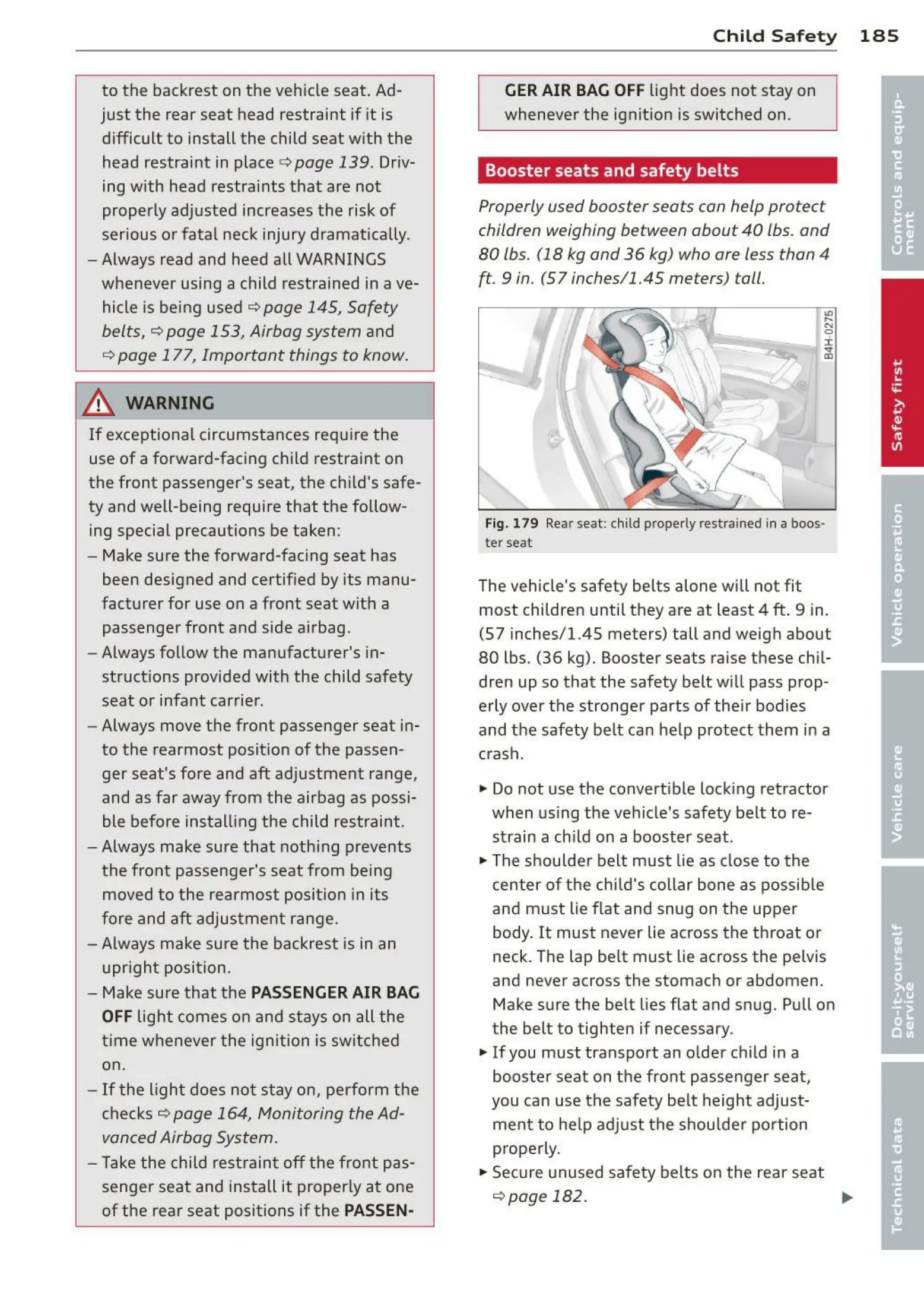
Booster seats and safety belts
Properly used booster seats con help protect
children weighing between about 40 lbs. and
80 lbs. (18 kg and 36 kg) who ore less than 4
ft. 9 in. (57 inches/1.45 meters) toll.
l!!
N
0
±
i,l;
Fig. 179 Rear seat: child properly restrained in a boos -
ter seat
The vehicle's safety belts alone will not fit
most children until they are at least 4
ft. 9 in.
(57 inches/1.45 meters) tall and weigh about
80 lbs. (36 kg). Booster seats raise these chil-
dren up so that the safety belt will pass prop -
erly over the stronger parts of their bodies
and the safety belt can help protect them in a
crash.
.. Do not use the convertible locking retractor
when using the vehicle's safety belt to re-
strain a child on a booster seat.
.. The shoulder belt must lie as close to the
center of the child's collar bone as possible
and must lie flat and snug on the upper
body.
It must never lie across the throat or
neck. The lap belt must lie across the pelvis
and never across the stomach or abdomen.
Make sure the belt lies flat and sn ug . Pull on
the belt to tighten if necessary .
.. If you must transport an older child in a
booster seat on the front passenger seat,
you can use the safety belt height adjust-
ment to help adjust the shoulder portion
properly.
.. Secure unus ed safety belts on the rear seat
c::>poge 182. ...



 To Next Page