Using Audio Loop-back Channels on Windows
As with macOS, the rst step of using Audio Loop-back is setting up your computer
to output sound to the Audio Loop-back outputs of EVO 4. On some software, you
can change this in the software itself in the settings. For details on how this is done,
we’d recommend contacting the developer of your software or reading through it’s
manual.
Otherwise, for software that doesn’t allow you to set the output channel, such as
web browsers or video call services, you will need to adjust your output
setting in the Windows Sound Settings.
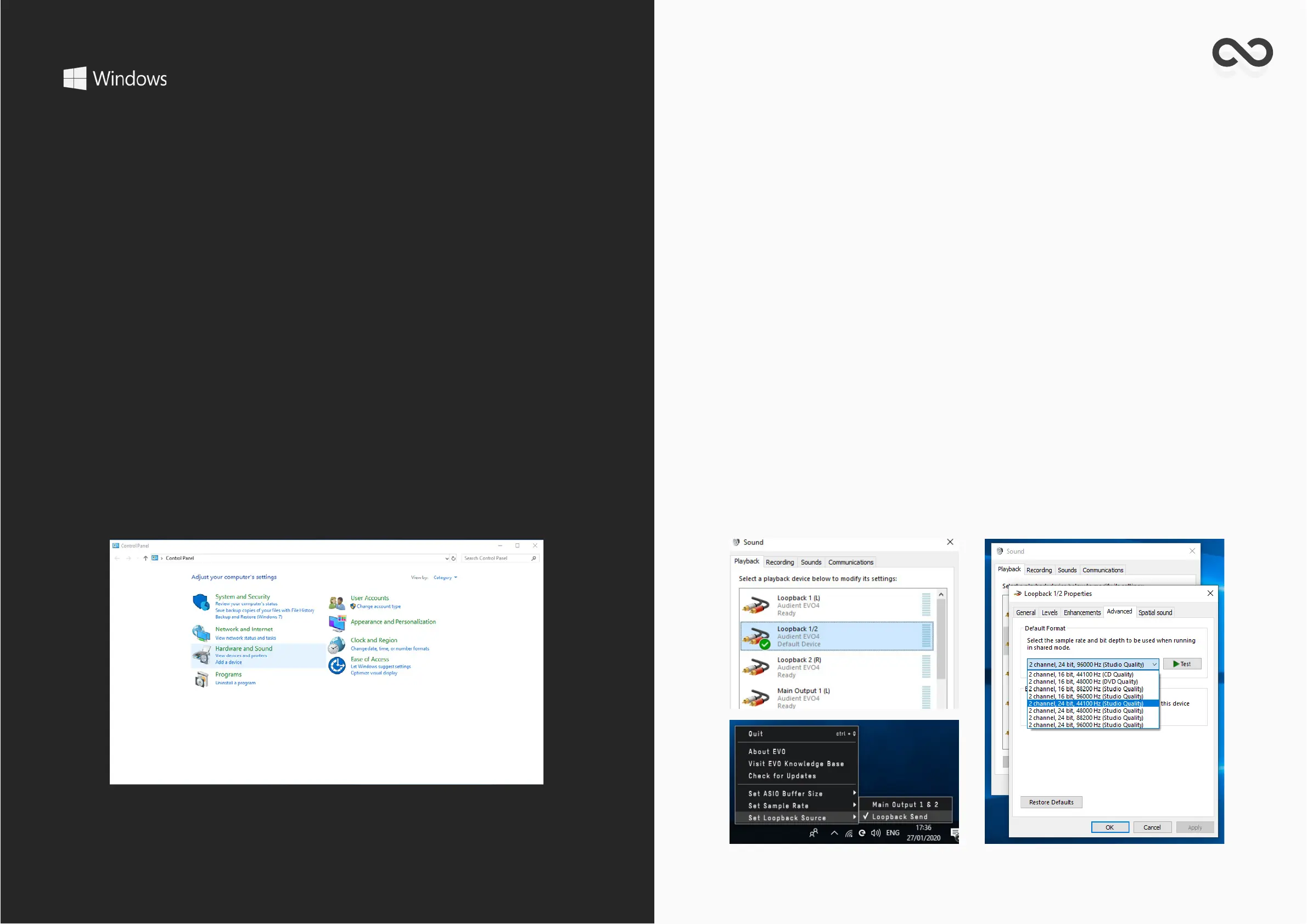
This can be adjusted by going to Control Panel > Hardware and Sound > Sound.
Now select the Playback tab.
We need to tell EVO 4 to send the Audio Loop-back outputs to the Audio
Loop-back Inputs. To do this, we go to the EVO app menu in the menu bar
and click Set Audio Loop-back Source. Now select Audio Loop-back Send as
your Audio Loop-back source.** When Sending Audio between programs, it’s
important to match the sample rates of the Audio Loop-back Outputs to the
sample rate of the software you are using to record or stream.
This can be done by double-clicking on the Audio Loop-back Outputs in the
Control Panel and navigating to the Advanced settings. Now simply use the
drop-down menu to select the sample rate to ensure this matches your Re-
cording/Streaming Software.
In the list of output devices, nd Audio Loop-back 1+2, select it and then click
“Set Default Device” Applications will then default to sending audio to the
Audio Loop-back output.*
Finally open up your recording or streaming software and select Audio Loop-
back 1+2 as your Input. So you can hear yourself, make sure you setup your
recording or streaming software to monitor the inputs.***
AUDIO LOOP-BACK
*****
*
AUDIO LOOP-BACK AUDIO LOOP-BACK



 To Next Page