Need help?
Do you have a question about the Audient ASP8024 HERITAGE EDITION and is the answer not in the manual?
Explains the manual's structure for user convenience and guides on navigating its sections.
Instructions for checking the console for transit damage and identifying packaging contents.
Guidance on contacting authorized technicians for repairs due to the console's complex internal design.
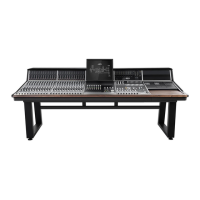
Discusses the semi-modular nature of the console and available optional modules and extras.
Visual guide to the different sections and controls of the console, identifying key areas.
Details the preamps, inserts, and controls for mic and line inputs on each channel.
Explains signal routing to multi-track buses and the use of aux/cue sends for flexibility.
Describes the 4-band console equalizer with shelving and parametric sections.
Explains the function and controls of the short fader for the input signal path.
Details the long fader used for monitor and stereo mix creation, operating on the LF signal path.
Allows stereo signals from effects units to be routed back into the console.
Controls the final level of signals routed to the multi-track bus outputs.
Controls the overall level of auxiliary outputs and allows soloing for previewing.
Explains the 8 subgroups for grouping tracks and controlling their output level.
Provides tonal shaping options for the Mix Bus Output with features like Retro Iron.
Details the soft knee VCA compressor optimized for mix bus use.
Controls the stereo output of the console, primarily used for creating fade-outs.
System for selecting and routing audio sources to control room monitors.
Routes signals to performers for monitoring and foldback.
Covers talkback functionality for studio and performer communication.
Explains sub group and main meters, talkback mic connector, and power indicators.
Details the 4-frequency oscillator and solo functions (AFL/PFL, Solo in Place).
Details rear panel inputs, outputs, and insert points (MIC, LINE, TAPE/DAW).
Covers OUTPUTS (MAIN, ALT, STUDIO LOUDSPEAKER, F/BACK) and AUX SENDS.
Details SUB GROUP INSERTS/OUTPUTS, MIX OUTPUTS, and EXTERNAL INPUTS.
Explains Multi-track Bus Outputs using multi-pole connectors and Tascam DB25 wiring.
Details the ASP8120 Ultra power supply, connections, and voltage selection.
Explains the inline architecture with Short Fader (SF) and Long Fader (LF) paths.
Explains routing SF channel path to multi-track outputs using the Bus Routing Matrix.
How to monitor recorded tracks from a DAW or tape machine.
Process of bringing recorded tracks back into the console for mixing.
How to use the eight subgroups to group tracks and control their levels.
How to apply EQ to channels for better mix cohesion.
Ways to connect outboard gear via channel inserts or auxiliaries.
Describes the two-channel mix bus, summing amplifiers, and Heritage output card.
Details using the Mix Bus Compressor for mix bus optimization.
How to record the final mix from the console's mix outputs.
Explains the functionality of the optional Patchbay Module for routing signals.
Explains the signal path for microphones and instruments entering the desk.
Covers inserts for the main mix bus, located after the Heritage Card.
Explains the stereo mix bus outputs.
Details the outputs for artist foldback sends.
Details the outputs for the 12 Aux Sends.
Details Multi-track Outputs and Tie Lines accessed via DB25 connectors.
Overview of the Dual Layer Control Module's analogue and digital control capabilities.
Step-by-step guide for installing the DLC module and its connect app on macOS.
Guide for installing the DLC module and AuNet app on Windows.
Guide for installing the Faderlink plugin for analogue automation.
Overview of DLC control surface functions and DAW-specific usage.
Details DLC line inputs/outputs and routing options to VCA outputs or subgroups.
Explains Auto Safe, Unity buttons, and VCA fader for analogue automation.
Steps for setting up analogue automation using Faderlink and the DLC module.
Outlines the manufacturer's warranty statement and limitations for the console.
Provides technical specifications for frequency response, noise, and more.
Details the Heritage Card, its design, and influences from classic studio consoles.
Definitions of core audio and console operational terms.
 General
| Type | Analog Mixing Console |
|---|---|
| Channels | 24 |
| Mic Preamps | 24 |
| Insert Points | Yes |
| Bus Outputs | 8 |
| Inputs | 24 |
| Line Inputs | 24 |
| Monitor Outputs | 2 |
| Phantom Power | Yes |
| Direct Outputs | 24 |
| Headphone Outputs | 2 |
| USB Interface | No |
| Firewire Interface | No |
| Metering | LED |

 To Next Page