38
Introduction
Recording is generally a three stage process made up of the tracking stage, the editing stage and
then the mixing stage. The tracking stage consists of capturing the audio onto a storage medium.
Traditionally audio was captured onto multi-track tape, however now the majority of people will
use a Digital Audio Workstation (DAW) such as Logic or Pro Tools.
The editing stage involves preparing audio for mixing, this usually involves everything from
trimming, editing and fading audio, to tuning parts and more. This is where the monitoring section
of the console really comes into its own, allowing you to quickly solo and cut channels out of your
monitoring mix.
The third stage of the process involves returning the recorded tracks from your DAW/ tape machine
back into the console. Using the faders and EQs, you can mix the audio until the individual tracks
come together as a collective whole. Once you are happy with your mix, you can combine it into a
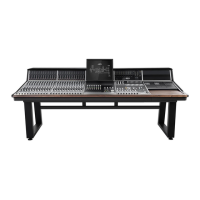
stereo mix using the analogue mix bus processing of the ASP8024- HE.
Summing can also be done in your DAW but you may find that summing through the console adds
a little more colour and punch to the overall mix, especially when fed through the discrete 990 op-
amps and Heritage Card tonal options.
In-line Architecture
The ASP8024-HE uses an inline architecture, which means the Mic/Line Inputs and the DAW/Tape
Returns are both situated on the same channel strip; these two paths are known as the Short
Fader (SF) and the Long Fader (LF) paths. Inline architecture allows you to split the various sections
of the channel strip between the two signal paths.
For example, you could use the Shelf EQs to add a high frequency boost to a vocal during tracking
and then use the Cue sends to send the same Mic/Line signal to a fold-back mix. At the same time
you could be using the Parametric EQs to cut out a room noise on the DAW/Tape Return path and
using one of the Auxiliaries to send the DAW/ Tape return signal to a reverb unit.
To split the channel strip, each section has a button which allows you to place it on either the LF
path or the SF path. The bus routing switches by default are on the SF path, while the Auxiliaries,
Cues and EQs default to the LF path. Furthermore, it is possible to flip the two signal paths so that
Mic/Line signal is sent to the LF path and the Daw/Tape Returns are sent to the SF path.


 To Next Page