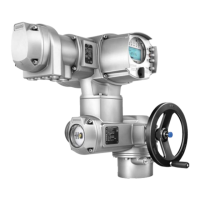
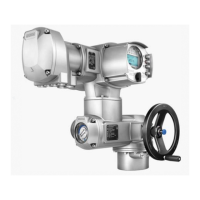
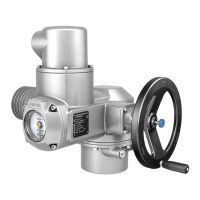
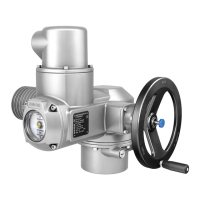
This document describes the AUMA SQ 05.2 – SQ 14.2/SQR 05.2 – SQR 14.2 series of part-turn actuators with AUMA MATIC AM 01.1 actuator controls.
Function Description
AUMA part-turn actuators are designed for the operation of industrial valves, such as butterfly valves and ball valves, transmitting torque to the valve for less than one full revolution. They are not designed to withstand thrust. The actuators are driven by an electric motor and include a handwheel for manual operation. Switching off in end positions can be achieved by either limit or torque seating. The AUMA MATIC AM 01.1 actuator controls operate the actuators and can be mounted directly to the actuator or separately on a wall bracket. These controls provide standard valve control for OPEN - CLOSE duty, position indications, and various signals, extending to full position control. Local operation, settings, and indications can be performed directly at the controls via push buttons and a selector switch.
The actuators are designed for both open-close and modulating duty. For open-close duty, the type of seating (limit or torque) for end positions OPEN and CLOSED is selectable. For modulating duty, a positioner is required, which uses an analog input (0/4 – 20 mA) for position setpoint and provides galvanic isolation for setpoint and feedback. The positioner also allows for adjustable behavior on loss of signal and adjustable sensitivity (dead zone and dead time).
Motor protection is provided by monitoring the motor temperature in combination with thermoswitches within the actuator motor (standard). Options include an additional thermal overload relay in the controls or a PTC tripping device in combination with PTC thermistors within the actuator motor.
Important Technical Specifications
- Actuator Type and Size: SQ 05.2, 07.2, 10.2, 12.2, 14.2 (open-close duty) and SQR 05.2, 07.2, 10.2, 12.2, 14.2 (modulating duty).
- Controls: AUMA MATIC AM 01.1.
- Operating Time: Ranges from 8 to 17 seconds depending on the actuator type and size.
- Torque Range: Varies by actuator type and size, e.g., 100-250 Nm for SQ/SQR 07.2.
- Swing Angle: Adjustable between 75° and < 105°.
- Self-locking: Yes, part-turn actuators are self-locking if the valve position cannot be changed from the outside by an external torque upon output drive.
- Manual Operation: Handwheel operation for setting and emergency operation; handwheel does not rotate during electrical operation.
- Handwheel Fitting: Handwheel is lockable.
- Position Feedback Signal (option): Potentiometer or 0/4 – 20 mA (EWG/RWG).
- Mechanical Position Indicator: Continuous indicator disc with symbols for OPEN and CLOSED.
- Running Indication: Blinker transmitter (option for modulating actuators).
- Heater in Switch Compartment: Self-regulating PTC heater, 5 – 20 W, 110 – 250 V AC/DC (standard). Options for 24 – 48 V AC/DC or 380 – 400 V AC. A resistance type heater of 5 W, 24 V AC is installed in the actuator in combination with AM or AC actuator controls.
- Electrical Connection: AUMA plug/socket connector with screw-type connection (standard). Options include terminals or crimp connection and gold-plated control plug (sockets and plugs).
- Threads for Cable Entries: Metric threads (standard). Options for Pg-threads, NPT-threads, G-threads.
- Service Conditions:
- Use: Indoor and outdoor permissible.
- Mounting Position: Any position.
- Installation Altitude: ≤ 2,000 m above sea level (contact AUMA for > 2,000 m).
- Ambient Temperature: Standard -40 °C to +80 °C (3-phase AC motors, open-close); -40 °C to +70 °C (1-phase AC motors, open-close); -40 °C to +60 °C (modulating duty). Options for -60 °C to +60 °C (extreme low temperature) and 0 °C to +120 °C (3-phase AC motors, open-close).
- Enclosure Protection: NEMA type 6P with AUMA 3-phase AC motor/1-phase AC motor (standard). DS Terminal compartment additionally sealed against interior (double sealed). According to AUMA definition, NEMA type 6P meets requirements for depth of water: maximum 8 m head of water; duration of continuous immersion in water: max. 96 hours; up to 10 operations during continuous immersion. Modulating duty is not possible during continuous immersion.
- Pollution Degree: 4 (when closed) according to EN 50178.
- Vibration Resistance: 2 g, from 10 to 200 Hz (according to IEC 60068-2-6).
- Corrosion Protection: KS (suitable for industrial units, water/power plants with low pollutant concentration, chemical industry) or KX (extremely aggressive atmospheres with high humidity/pollutant concentration). KX-G is an aluminum-free version of KX.
- Finish Coating: Powder coating (standard), two-component iron-mica combination (option).
- Colour: AUMA silver-grey (RAL 7037) (standard), other colours available (option).
- Weight: Approx. 7 kg (with AUMA plug/socket connector).
- EU Directives: Electromagnetic Compatibility (EMC): (2004/108/EC), Low Voltage Directive: (2006/95/EC), Machinery Directive: (2006/42/EC).
Usage Features
- Commissioning: Requires setting the selector switch to position 0 (OFF) before switching on power. Heat-up time is required for low-temperature versions (e.g., 60 min for -50 °C, 80 min for -60 °C). End stops are generally set by the valve manufacturer. Torque switch settings must suit the valve and should only be changed with the valve manufacturer's consent. Limit switch settings are checked by operating the actuator locally and observing indication lights. The PTC tripping device (if optioned) can be tested. Electronic position transmitters (EWG/RWG) require setting the measuring range and adjusting current values. Potentiometer settings involve moving the valve to end positions and turning the potentiometer to align with 0% or 100%.
- Local Controls: Operation via push buttons (OPEN, STOP, CLOSE) and a selector switch for local or remote control. The selector switch is not a mains switch; power supply is maintained even in the 0 (OFF) position.
- Remote Operation: Actuator can be operated via remote control, operation commands (OPEN, STOP, CLOSE), or analog setpoints (e.g., 0 – 20 mA).
- EMERGENCY Command (Option): An EMERGENCY input can be connected to the control voltage using an NC contact. Upon removal of the signal, the actuator runs to a preset end position (CLOSED or OPEN). This command is effective in all selector switch positions.
- Wall Bracket Mounting (Option): Controls can be mounted separately from the actuator using a wall bracket, useful in confined spaces, high temperatures, or heavy valve vibrations. Permissible cable length is max. 100 m. Shielded cables are required for position transmitters.
- Parking Frame (Option): Provides safe storage for a disconnected plug, protecting bare contacts and against environmental influences.
- Protection Cover (Option): Covers the plug compartment when the plug is removed.
- Double Sealed Intermediate Frame (Option): Prevents ingress of dust and water into the housing by inserting a double sealed intermediate frame between the plug/socket connector and the housing.
Maintenance Features
- Preventive Measures:
- Every 6 months/annually: Visual inspection of cable entries, glands, and blanking plugs for correct tightness and sealing. Check fastening screws between actuator and gearbox/valve for tightness, applying specified torques if needed. Perform a test run if rarely operated.
- For IP68 after continuous immersion: Check actuator for water ingress, locate and repair leaks, dry the device, and check for proper function.
- Lubrication: The gear housing is factory-filled with grease. Grease change is recommended after 4-6 years for modulating duty, 6-8 years for frequently operated open-close duty, or 10-12 years for rarely operated open-close duty. Seals should be exchanged during grease changes. No additional lubrication of the gear housing is required during operation.
- Disposal and Recycling: Devices have a modular design for easy separation and sorting of materials (electronic scrap, metals, plastics, greases, oils). Greases and oils are hazardous to water and must be disposed of properly. Controlled waste disposal or separate recycling of disassembled material is recommended.
- Service and Support: AUMA offers extensive service, maintenance, and product training.
- Faults during Commissioning: The manual provides troubleshooting steps for common issues such as mechanical position indicator not setting, actuator operating into valve end position despite correct limit switching, no value at RWG measuring points, EWG position transmitter issues, and limit/torque switches not tripping.
- Fuses: Fuses are located on the signal and control board (F1/F2), power supply unit (F3), and for heater/switch compartment/PTC tripping device (F4). Only original AUMA fuses of the same type and value should be used.
- Motor Protection (Thermal Monitoring):
- Thermal Switch (standard): Actuator can be controlled again after the motor cools down and the "collective fault" indication light goes out.
- Thermal Switch with Overload Relay (option): Operation resumes after resetting the fault signal via the overload relay in the controls (requires opening the cover).
- PTC Thermistor (option): Operation resumes after resetting the fault signal via the selector switch position Reset on the local controls.

 Need help?
 General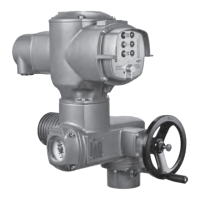

 To Next Page