→
Prior to positioner setting, set limit and torque switching as well as potentiometer
or electronic position transmitter.
10.6.1. Input ranges (signal type) for setpoint and actual value
The input range (signal type) for setpoint E1 and actual value E2 is set in the factory
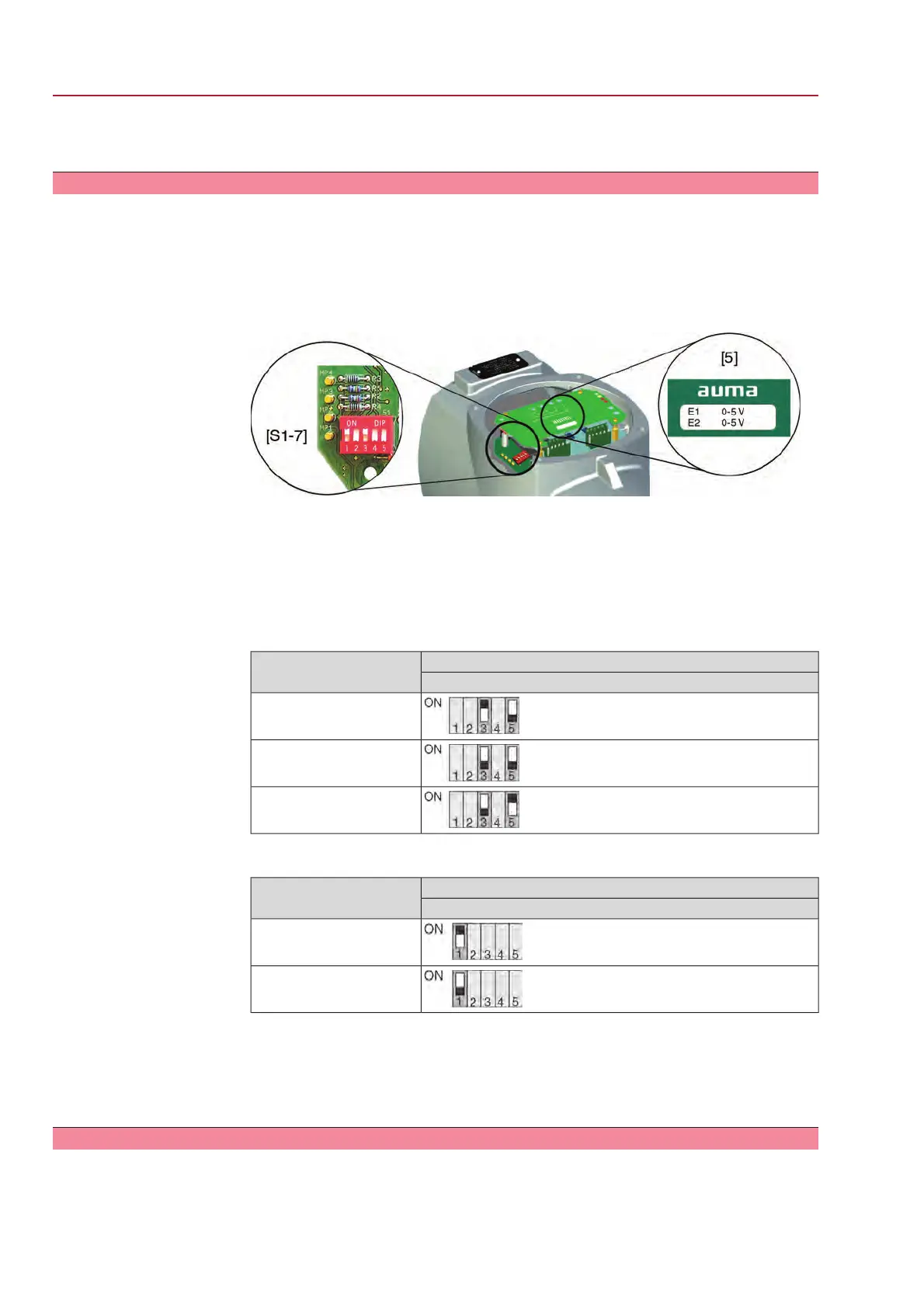
and marked with a label on the cover plate of the positioner.
The type of signal can be modified at a later date exclusively for versions with setpoint
E1 실 0/4 – 20 mA and split-range version. For these versions, the positioner board
is equipped with an additional contact.
Figure 34:Version with additional switch on the positioner board
[5] Label indicating the set input ranges
[S1-7]5-contact DIP switch for setting
DIP1 Actual value E2 (current or voltage signal)
DIP3 Setpoint E1 (current or voltage signal)
DIP5 Setpoint E1 (double signal range e.g. for split range)
Table 11: Input range setting for setpoint E1
[S1–7]Setpoint E1
DIP 3 and 5
0/4 – 20 mA
0 – 5 V
0 – 10 V
Table 12: Input range setting for actual value E2
[S1–7]Actual value E2
DIP 1
0/4 – 20 mA
1)
0 – 5 V
2)
for internal feedback of electronic position transmitter RWG1)
for internal feedback of precision potentiometer 5 k˖
2)
Information When changing the setting, a new label [5] indicating the set signal type must be
provided. Furthermore, the wiring diagram indicated on the name plate of the actuator
controls also changes.
10.6.2. Behaviour on loss of signal (actuator reaction)
In case of a loss of signal of setpoint E1 or actual value E2, the reaction of the actuator
can be programmed via switch [S2-7].The complete selection range, however, is
only available for signals 4 – 20 mA.
46
SQ 05.2 – SQ 14.2/SQR 05.2 – SQR 14.2
Commissioning – controls settings AM 01.1


 To Next Page