Calidus
EMERGENCY PROCEDURES
AutoGyro_POH_Calidus Revision 4.0 – Issue Date 17.JAN.2019 3-13
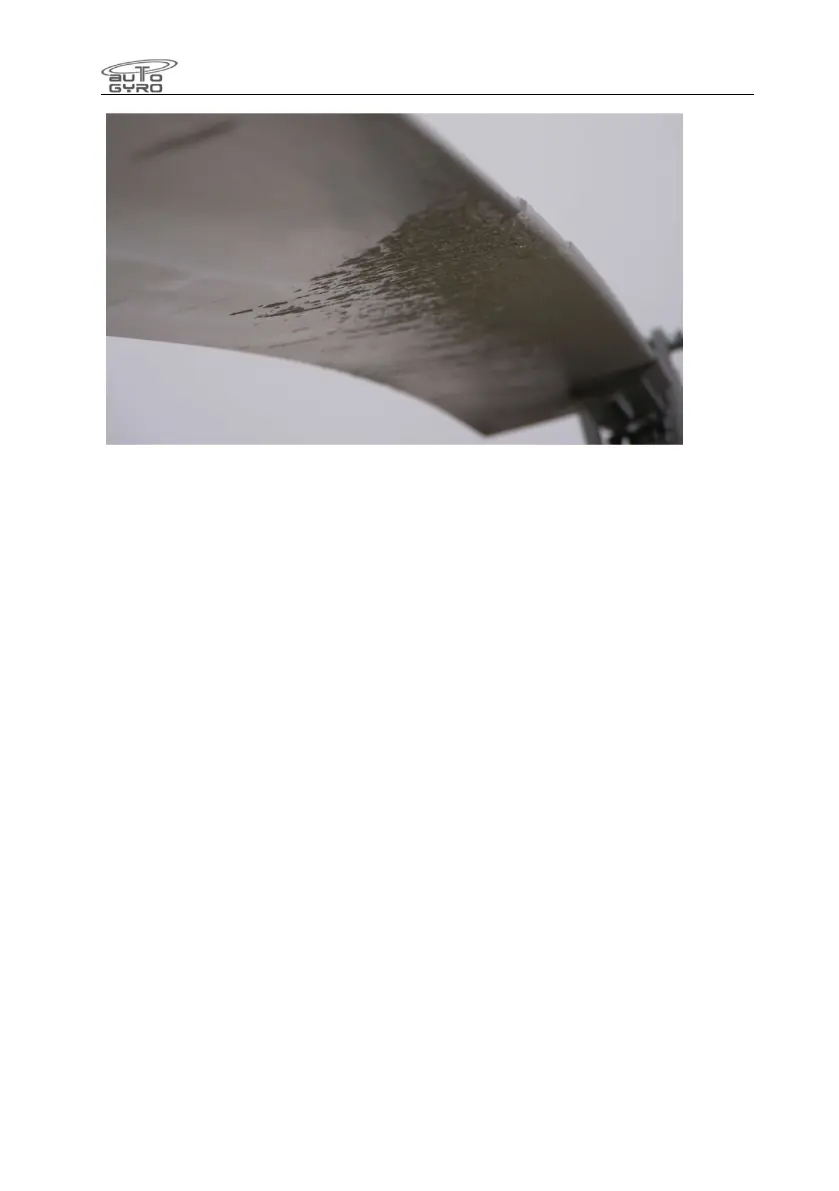
Photo of rotor blade with significant icing built up
3.19 Landing with a Deflated Tyre
Plan to land directly into the wind with minimum rate of descent at touch-down, if possible
on a grass runway. Maintain directional control with adequate pedal input. Consider the use
of some propeller thrust to increase rudder effectivity. Lower nose gently with the nose
wheel pointing straight.
Alternatively, if landing on asphalt is unavoidable, approach normally, with the intent of a
zero-speed touch-down directly into wind.
Only if impossible to recover the aircraft from the landing area should it be manoeuvred
under its own power, as this could further damage the tire and wheel rim.
3.20 Failure of Variable Pitch Propeller (if installed) See also Section 9.
Noticeable defect:
In case of a noticeable mechanical defect, indicated by sudden vibration or noise, perform a
precautionary landing.
Run-away:
Propeller pitch changes without command, usually resulting in unexpected or sudden
change in engine RPM and engine manifold pressure.
Run-away to FINE: RPM will increase and propeller pitch will stop in full
FINE position. Reduce power if needed, to stay within RPM limits.
Run-away to COARSE: RPM will decrease and MAP will rise until
propeller pitch stops in full COARSE position. Reduce power if needed,
to stay within MAP limits.
Removing the PROP fuse will cease the pitch change. Continue according to emergency
procedure ‘FREEZE’.


 To Next Page