the top line of the screen. Press and hold the PTT key to make a callback.
6.1.4 Sub-Code scan storage
In MR mode or VFO mode, the scanned CTCSS/DCS code can be stored as only TX CTCSS/DCS code, RX CTCSS/DCS code only, TX and RX
CTCSS/DCS code to replace the CTCSS/DCS code setting of the current channel or frequency mode of the radio.
To save the settings of CTCSS/DCS code scan, the operation is as follows:
(1) Press
key to enter menu >> SCAN >> 4 Scan Memory.
(2) Press the
key to enter the Scan Memory setting, and press the or key to select:
• ALL: The scanned CTCSS/DCS code will be stored as the received and transmitted CTCSS/DCS code of the current channel or frequency mode (at the
same time as the received and transmitted Sub-Code).
• DECODER: The scanned CTCSS/DCS code will be stored as the receiver CTCSS/DCS code of the current channel or frequency mode (only replace its
receiver RX CTC/DCS).
• ENCODER: The scanned CTCSS/DCS code will be stored as the transmitted CTCSS/DCS code of the current channel or frequency mode (only replace its
transmitted TX CTC/DCS).
(3) Press the
key to save the settings and return to the previous menu;
Note: Only when a valid CTCSS/DCS code is scanned and stopped, press the
key to store the CTCSS/DCS code and replace the
corresponding CTCSS/DCS code of the current channel or frequency.
6.2 DTMF
DTMF is an in-band signaling method using dual sinusoidal signals for any given code. Originally developed for telephony systems, it has proved a very
versatile tool in many other areas.
In two-way radio systems, DTMF is most commonly used for automation systems and remote control. A common example would be in amateur radio
repeaters where some repeaters are activated by sending out a DTMF sequence (usually a simple single-digit sequence).
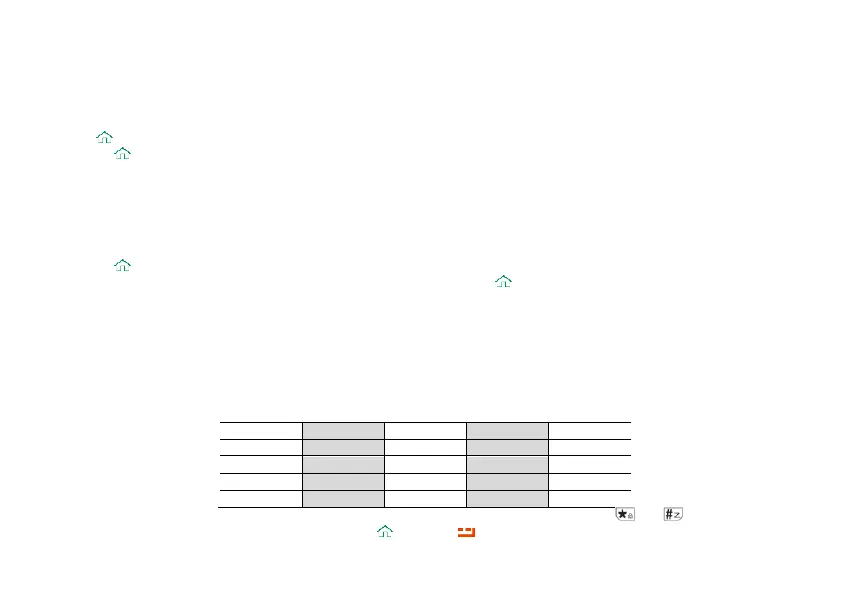
DTMF frequencies and corresponding codes
The radios has a full implementation of DTMF, including the A, B, C and D codes. The numerical keys, as well as the and keys correspond to the
matching DTMF codes. The A, B, C and D codes are located in the
, , and keys respectively.



 To Next Page