Manual 2100-671C
Page 18 of 59
To put the blower into override:
1. Press MENU key to go to the Main Menu screen.
2. Press UP or DOWN keys and ENTER key to enter
TECHNICIAN password 1313.
3. Press UP or DOWN keys to scroll to I/O Config;
press ENTER key.
4. Press UP or DOWN keys to scroll to Fans / Blowers;
press ENTER key.
5. Press UP or DOWN keys to scroll to Blower 1.
6. Press ENTER key to scroll to Blower Overrides?
(see Figure 23).
7. Press UP or DOWN key to change No to Go. The
override will begin and the screen will change to
the override screen (see Figure 23).
The override will last for 5 minutes or until the Blower
Overrides parameter is set to No again.
EEV Operation
EEV Superheat Control
The electronic expansion valve (EEV) will open or
close to maintain the superheat setpoint while the
compressor is running (see Table 4). When the
compressor is not running, the valve will close to the
20% open default position.
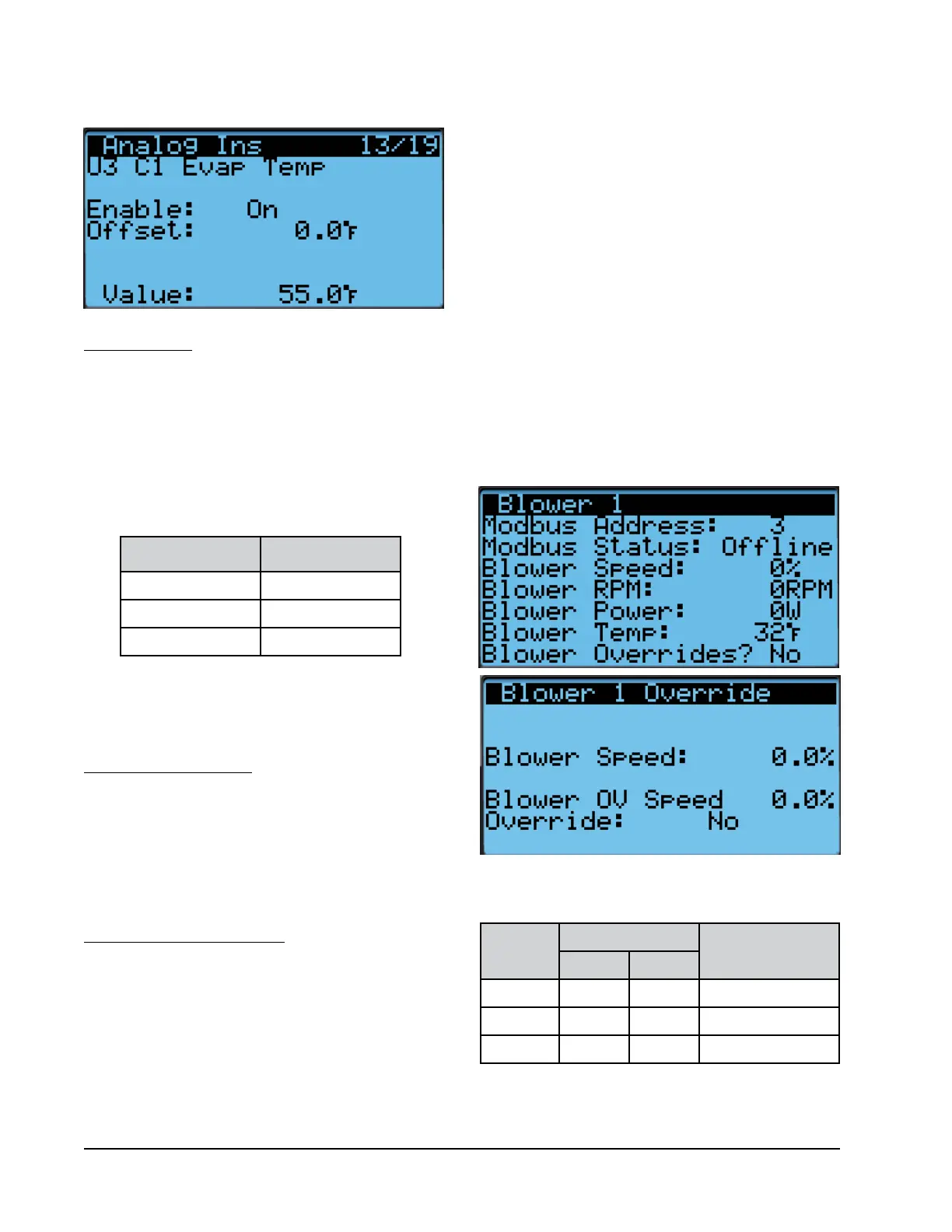
FIGURE 22
Adjusting Evaporator Freeze Sensor Values
FIGURE 23
Putting Blower Output into Override Mode
TABLE 5
Rated Airflow
Nominal Rated CFM
Nominal Rated ESP
High Low
W090A 3000 2100 0.25
W120A 4000 2800 0.30
W150A 4600 2800 0.35
TABLE 4
Unit Specific Superheat Setpoints
Unit Superheat
W090A 14°F
W120A 10°F
W150A 14°F
Low superheat protection will be active once the
superheat value is at or below 5°F. At this point,
the control will aggressively close the valve so that
superheat is maintained.
Additional EEV Alarms
Low Superheat Alarm
This alarm will become active when the calculated
superheat goes below 5°F. This alarm will clear itself
when the condition is no longer present.
This alarm cannot be adjusted.
Indoor Airflow
Indoor Airflow Components
Blower
The unit is equipped with a blower that is driven by an
electronically commutated motor (ECM). The blower
is controlled by a 0-100% signal through Modbus
communication. The motor controller converts this
signal to a PWM signal. The blower uses a 22" (560
mm) diameter wheel and operates up to 1500 rpm.
The blower output can be put into an override mode for
verification or troubleshooting.



 To Next Page