28
Common settings for the two examples described above:
- P13 start-up delay of 15 minutes (average time required for the polarization of redox electrodes)
- P16 protection PASSWORD to prevent unauthorized access
ERRORS / ALARMS
Every error or anomaly detected by the system generates an alarm message on the display:
LEV1 / LEV2 The level sensor 1 or 2 detected a low level of the liquid to be dosed; restore the level into the
related tank.
FLOW The flow sensor detected an anomaly that can be due to low pressure into the hydraulic circuit or
wrong adjustment of the flow sensor in the electrode-holder; restore the flow or adjust the sensor.
STOP This message indicates that the pumps have been manually de-activated by pressing the
ON/OFF button.
UR / OR Under/Over Range: measurement out of range; this signal can be generated by a dead or broken
electrode, or by a damaged or disconnected cable; check the system and restore correct
measurement conditions.
AL.1 / AL.2 Dosing time alarm for pump 1 or 2: measurement is outside the set-point for a time longer than
the set limit, due to an insufficient dosage or a wrong configuration of the alarm time (see
parameters P11 and P12); set the parameters properly.
Calibration Impossible Check the status of electrode and connection cable; check that the calibration solutions are not
expired or contaminated; repeat the procedure.
MAINTENANCE
The periodic maintenance operations are essential for the proper functioning of the system and its duration in time.
The below advices should be strictly followed.
Before any operation, make sure the system is unplugged!
Dosing Pumps
Weekly operations:
- Check the level of the solution to be dosed to prevent the pump from running dry.
- Check that the suction and head pipes are clean and not containing any impurities.
- Check that the filter is not clogged to avoid the decreasing of flow rate.
Operations every three months (or in case of pump drifting):
- Clean all the parts that come into contact with the chemical (pump body, foot filter and injection valve). If the pump
doses additives that from crystals, clean more frequently.
Proceed as follows:
o Dip the suction tube and the foot filer into clean water.
o Start the pump and leave it run for a few minutes to let the water wash the pump head.
If there are crystals to remove, proceed as follows:
o First use a proper chemical (instead of water) to dissolve the crystals (e.g. hydrochloric acid for sodium hypochlorite
crystals) and let the pump work for a few minutes.
o Repeat the procedure with clean water.
Once the cleaning is done, connect again the pump to the plant and resume normal operations.
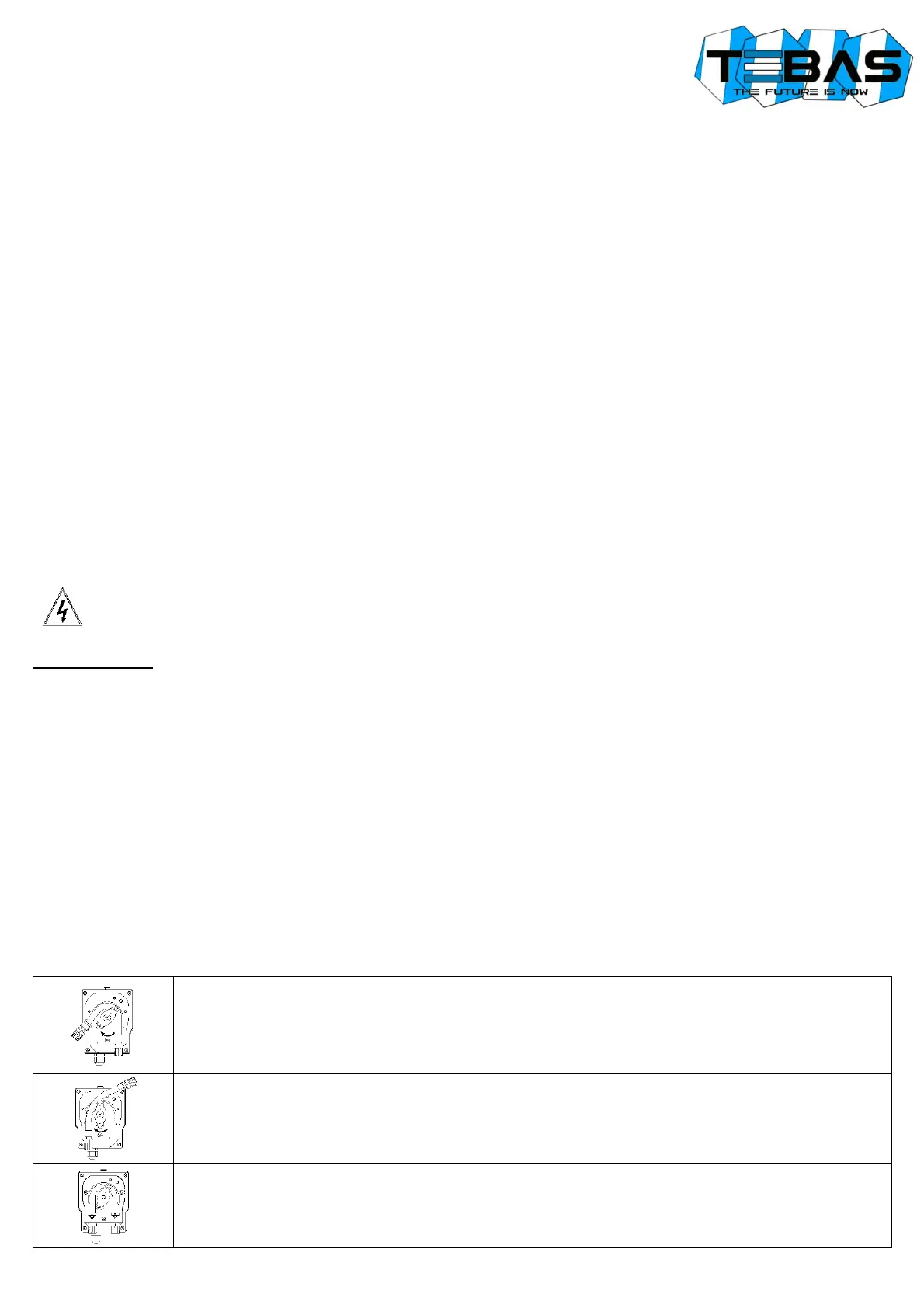
Extraordinary maintenance – Replacing the peristaltic tube:
Unscrew 2 front screws and remove the transparent cover. To remove the old tube, first release the
left connector and then turn the roller-holder as shown by the arrow in the figure, to free the tube up to
the right connector.
Insert the left connector into the new tube, in its housing, while making sure that the rounded part is
positioned inward. Then turn the roller-holder clockwise, so that the tube is inserted in its housing.
Insert the right connector in its housing and tighten the two front screws to fix the transparent cover.


 To Next Page