40
8.1.3 Exposure Time
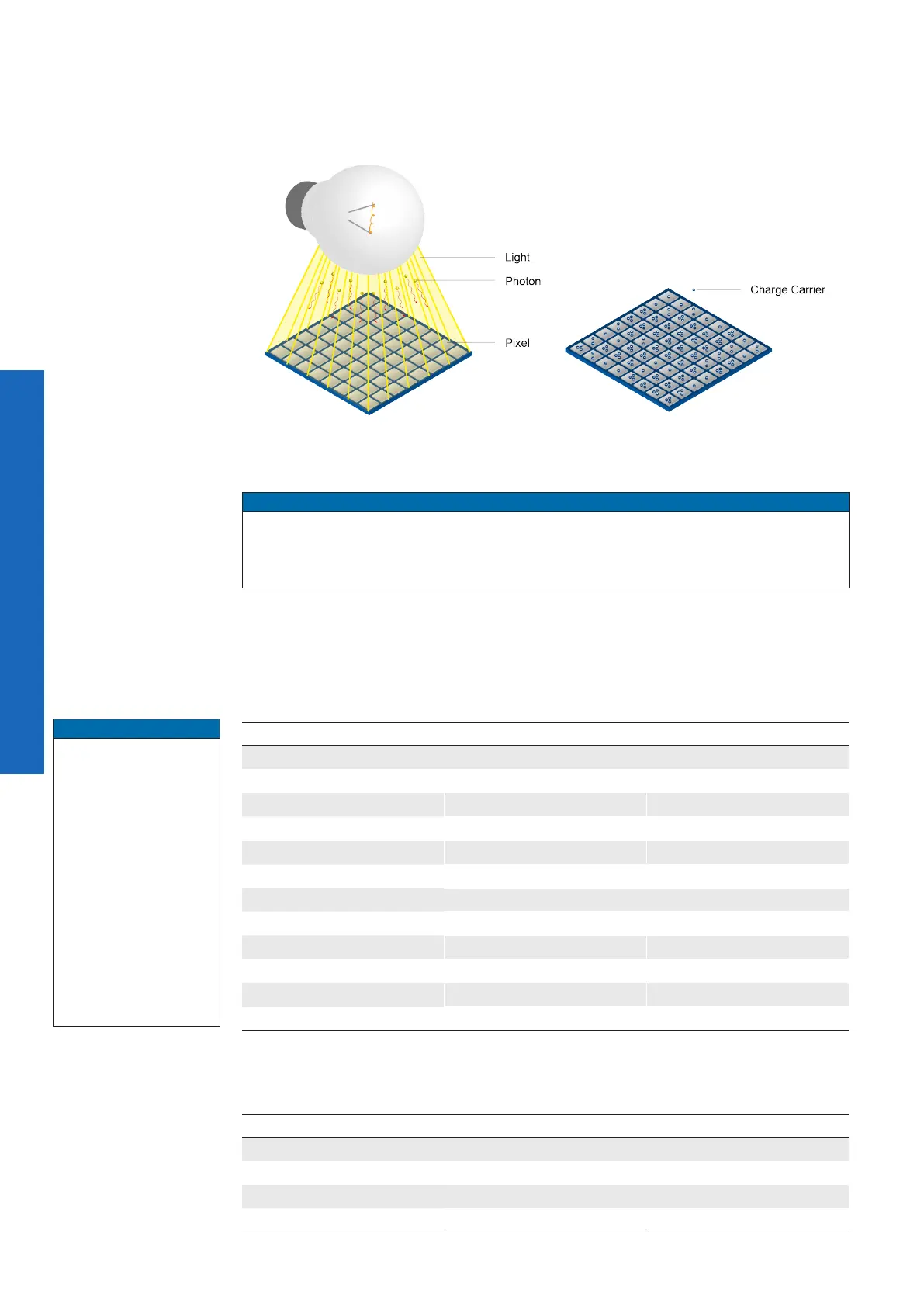
On exposure of the sensor, the inclination of photons produces a charge separation on
the semiconductors of the pixels. This results in a voltage difference, which is used for
signal extraction.
The signal strength is inuenced by the incoming amount of photons. It can be increased
by increasing the exposure time (t
exposure
).
Notice
Due to the sensor, xed pattern noise effects can occur at high exposure times. You
can counteract this by setting the gain to a value of approximately 1.5 and reducing the
exposure time accordingly.
On Baumer VEX cameras, the exposure time can be set within the following ranges (step
size 1μsec):
8.1.3.1 VEXG
Camera Type t
exposure
min t
exposure
max
Monochrome
VEXG-02M 40 μsec 1 sec
VEXG-13M 40 μsec 1 sec
VEXG-25M 40 μsec 1 sec
VEXG-52M.R 20 μsec 1 sec
VEXG-100M.R 48 μsec 1 sec
Color
VEXG-02C 40 μsec 1 sec
VEXG-13C 40 μsec 1 sec
VEXG-25C 40 μsec 1 sec
VEXG-52C.R 20 μsec 1 sec
VEXG-100C.R 48 μsec 1 sec
8.1.3.2 VEXU
Camera Type t
exposure
min t
exposure
max
Monochrome
VEXU-24M 57 μsec 60 sec
Color
VEXU-24C 57 μsec 60 sec
Figure16►
Incidence of light
causes charge separa-
tion on the semiconduc-
tors of the sensor.
Notice
Only for cameras
with rolling shutter
sensors!
The modication of
the Exposure Time is
done by recongura-
tion of the sensor.
If the modication oc-
curs during a sensor
readout, the update
will be delayed until
the end of the current
readout.


 To Next Page