Operating Principles and Design
bbe BenthoTorch Manual Page 11
Operating Principles and Design
Principles of Operation
F
LUORESCENCE OF DIFFERENT ALGAE CLASSES
The BenthoTorch is a fluorometer made for quick and easy measurements of benthic algae including an algae
differentiation measurement. The results are separately given for green algae cyanobacteria and diatoms.
Due to the fact that algae of the same division contain a similar quantity and quality of photosynthetic pigments,
their fluorescence excitation spectrum (with a fixed emission wavelength at 680nm) is significant. Thus, it is
possible to differentiate divisions of algae by their fluorescence excitation spectrum.
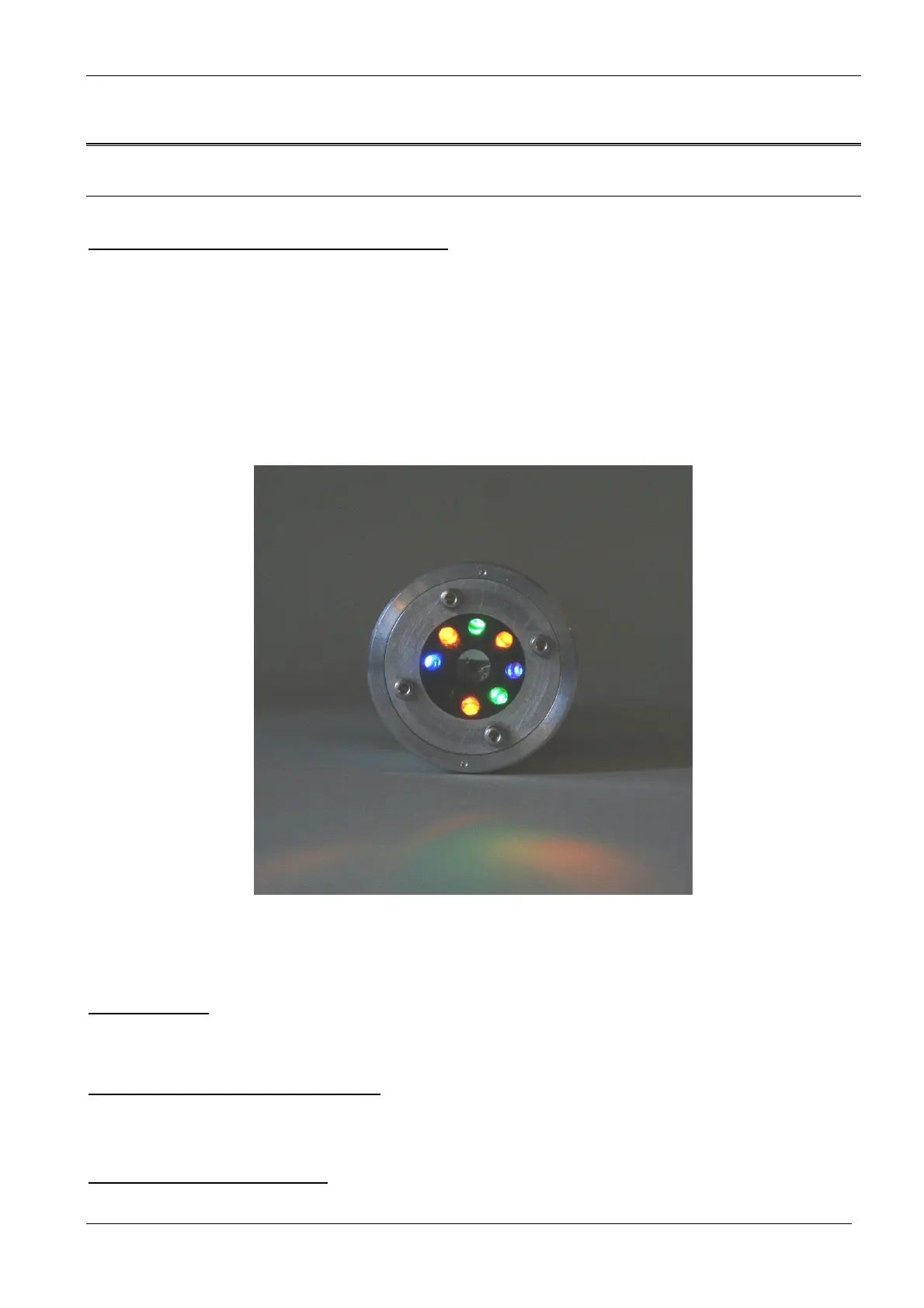
The bbe BenthoTorch for algae differentiation uses 7 LEDs for fluorescence excitation. The LEDs emit light at 3
selected wavelengths (470nm, 525nm, 610nm).
There is one additional LED of 700nm (not visible in the picture above), that is used to compensate effects of the
background reflection.
B
ENTHIC ALGAE
Benthic algae are grow in layers on a surface or on the ground of the waterbodies. To measure the chlorophyll
concentration of these layers two effects have to be taken in account:
The shadowing of the upper layer of algae:
This shadowing reduces the excitation light in the lower layers and it reduces the fluorescence light on its way to
the fluorescence detector.
To compensate this effect a mathematical model is applied in the BenthoTorch.
The reflectance of the background:
The higher the reflectance of the background, the more excitation light passes the algae layer more than one
time. This leads to a higher fluorescence signal.


 To Next Page