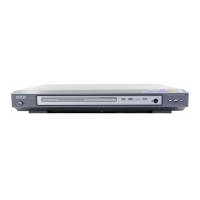
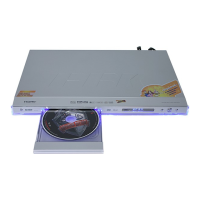
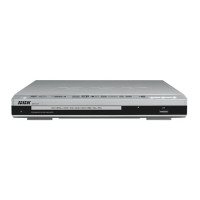
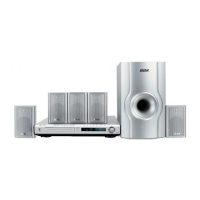
This document serves as a service manual for the BBK DV118SI(RU) DVD player, specifically for version SI09.16.A. It provides comprehensive information for maintenance personnel, covering safety precautions, troubleshooting methods, functional descriptions, technical specifications, and circuit diagrams.
Function Description
The BBK DV118SI(RU) is a versatile DVD player designed to handle a wide range of disc types and media formats. Its core function is the playback of digital video, audio, and graphic files, offering a rich multimedia experience.
Compatible Disc Types:
- Video Playback: DVD-video, Super VCD, VCD, and compatibility with MPEG-4 standards including DivX3.11, DivX4, DivX5, DivX Pro, and XviD compressed video files.
- Audio Playback: CD (CD-DA), HDCD, MP3, WMA, and OGG Vorbis formats.
- Karaoke: DVD-Video, VCD, and CD+G Karaoke discs.
- Graphics: Kodak Picture CD and JPEG compatibility for digital graphic albums.
- Recordable Media: CD-R/CD-RW, DVD-R/DVD-RW, DVD+R/DVD+RW.
Audio Features:
- Equipped with a 192 kHz/24 bit Audio Digital/Analog converter.
- Offers Coaxial and Optical outputs for Dolby Digital/DTS/LPCM digital audio.
- Mixed audio output for amplifier and TV connection.
- Includes digital multi-channel decoders for Dolby Digital/DTS audio stream playing.
- Built-in Dolby Pro Logic II decoder converts stereo signals into multi-channel sound.
- Features a MIC input for karaoke function (available on models DV611SI, DV615SI, DV624SI, DV626SI, DV628SI, and DV214&216SI, DV118SI).
- Headphones output (available on models DV626SI, DV628SI).
Video Features:
- Progressive Scan Output (Y Pb Pr) for flicker-free and stable images.
- Provides Composite, Component (Y Cb Cr), S-Video, and RGB/SCART outputs for various connection types.
- Capable of playing NTSC/PAL discs.
- Supports multiple dubbings, angles, and subtitles.
- Adjustable image parameters: sharpness, gamma, brightness, contrast, hue, and saturation.
Other Features:
- USB Interface: Allows connection of MP3 players, flash cards, or digital cameras.
- KARAOKE+ System: Expands karaoke functionality.
- Localization: Adaptation interface and filenames for Russia, CIS, and Baltic States, with ID3-tags and CD-Text support for simplified operation.
- Memory Function: Saves the last playback position after stopping.
- Q-Play Function: Enables direct playback and skips unskippable commercial content.
- Virtual Keyboard: Provides convenient DVD playback control.
- Browser Function: Easy access to playback control.
- Automatic Screensaver: Prevents screen burn-in.
- Parental Control: Protects children from inappropriate content.
- Wide Power Supply Range: Operates on ~110-250V, 50/60 Hz, with automatic short circuit protection.
Important Technical Specifications
Supported Formats: DVD-Video, Super VCD, VCD, MPEG-4, CD-DA, CD+G, HDCD, MP3, WMA, Kodak Picture CD, JPEG.
Data Medium: CD-R, CD-RW, DVD-R, DVD+R, DVD-RW, DVD+RW.
Inputs:
- Microphone input (two microphone inputs for DV611SI, DV624SI, DV626SI, DV628SI models; one microphone input for DV214&216SI & DV118SI).
Outputs:
- Audio: Analog outputs (2.0CH output), Coaxial digital audio out.
- Video: S-Video output, RGB/SCART output, Composite output.
Video Characteristics:
- Signal swing of composite video output: 1.0Vp-p (75 Ω).
- Signal swing of S-Video output: 1.0Vp-p (75 Ω) (C: 0.286Vp-p (75 Ω), Y: 1.0Vp-p (75 Ω)).
- Signal swing of component video output: Cb/Cr: 0.7Vp-p (75 Ω).
Audio Characteristics:
- Frequency: 20-20000 Hz (±1 dB).
- Signal-to-noise ratio: > 100 dB.
Voltage Range: ~110-250V, 50/60 Hz.
Temperature Requirement: 5-35°C.
Moisture Requirement: 15-75% (not condensate).
Model Specifics:
- DV118SI: Dimensions (mm): 260×175×38, Weight (kg): 1.3, Power consumption (watt): 14.
- DV216SI: Dimensions (mm): 260×175×38, Weight (kg): 1.3, Power consumption (watt): 14.
Usage Features
The DV118SI(RU) offers a user-friendly interface with various settings to customize the playback experience.
Function Settings:
- Language Settings: Allows selection of interface language (Russian, English, Ukrainian, Romanian), DVD menu language, soundtrack language, and MP4/DVD subtitle languages. Numeric buttons can be used for language codes if needed.
- Image Settings: Adjusts TV system (Auto, PAL, NTSC), TV scan mode (progressive, interlaced), video output (S-Video, Comp, SCART), TV format (4:3 Pan&scan, 4:3 letterbox, 16:9 TV), sharpness (High, Medium, Low), gamma, brightness, contrast, hue, and saturation. Progressive scan requires TV support.
- Sound Settings:
- Mixer: Configures stereo signal mode (Stereo), stereo mix (L+R, L, R), surround mix (Off, Virt. Surr.), low band distribution, and individual channel volume adjustments.
- Digital Audio Output: Sets SPDIF format (RAW, PCM) and LPCM options (48 kHz 16 bit, 96 kHz 24 bit).
- Sound Correction: Includes max volume limiting, equalizer modes (Rock, Pop, Live, Dance, Techno, Classic, Soft), echo effects, and tone balance adjustment.
- Playback Settings:
- DVD: Advertisement skip (Yes, No) for unskippable blocks.
- VCD/SVCD: PBC menu (On, Off) to select disc content playback order.
- Files: Selection of reproduced files (Audio, Picture, Video).
- Repeat: File repeat mode (Off, Single, All).
- Load Effect: Type of transition between JPEG files (Off, from top, from bottom).
- Karaoke Settings: Controls microphone on/off, karaoke disc playback mode (L Channel, R Channel, No ast, No VOC), microphone sound volume, and echo level.
- Preference Settings: Spectrum analyzer (Gr. Equalizer: On, Off) and screensaver (On, Off).
- Parental Control: Sets age restrictions (Any, Kid, G, PG, PG-13, PGR, R, NC-17) and allows setting a four-digit password (default: 7890).
- Initial Setup Menu: Accessed via the RIGHT key, allowing selection of desired items for confirmation.
- Reset to Defaults: Restores all settings to default, except age restrictions and password.
- Channel Delay Set-up: Allows precise adjustment of time delay for surround and central channels in Dolby Digital and Dolby Pro Logic modes, based on speaker distance from the listener.
Maintenance Features
The service manual emphasizes several aspects crucial for effective maintenance of the DV118SI(RU) player.
Safety Precautions:
- Power Board: Maintenance personnel must exercise extreme caution when dealing with the power board (220V AC and 330V DC) to prevent injury.
- Antistatic Precautions: Static electricity can severely damage integrated circuits. Measures include using grounded electric conduction metal, antistatic table cushions, grounding all devices and equipment, wearing grounded antistatic wrist rings, and covering/painting operating areas with antistatic materials.
- Laser Head Precautions: Avoid direct eye exposure to the laser head when it is working. Do not use wiping water or alcohol to clean the laser head; use a cotton swab instead.
- Placement Position: Avoid high temperature/humidity, strong magnetic fields (loudspeakers, magnets), and unstable surfaces.
Maintenance Methods:
- Visualized Method: Inspect for physical abnormalities like collisions, missing elements, poor soldering, copper foil damage, wire disconnections, or burnt components. Check power supply and touch components for excessive heat.
- Electric Resistance Method: Use a multimeter to compare resistance values with normal values. For integrated ICs, elements should be broken down for accurate testing.
- Voltage Method: Use a multimeter to test power supply voltage and specific points, judging trouble spots by voltage variations.
- Current Method: Less frequently used due to its cumbersome nature, requiring series connection of the multimeter in the circuit.
- Cutting Method: Used in conjunction with resistance and voltage methods for short circuit and current leakage issues. Isolating circuit levels helps pinpoint the fault.
- Element Substitution Method: Directly replace elements if their condition cannot be determined.
- Comparison Method: Compare voltage and waveform data from a faulty PC board with a known good one to identify issues.
Required Devices for Maintenance:
- Digital oscillograph (≥100MHE)
- TV set
- SMD rework station
- Multimeter
- Soldering iron
- Pointed-mouth pincers
- Cutting nippers
- Forceps
- Electric screwdriver
- Terminals connecting cord
- Headphone
- Microphone
Troubleshooting Flow Chart:
The manual includes a detailed flow chart to guide technicians through diagnosing common issues such as no sound, no image, black and white image, discs not readable, and microphone malfunction. This systematic approach helps identify the cause and suggests actions to eliminate the trouble, often involving checking power supply, connections, settings, or replacing specific components like the insurance tube, rectifying diode, loader pickup, or MT1389 chip.
Waveform Diagrams:
A dedicated section provides waveform diagrams for various signals within the player, including pulse DC of the power board, spindle signal (DMO), feed signal (FMO), traction signal (TRO), focus signal (FOO), FLASH chip signals (SF_DI, SF_CK), 27MHz clock, reset signal (URST), and video/audio output signals. These diagrams are crucial for accurately judging where a trouble lies and improving servicing skills.
PCB Board Layouts and Circuit Diagrams:
The manual includes surface and bottom layer layouts for the Decode Board, AV Board, Power Board, Main Panel, OK Board, and USB Board. Detailed circuit diagrams are provided for the Decode Board, AV Board, Power Board, Main Panel, OK Board, and USB Board, offering a comprehensive view of the player's internal electronics for in-depth troubleshooting and repair.

 Need help?
 General

 To Next Page