Principle of compressing the acoustic signat’s dynamic
range.
whisper etc. have merely disappeared. To
avoid this, you just have to decrease the volume
of “loud” sounds by simultaneously increasing
the volume of “soft” sounds with the volume of
“average” sounds left unchanged, i.e. Just
decrease the dynamic range of sound
accompaniment. Only Dolby Digital system
provides for such a method of sound control. It
uses the principle of compressing the acoustic
signal’s dynamic range while recording;
therefore, while playing an inverse
transformation(volume expansion) takes place.
This is called”night” mode. The regulation limits
are restricted, however, to avoid distortions of
resultant signal.
The Dolby Digital system provides an
extremely broad dynamic range of playback
sound-from gentle to roaring. It creates the
presence effect, especially while seeing motion
pictures. However, at night a powerful sound
with a broad dynamic range may give pleasure
to you ,but disturb and annoy your family and
neighbors. If you just decrease the volume, you
will immediately notice that you ceased to hear,
e, g, dialogues as clear as you do at normal
volume, and such sound effects as rustle,
“Night” mode
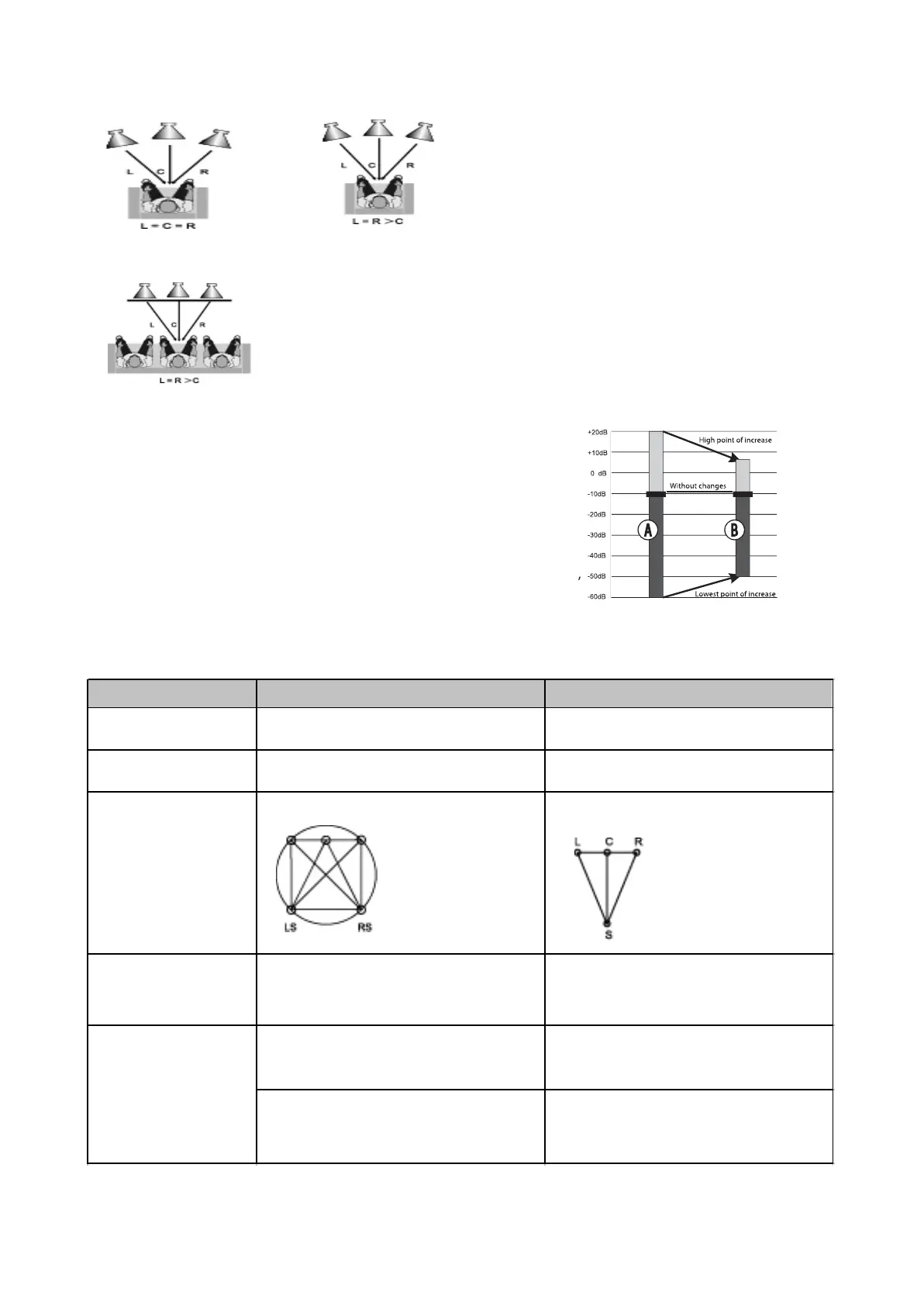
Fig.1.Delay of central
channel=0
Fig.2.Small area Delay
of central channel=L=(or
Fig.3.Small area Delay
of central channel=0
L=R>C
Dolby Digital Dolby Pro Logic s urround
Rear channel Stereo 20 Hz -20 kHz
Mono channel with li mited frequency
range(100Hz-7 kHz )
Low-frequency
channel(s ubwoofer)
Available,20-120 Hz N/a
Sound field dis tribut ion Muitivariate From left t o right, from right to left, from
front to rear, from rear t o front
Channels
6 independent c hannels, each
reproducing it s own si gnal at a t ime
4 segment ed channels . Only one channel
is dec oded at a ti me.
Creates an opt imum s ound field with
illus ion of an equal distanc e from listener
to each speak er.
The most c ost-efficient way to ens ure
high-qualit y surround effect.
Allows adjust ing the dec ompress ion
degree of sound infromati on("night"
mode).
Surround sound may be rec eived from
any signal s ource.
Miscell aneous
- 12 -



 To Next Page