Instruction Manual for DAC3 HGC and DAC3 L with 2.X Firmware Page 16
trigger output at the end of the chain (less
common).
Typical trigger applications:
• DAC3 → Amplifier
• DAC3 → Amplifier → Amplifier
• DAC3 → Preamplifier → Amplifier
• AVR → DAC3, and AVR → Amplifier
(AVR with 2 trigger outputs controls
DAC3 and power amplifier)
Trigger Bus Applications
The Benchmark bi-directional trigger system
also supports multiple trigger ports wired
together on a bus.
A group of Benchmark trigger ports can be
connected to a group of non-Benchmark
trigger input ports to form a single trigger
bus. A bus should never be connected to
more than one non-Benchmark trigger output
port. If an output port is connected to the
bus, this device should be used to start the
audio system.
A 3.5 mm (1/8") TRS "Y" cable can be used to
split the trigger output of the DAC3 to feed
more than one trigger input.
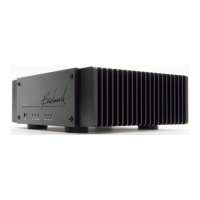
Benchmark AHB2 power amplifiers have two
trigger I/O ports that are wired in parallel.
This makes it easy to connect more than one
power amplifier to a trigger bus (without the
use of a "Y" cord). Connect a trigger cable
between the DAC3 and the first amplifier.
Use another trigger cable to connect this
amplifier to the next amplifier. Any number of
Benchmark amplifiers can be added to the
trigger bus. The DAC3 will turn on first, and
after a delay, all of the amplifiers will turn on
together.
Bi-Directional Trigger Applications
Benchmark products support bi-directional
communications over a trigger bus. Any
Benchmark product connected to the bus can
turn the entire system on or off. Because of
the bi-directional design, any power button on
a Benchmark DAC3 or AHB2 can be used to
start or stop the system.
The Benchmark device that starts the system
will become the trigger master. If the trigger
master is turned off, all slave devices will
follow. If a slave device is turned off, all other
devices will stay on.
If the DAC3 is used to turn the system on,
any connected AHB2 amplifiers will become
slave devices and they can be turned off
without shutting down the DAC3. This feature
makes it easy to turn the AHB2 amplifier(s)
off when listening to headphones.
Slave devices can force the entire trigger bus
to shut down if the POWER button or OFF
button is pressed and held for 3 seconds.
Tip: Press and hold the POWER button on
any Benchmark device for 3 seconds to force
a shutdown of the entire trigger-connected
system.
Trigger Specifications
The Benchmark 12V TRIGGER I/O has a
wide operating range to allow interfacing with
most other DC trigger systems. It should only
be used with trigger inputs that are designed
to tolerate 12 VDC.
• 12 VDC 200 mA current-limited output
• Input responds to 3.3 V logic and
higher
• Maximum input voltage = 30 VDC
• Maximum reverse input voltage = -0.3
VDC
• Input Impedance = 20 k Ohms
• 1/8" (3.5 mm) TRS jack
• Tip = 12 Volt Trigger I/O
• Ring = no connection
• Sleeve = chassis ground


 To Next Page