Instruction Manual for DAC3 HGC and DAC3 L with 2.X Firmware Page 19
After holding the button(s) for 3 seconds,
either the 4X lamp or the 2X lamp will flash
once indicating the new USB MODE. A flash
of the 4X lamp indicates that the unit is now
in USB Audio 2.0 mode. A flash of the 2X
lamp indicates that the unit is now in USB
Audio 1.1 mode.
Tip: The 4X or 2X lamp will flash once every
time the USB input is selected. This flash
provides a convenient indication of the
current USB MODE.
Tip: Avoid any unnecessary switching
between USB MODES. Rapid switching
between modes can confuse some operating
systems.
Driving Power Amplifiers
The DAC3 is designed to directly drive
virtually any audio power amplifier or
powered monitor. This direct connection
provides the cleanest and shortest path from
the digital source to the monitor output.
Tip: In most cases, Benchmark does not
recommend placing an audio device between
the DAC3 and the power amplifier. One
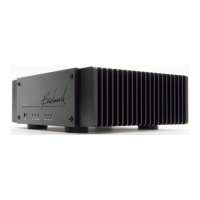
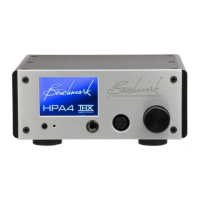
notable exception is the HPA4 line amplifier.
The HPA4 provides stepped relay gain control
with exceedingly low THD and noise. The
HPA4 provides the ultimate analog volume
control and it can operate transparently
between the DAC3 and a power amplifier.
The RCA and XLR outputs on the DAC3 are
equipped with low-impedance high-current
drivers. These robust outputs are well
equipped to drive a wide variety of input
impedances. The DAC3 outputs remain clean
when driving amplifiers that present difficult
loads (high input capacitance and/or low input
impedance).
The XLR outputs on the DAC3 are equipped
with jumper-configured passive low-
impedance output pads. These pads can be
set to an attenuation of 0 dB (pad off), 10
dB, or 20 dB. The pads should be used to
match the output level of the DAC3 to the
input sensitivity of the power amplifier. Most
power amplifiers and powered monitors will
require the use of the 10 dB or 20 dB pads.
Use the 0 dB setting when driving a
Benchmark AHB2 power amplifier.
Tip: The Benchmark AHB2 power amplifier
has a unique low-gain topology that allows it
to accept full studio-level input signals. This
high-level interconnection provides a very
low-noise connection between the DAC3 and
the AHB2. Set the input SENSITIVITY
switch on the AHB2 to 22 dBu (all the way
down). This places the AHB2 full-power
output point at an input level of 22 dBu. This
level is exactly 2 dB lower than the calibrated
HT output level of the DAC3 (when the pads
are set to 0 dB). This configuration optimizes
the gain-staging between the DAC3 and the
AHB2 while placing the DAC3 volume control
in the proper range.
Tip: If you are using a DAC3 with non-
Benchmark power amplifiers, the XLR pads
should be set so that comfortable listening
levels occur when the VOLUME control is set
above 11 o’clock. This will optimize the gain-
staging between the DAC3 and your power
amplifier.
Tip: Increase the pad setting if a comfortable
listening level is reached at a VOLUME
control setting below the 11 o'clock position.
Tip: Decrease the pad setting if a comfortable
listening level cannot be reached when the
VOLUME control is fully clockwise.
Instructions for setting the XLR pad jumpers
are detailed in the Internal Settings section
of this manual. The DAC3 is shipped with the
XLR pads disabled (set to 0 dB). No
adjustments will be necessary if you will be
using a Benchmark AHB2 power amplifier.
HPA2™ Headphone Amplifier
(DAC3 HGC model only)
The left headphone jack has a mute switch
that mutes all of the analog outputs on the
back of the DAC3. The right headphone jack


 To Next Page