Instruction Manual for DAC3 HGC and DAC3 L with 2.X Firmware Page 35
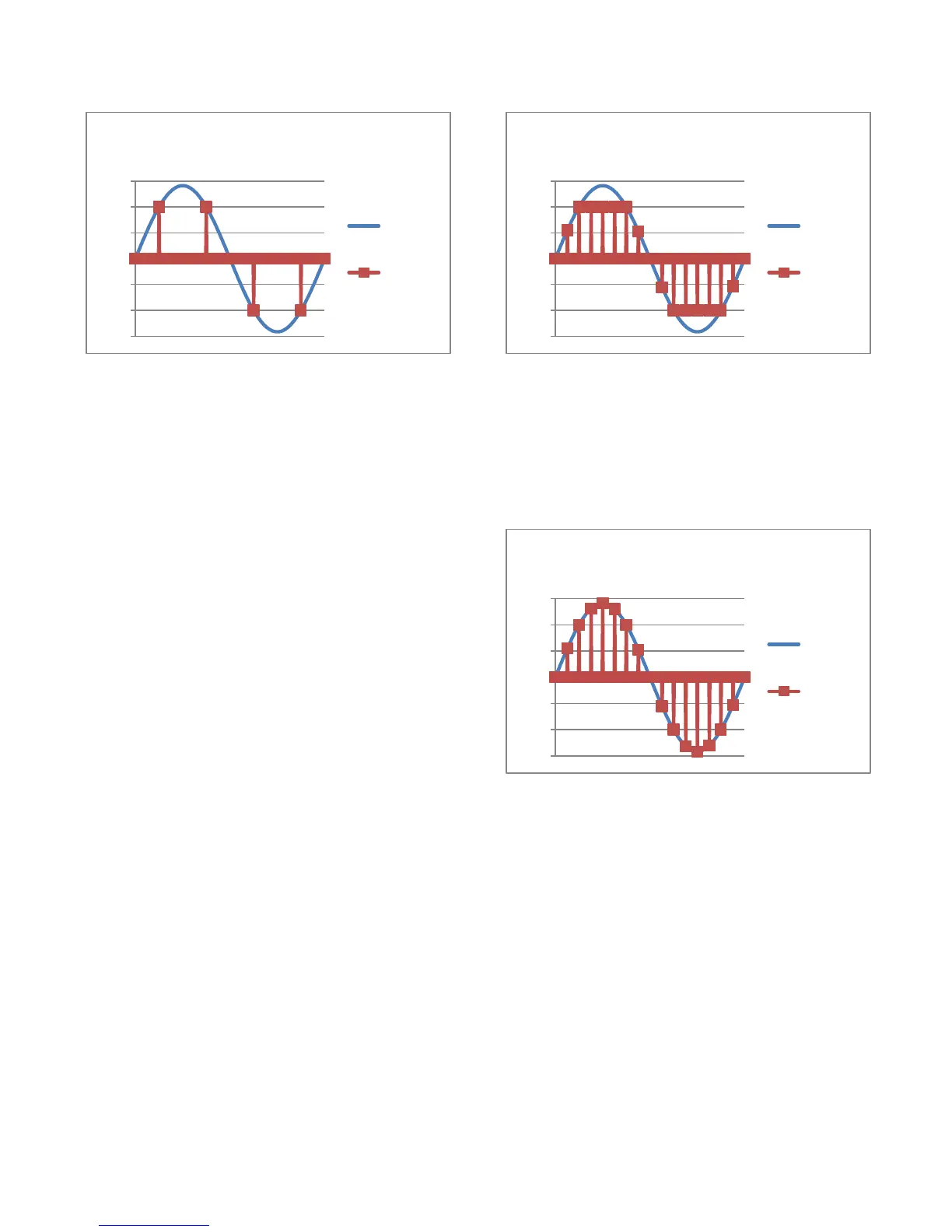
Intersample overs are common in low sample
rate (44.1 kHz and 48 kHz) commercial
releases. Due to the mathematics and the
bandwidth of typical input signals,
intersample overs are less of a problem in
high sample rate recordings. The reason for
this is that the worst-case (+3.01 dB)
intersample overs occurs for pure tones that
are exactly 1/4 of the sample rate (as shown
in the figure above). At the 44.1 kHz CD
sample rate, the worst case occurs at 11.025
kHz. It turns out that many recordings have
substantial peaks near this frequency. In
contrast, at a sample rate of 88.2 kHz, the
worst-case intersample overs occur at a
frequency of 22.1 kHz where most musical
sources have insufficient energy to produce
significant intersample overs. The 88.2 kHz
sample rate is still susceptible to intersample
overs, but the magnitude of the worst-case
overs tends to be much lower. For example,
at 1/8th of the sample rate (11.025 kHz), the
maximum intersample peak is about +0.66
dB instead of the 3.01 dB worst case at a
sample rate of 44.1 kHz.
The biggest advantage of higher sample rates
may be the immunity to intersample overs. If
higher sample rates sound better, this
difference may be entirely due to the absence
of DSP overloads caused by intersample
overs. Benchmark's high-headroom DSP
renders low sample rates with the clarity and
detail normally associated with high sample
rates.
PCM systems can accurately capture peaks
that exceed 0 dBFS, but these peaks will
overload the oversampling interpolators in
most delta-sigma D/A converters. The
solution is not to eliminate the interpolation
process; the solution is to build interpolators
with more headroom.
The interpolation process is absolutely
necessary to achieve 24-bit state-of-the art
conversion performance. Unfortunately,
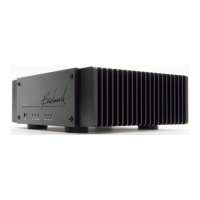
intersample overs cause clipping in most
interpolators. This clipping produces distortion
products that are non-harmonic and non-
musical. We believe these broadband
distortion products often add a harshness or
false high-frequency brightness to digital
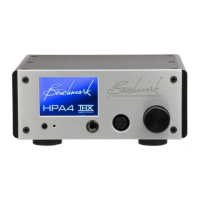
reproduction. The DAC3 avoids these
problems by maintaining at least 3.5 dB of
headroom in the entire conversion system.
We believe this added headroom is a
groundbreaking improvement.
-1.5
-1
-0.5
0
0.5
1
1.5
Intersample Overs
(1 = Maximum Digital Code)
Analog
Audio
Digital
Samples
-1.5
-1
-0.5
0
0.5
1
1.5
Conventional Interpolation
(Intersample Overs are Clipped)
Analog
Audio
Digital
Samples
-1.5
-1
-0.5
0
0.5
1
1.5
High-Headroom Interpolation
(Intersample Overs are Not Clipped)
Analog
Audio
Digital
Samples


 To Next Page