HD-973P Series Multi-Level Parking Lift 8 P/N 5900076 — Rev. B3 — January 2024
Components
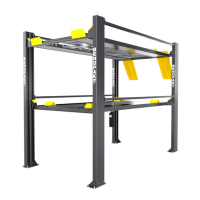
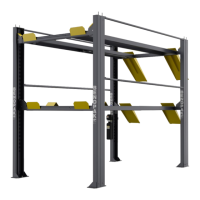
The main components of your Lift include:
• Power Post. The Post that holds the Power Unit. Mount the Power Unit on one of the two
Mounting Brackets.
• Power Unit. An electric/hydraulic unit that connects to an electric power source and then
provides Hydraulic Fluid to the Hydraulic Cylinder that raises and lowers the Runways.
• Flex Tubes. Not shown. A flexible, black tube that attaches to an opening on the Powerside
Runway on one end and to the Power Unit on the other end. Used for protecting the Return Line,
Air Line, and Hydraulic Hose (and Microswitch Cable for Upper Platform) as they are routed to the
Power Unit. One Flex Tube per Platform.
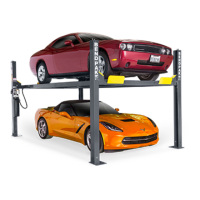
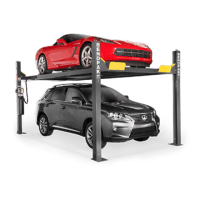
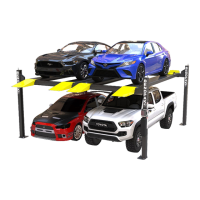
• Upper Platform. Can hold Vehicles up to 7,000 lbs. (3,175 kg).
• Lower Platform. Can hold Vehicles up to 9,000 lbs. (4,082 kg).
• Powerside Runway. On the same side as the Power Post (holds the Power Unit). The
Powerside Runway has the Hydraulic Cylinder and the Lift Cables under it. Both Platforms have a
Powerside Runway.
• Offside Runway. This Runway does not have a Hydraulic Cylinder or Cables under it. Both
Platforms have an Offside Runway.
• Aluminum Decks. Sit in between the two Runways. These Decks help prevent fluid leakage
from falling onto the Vehicle below. Two per Platform.
• Safety Shutoff Bar. Located on the underside of the Upper Platform. The Safety Shutoff Bar
stops upward movement of the Lift. If you are raising a Vehicle on the Lower Platform and it hits
the Safety Shutoff Bar, the Lift immediately stops moving.
• Crosstubes. Each Platform has one at each end of the Lift. The Crosstubes are hollow; the
Cables that raise and lower the Runways are routed through the Crosstubes. The Crosstubes are
not interchangeable: Each Crosstube has an opening (called a ‘Windows’) that face the inside. All
Windows open to the inside of the Lift only.
• Stiffener Tubes. Provide extra structural stability for your Lift. Two Stiffener Tubes connect the
Powerside Posts and another two connect the Offside Posts.
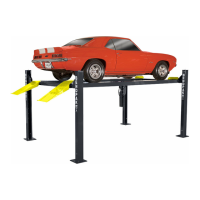
• Drive-up Ramps. The Upper Platform uses a longer set of Ramps, and the Lower Platform uses
a shorter set of Ramps. Used to drive onto and off of the Runways. Two per Platform.
• Tire Stops. Located at the Front of the Lift, Tire Stops prevent the Vehicle’s Front Tires from
going any further forward. Additionally, always chock the Vehicle’s Rear Tires. Two per Platform.
• Safety Locks. Mechanical Locks on the Platforms that, once engaged, hold the Runways in
position, even if the power goes out or there is a leak in the hydraulic system. Your Lift has two
Safety Ladders per post, which engage the Safety Locks. Locking positions are spaced every four
inches. This allows you the flexibility to lock the Runways at just the right height. Always leave
your Lift on the ground or engaged on a Safety Lock.
• Platform Selector Valve. Controls which Platform is in operation; only one Platform may be
raised or lowered at a time.
• P
ushbutton Air Valve. Moves the Safety Locks away from the Ladder so that they do not
engage as you lower the Lift. Used to lower the Runways.
• Safety Ladders. Steel components that look similar to a ladder and are installed at the back of
each Post. The Safety Locks on the Platforms engage the openings in the Safety Ladders.


 To Next Page