ENGLISH
ENGLISH
TVS High
Voltage
Transients
The internal circuitry of the controller is designed with Transient Voltage Sup-
pressors (TVS) which can only protect against high-voltage surge pulses with
less energy. If the controller is to be used in an area with frequent lightning
strikes, it is recommended to install an external surge arrester.
* When the internal temperature is 81° C, the reducing power charging mode which reduce the
charging power of 5%,10%,20%,40% every increase 1° Cis turned on. If the internal temperature
is greater than 85 ´° C, the controller will stop charging. When the temperature declines to be
below 75 ºC, the controller will resume.
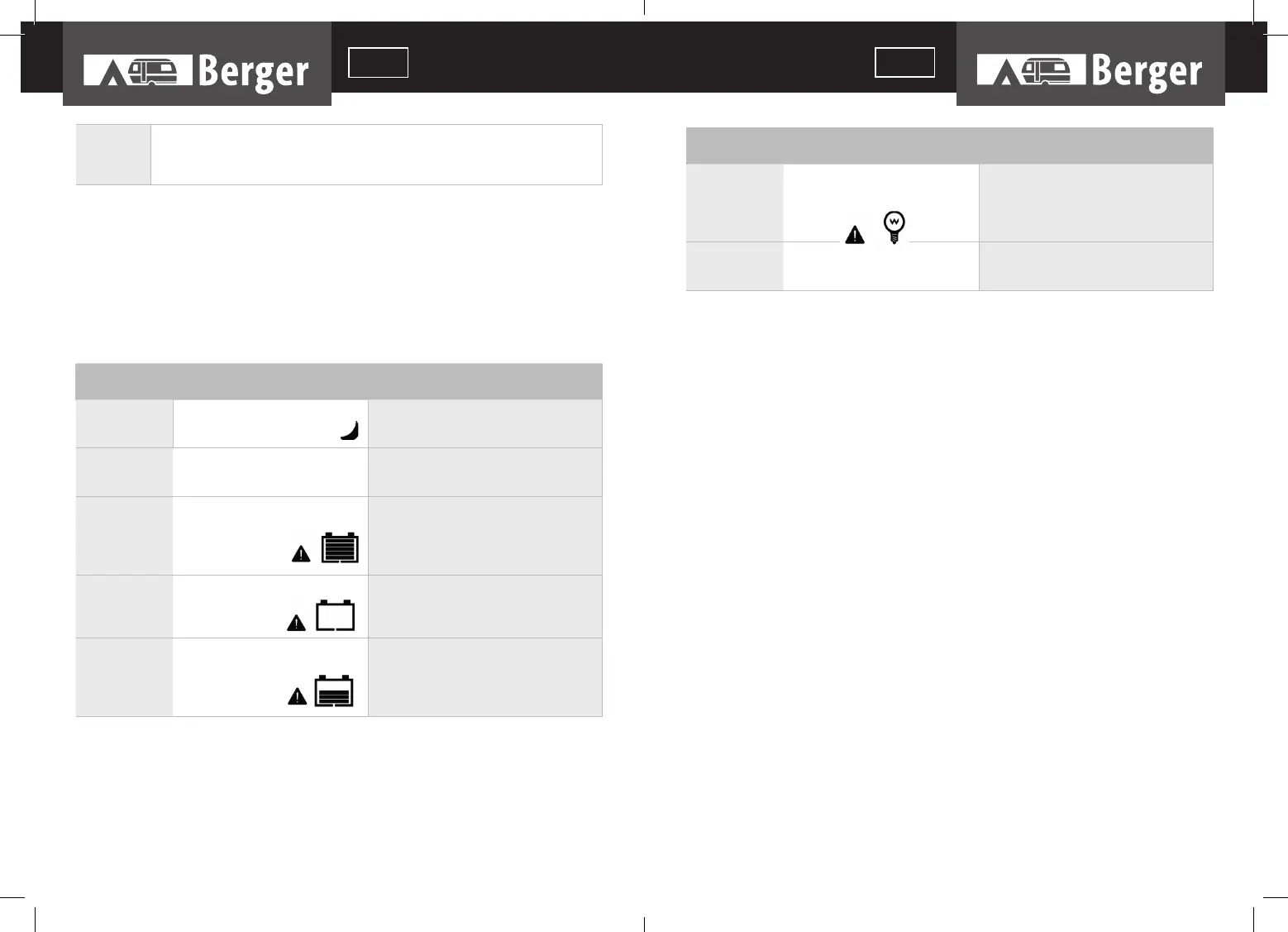
TROUBLESHOOTING
Possible
reasons
Faults Troubleshooting
Load Overload 1. Die Last ist kein Ausgang
(1) Please reduce the num-
ber of elec tric equip ment s.
(2) Restart the controller.
(3) wait for one night-day cycle (night
time>3 hours).
Load Short
Circuit
Last- und Fehlersymbol blinken
(1) Check carefully loads connection,
clear the fault. (2) Restart the cont-
roller.
MAINTENANCE
The following inspections and maintenance tasks are recommended at least two times per
year for best performance.
• Make sure controller fi rmly installed in a clean and dry ambient.
• Make sure no block on air-fl ow around the controller. Clear up any dirt and fragments on
radiator.
• Check all the naked wires to make sure insulation is not damaged for
• solarization, frictional wear, dryness, insects or rats etc. Repair or replace some wires if
necessary.
• Tighten all the terminals. Inspect for loose, broken, or burnt wire connections.
• Check and confi rm that LED is consistent with required. Pay attention to any troubleshoo-
ting or error indication .Take corrective action if necessary.
• Confi rm that all the system components are ground connected tightly and correctly.
• Confi rm that all the terminals have no corrosion, insulation damaged, high temperature or
burnt/discolored sign, tighten terminal screws to the suggested torque.
• Check for dirt, nesting insects and corrosion. If so, clear up in time.
• Check and confi rm that lightning arrester is in good condition. Replace a new one in time
to avoid damaging of the controller and even other equipments.
WARNING: Risk of electric shock!
Make sure that all the power is turned off before above operations, and then follow the
corresponding inspections and operations.
Possible
reasons
Faults Troubleshooting
PV array dis-
connection
LCD display during daytime
when sunshine falls on PV
modules properly
Confi rm that PV wire connections are
correct and tight.
Battery voltage
is lower than
8V
Wire connection is correct, the
controller is not working.
Please check the voltage of battery.
At least 8V voltage to activate the
controller.
Battery over
voltage
Battery level shows full, battery
frame blink, fault icon blink Check if battery voltage is higher than
OVD(over voltage disconnect voltage),
and disconnect the PV.
Battery over
discharged
Battery level shows empty,
battery frame blink,
fault icon blink
When the battery voltage is restored
to or above LVR(low voltage reconnect
voltage), the load will recover
Battery Over-
heating
Battery level shows empty, bat-
tery frame blink, fault icon blink
The controller will automatically turn
the system off. But while the tempe-
rature decline to be below 55 ºC, the
controller will resume.
58
59


 To Next Page
 Loading...