10 11
OPERATING INSTRUCTIONOPERATING INSTRUCTION
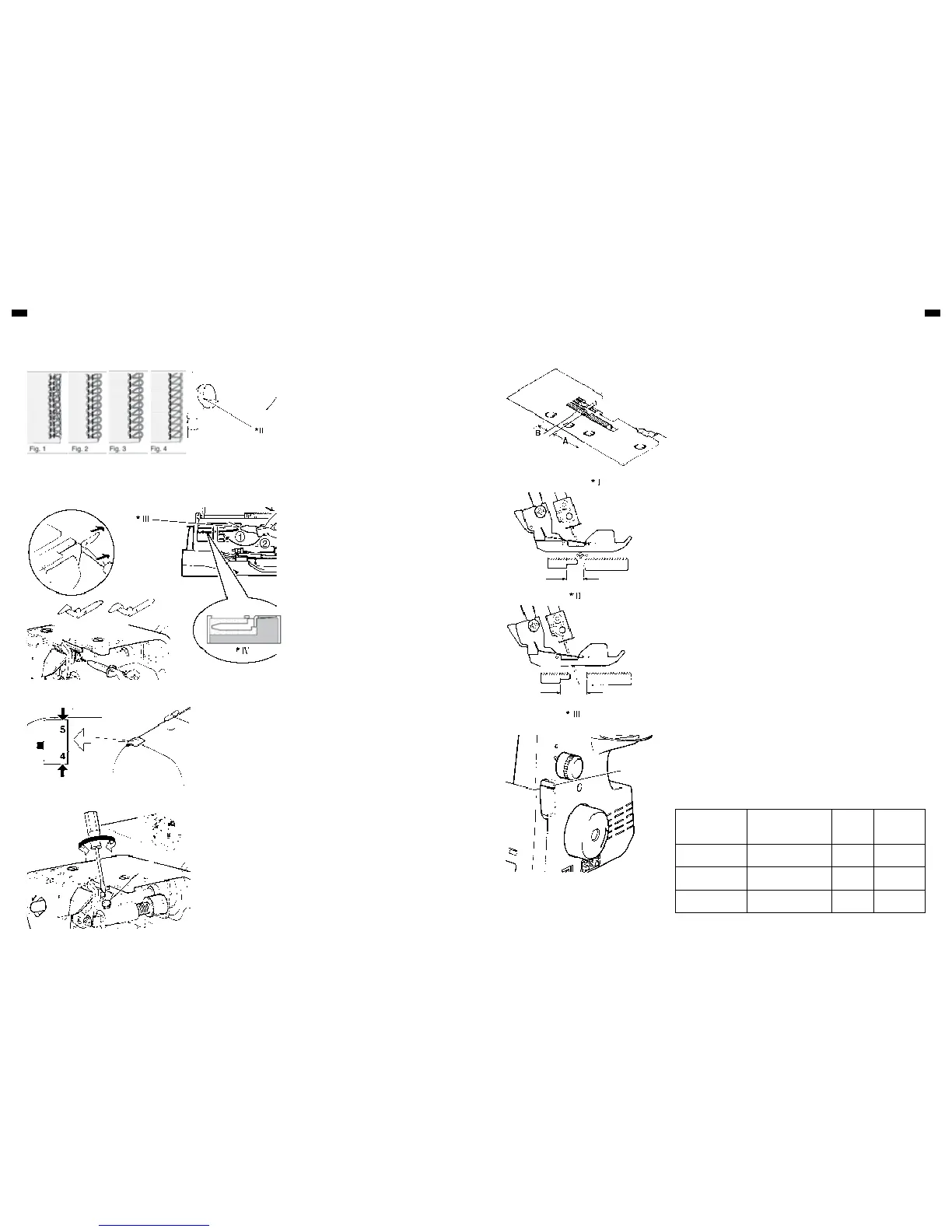
Overedge cutting width can be adjusted from 4 to 7
mm by simply turning overedge cutting width dial
according to the kind of fabric.
It is set at standard width of 6 mm when delivered
from the factory.
Turn it towards “5” if fabric edge curls while sewing.
(Fig. 1)
Turn it towards “7 “ if loops hang off the edge. (Fig.
2)
Loops may hang off the edge, when you sew with
lightweight fabric using 3 threads (right needle
only), and setting cutting width dial at 4 - 5 (Fig. 3).
In such a case change the stitch finger (A) to (B) to
get neat stitching (Fig. 4).
The differential feed has two independent feed dogs, one front (A) and one rear
(B).
Each feed dog has an individual feed mechanism which enables the feeding of
material at a different ratio.
DIFFERENTIAL FEEDADJUSTING OVEREDGE CUTTING WIDTH
STITCH FINGER (B)
FOOT PRESSURE REGULATOR
Presser foot pressure has been correctly set at the
factory, so you do not need to adjust it for most of
ordinary sewing. If adjustment is necessary, turn
the foot pressure regulator to higher number to
increase or to lower number to decrease pressure.
SEWING WITH EXTRA HEAVYWEIGHT FABRIC OR MULTIPLE LAYERS OF FABRIC
A wide range of fabric can be overlocked on this
machine, but it is recommended to tighten screw as
illustrated, when sewing with extra heavyweight
fabrics or mulitiple layers of fabric. Open working
table for adjustment.
Loosen the screw when sewing with light to normal
weight fabric or turning overedge cutting width dial,
or otherwise fabric may not be well cut.
The machine is set for normal weight fabrics from
the factory.
POSITIVE DIFFERENTIAL FEED
WHEN SET FOR POSITIVE DIFFERENTIAL FEED, the front feed dog (A)
makes a longer stroke than the rear feed dog (B).
This has the effect of accumulating material under the presser foot to offset the
wavering on the fabric.
NEGATIVE DIFFERENTIAL FEED
WHEN SET FOR NEGATIVE DIFFERENTIAL FEED, the front feed dog (A)
makes a shorter stroke than the rear feed dog (B).
This has the effect of stretching material under the presser foot to offset the
puckering on the fabric.
SETTING DIFFERENTIAL FEED
Set by simply moving the differential feed control lever in the direction desired
referring to the chart below.
The adjustment can be made between 0.7 (negative effect) and 2 (Positive
effect). These settings give the best ratio of feeding.
For normal sewing, the lever should be set at 1.
The lever can be reset even while sewing.
EFFECT AND
APPLICATION
TYPE OF FEEDING SETTING
FEED RATIO
REAR/FRONT
Waver-free seams,
Gathering
Positive differential feed 1-2 |-----------|----------------|
No differential feed Neutral feed 1 |--------------|-------------|
Pucker-free seams Negative differential feed 0.7-1 |-----------------|----------|
Illustration
V. Increase
VI. Decrease
VII. Tighten
VIII. Loosen
IX. Screw
Illustration
II. Overedge cutting width dial
III. Stitch finger (B)
IV. Cross section
Illustration
I. Differential feed dogs
II. Positive differential feed
III. Negative differential feed
IV. Differential feed control lever
IV
V
VII VIII
IX
VI


 To Next Page