4
bernette SEWING MACHINE WORKBOOK
SEWING MACHINE NEEDLES
General Information
Along with thread, needles are very important to stitch formation. Many “mechanical”
problems and damage to fabrics can be traced to a bent, damaged, or incorrect size or
type needle.
When selecting the correct needle, consider the following:
• Needle system – 130/705H
• Needle point – assures proper stitch formation; avoids fabric damage
• Needle size – smaller for lightweight fabrics; larger for heavier fabrics
If the needle is:
• Too small – the thread can’t stay in the groove to form a loop to be picked up by the
hook point
• Bent – the thread loop forms too far away from hook point and the hook can’t enter
the loop to form a stitch
• Blunt – the needle won’t pierce fabric, so no thread loop forms to make a stitch
Need to Know
• Needles should be changed after every 4-6 hours of stitching. The needle is the most
inexpensive part in your sewing machine, but it is crucial for getting good results and
keeping your machine running well.
• Don’t let false economy keep you from doing what is best for your sewing projects
and your machine.
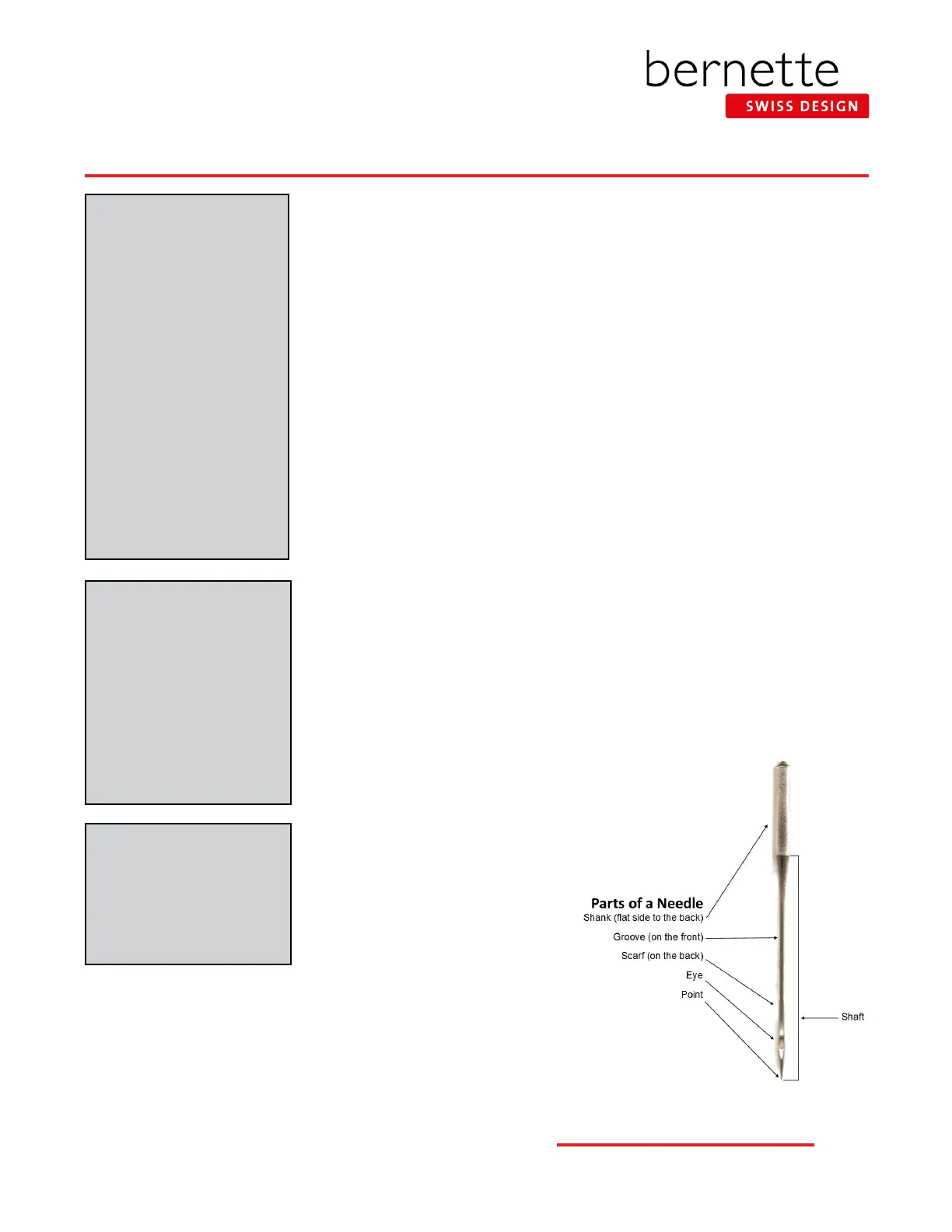
• The selected thread should t in the groove on the front of the needle. If it isn’t
protected by the groove, a needle
with a larger groove should be
used.
• Always make sure needles are fully
inserted as high as possible, with
the at side to the back.
Needle “Secret” Code
• DRI = Triple
• E = Embroidery
• J = Jeans
• L, LL, R = Leather
• M = Microtex
• MET = Metallic
• N = Topstitching/
Cordonnet
• Q = Quilting
• S = Stretch
• SUK = Fine Ball Point
• SES = Medium Ball Point
• WING = Wing
• ZWI = Double
• ZWIHO = Double Wing
Needle Size Conversion
Regardless of the system,
the greater the number,
the larger the diameter of
the needle.
European vs. Domestic
60=8 90=14
70=10 100=16
75=11 110 =18
80=12 120=19
Needle Size for Fabrics
60 – very ne batiste
70 – shirt-weight
80 – medium-weight
90 – denim and twill
100/110/120 – canvas



 To Next Page