6
bernette SEWING MACHINE WORKBOOK
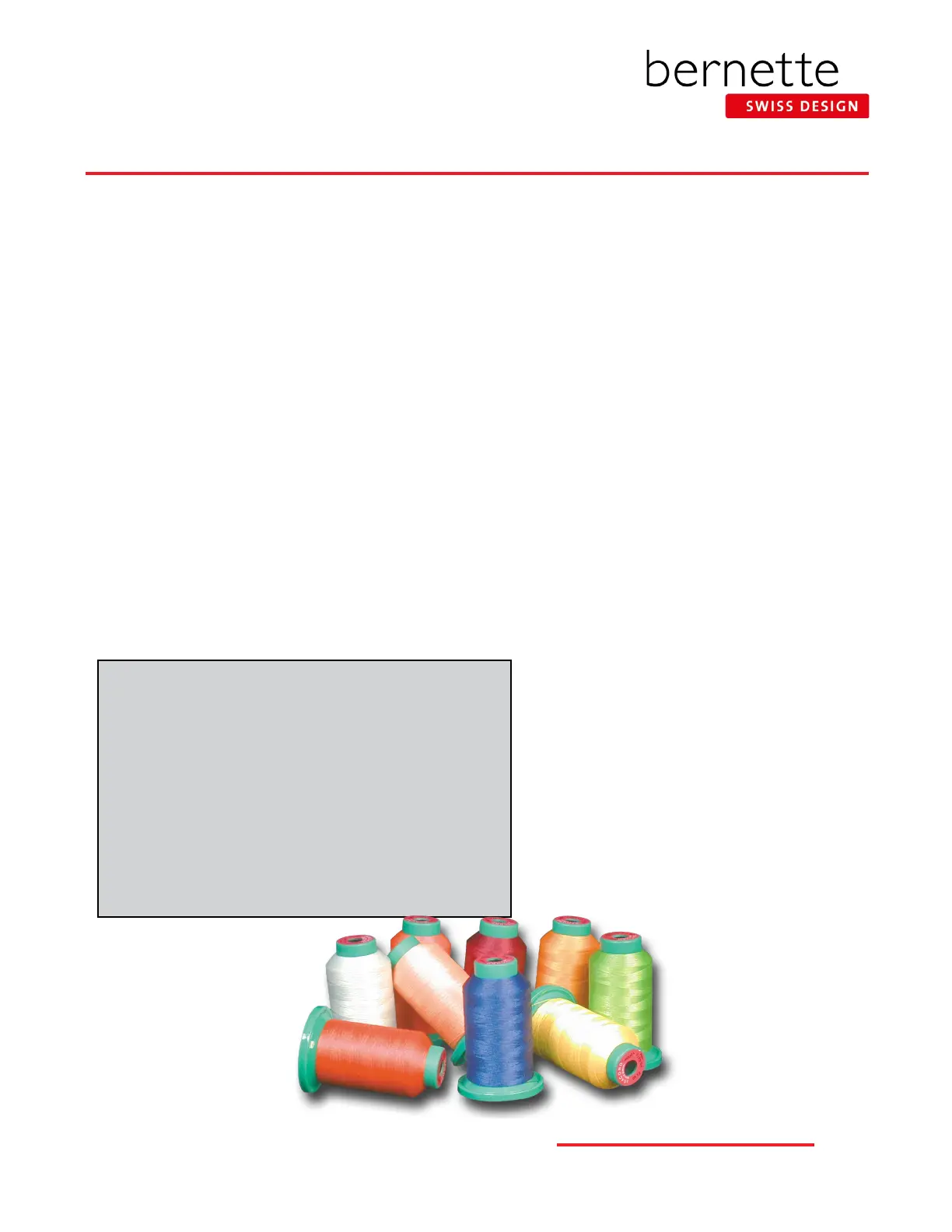
THREAD
To achieve quality stitches, a sewing machine needs three things: suitable
thread, correct needle size, and properly adjusted thread tensions. Poor
quality or the wrong type of thread can cause inferior stitches on any
machine. Low-quality thread results in crooked and looped stitches,
puckered seams, frayed thread, and/or needle breakage. Did you know
that thread passes through the eye of the needle approximately 37 times
in a “seesaw” action before it forms a single stitch?
Long staple threads are stronger and smoother than short staple threads
(Staple refers to the length of bers twisted together to form a single ply.)
Most bargain-priced threads are made of short staple and will deposit
more lint and fuzz into your sewing machine, potentially causing tension
inconsistencies and possibly even damage to your machine over the long
term. Using long staple threads also results in less snagging and fraying.
Ply refers to the number of strands twisted together to make a single
thread. The plies are usually indicated by a number after the weight of the
thread such as 50/3, which means a 3-ply, 50 weight thread. The lower
the weight, the heavier the thread; conversely, higher numbers indicate
ne or lightweight thread.
Fibers
Fiber refers to the type of material used to
produce the thread.
Polyester
Good for clothing construction on man-made,
natural, or blended fabrics. Tolerates high
temperatures. Polyester embroidery thread
has a high sheen; excellent for machine
embroidery, abrasion resistant, and will not
fade.
Cotton
Available in a wide range of weights from
12-100, cotton thread gives a soft, full look
to embroidery, applique, and buttonholes. It
is also excellent for clothing construction on
natural bers, patchwork piecing, darning and
heirloom sewing.
Rayon
A glossy embroidery thread, rayon is not as
strong as cotton and polyester bers, making
it useful for decorative work but not for
construction techniques.
Silk
Used on silk and wool fabrics, this strong,
lustrous ber is good for construction and
decorative details such as buttonholes. Also
used for machine and hand basting.
Guidelines for Thread Weights
12 wt.— Couching, bobbinwork
30 wt.— Embroidery, bobbinwork
40 wt.— General construction, quilting, embroidery
50 wt.— General construction, piecing, bobbin thread, quilting
60 wt.— Lingerie, heirloom, appliqué, bobbin thread, quilting
80 wt.— Extra-ne lingerie, heirloom



 To Next Page