12’–24’ BASIC 6
®
WWW.BIGASSFANS.COM ©2012 DELTA T CORP. ALL RIGHTS RESERVED
8
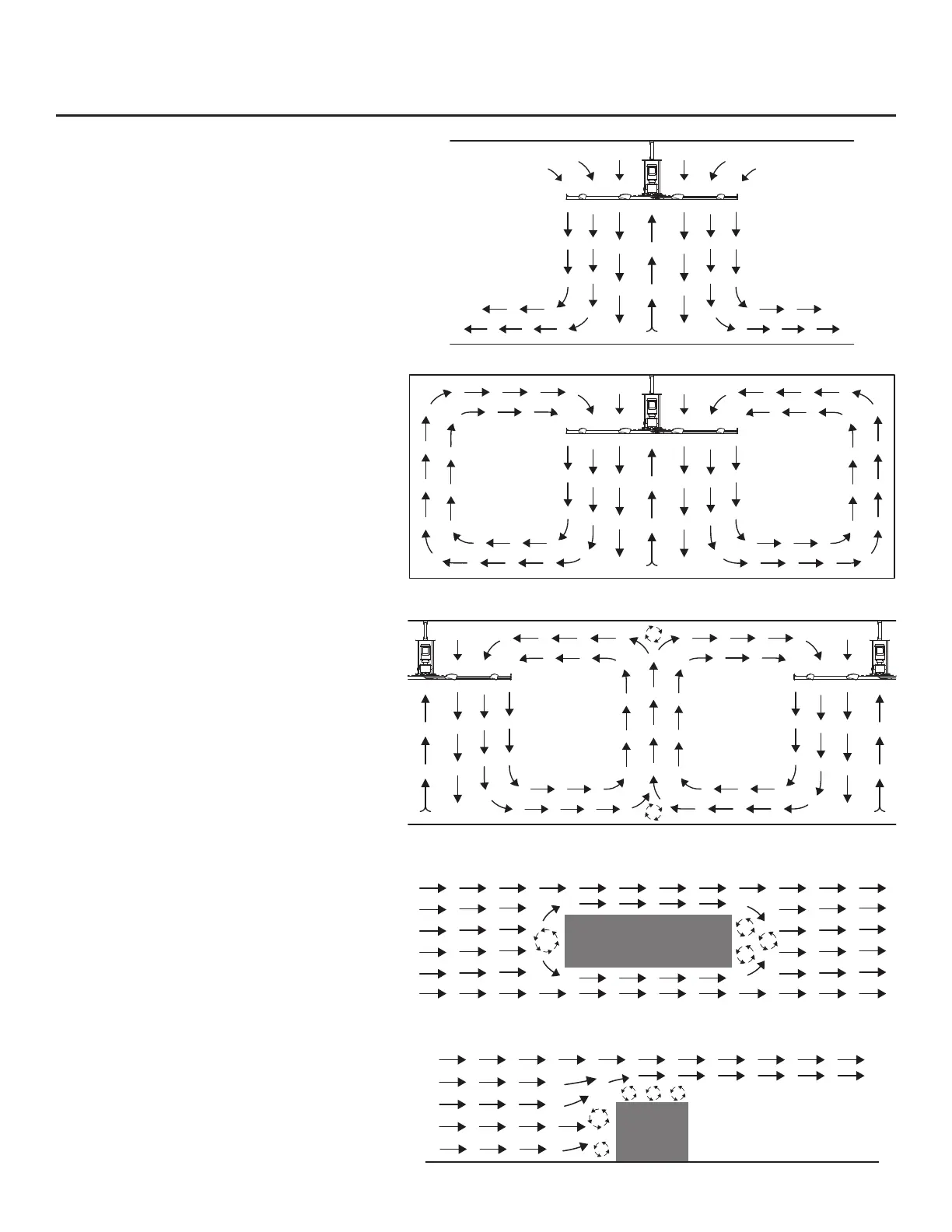
Understanding airow patterns
Airow with streamlined obstruction
Obstructions on the oor tend to block the
horizontally moving air. Thin or streamlined
obstructions do not block much airow,
regardless of size. The air tends to ow
smoothly around these obstructions, losing little
momentum, and leaving only a small stagnant
area behind the obstruction.
Airow with wide, blunt obstruction
A wide, blunt, or at-faced obstruction forces
the air to change direction, turning upward and
outward. There is a stagnant area behind these
obstructions that is wider and higher than the
obstructions themselves.
Airow in an enclosed area
The oor jet radiates outward until it reaches the
walls, which deect the jet upward. After it hits
the ceiling, the upward ow is directed inward
to the low pressure area above the fan where
it is then pulled down toward the oor. This
creates a convection-like air current that gathers
momentum. Once this current is established,
the fan begins to move air outside of the
current, escalating its cooling effects.
Airow in an open area
The airow moves from the fan toward the oor.
Once airow hits the oor, it moves outward in
all directions. The deection of air off the oor is
called a “oor jet.”
Airow with multiple fans
Where there are multiple fans appropriately
spaced, the expanding jets of adjacent fans
meet to create a pressure zone. The pressure
zone acts like a wall, causing each fan to
behave like a single enclosed fan. Typically,
a single fan’s performance will increase when
working in conjunction with other fans.
Pre-Installation (cont.)
Overhead View
Side View


 To Next Page