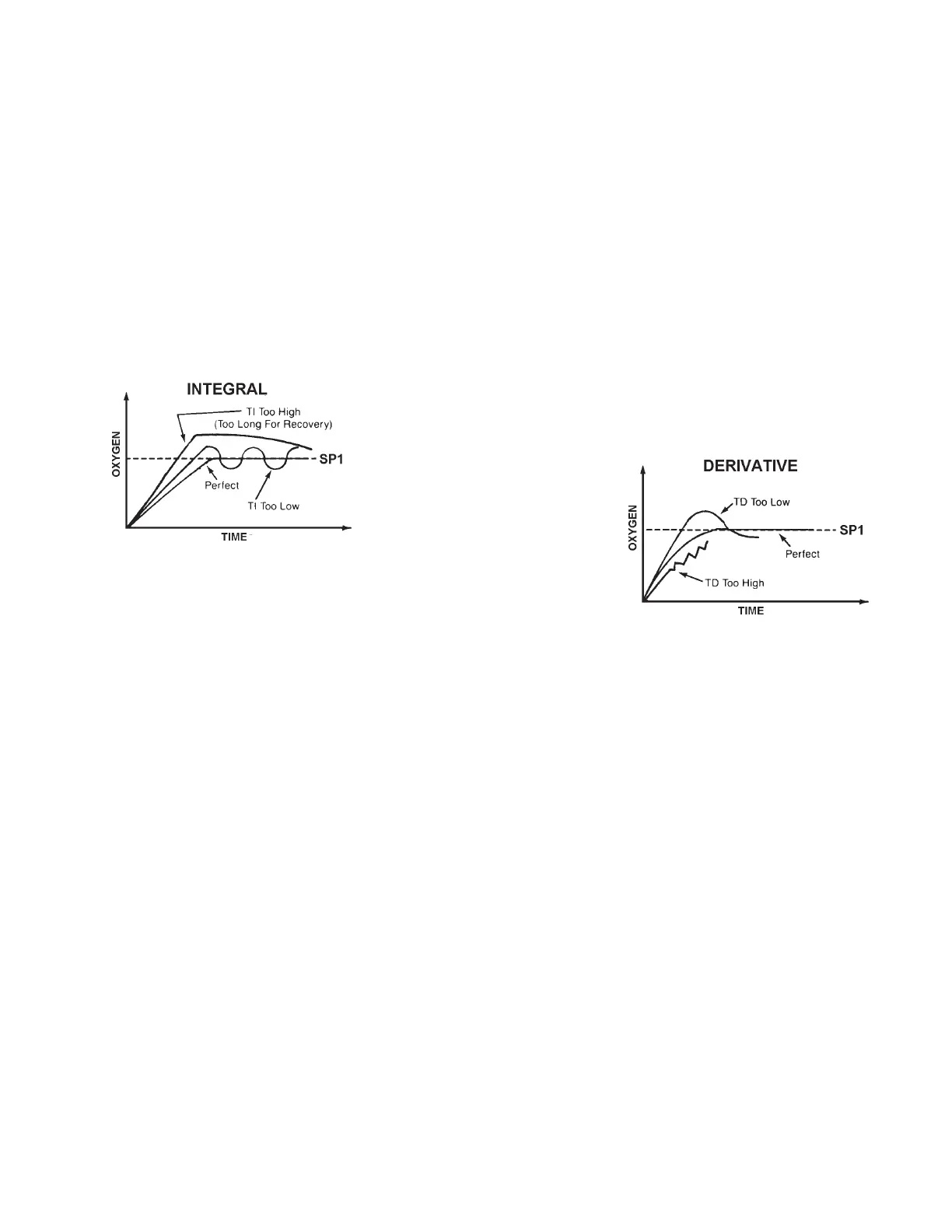
ally oscillation will dampen to steady
state, if load hasn't changed yet.
If integral time is too long, it's
slow to respond. Steady state and
setpoint take a long time to merge.
STEPS:
1. Watch oxygen control process in
work mode under normal load
change. Note offset at one load.
While load changes, note time till
new offset stabilizes at steady
state. To change load open the
chamber door and ventilate.
2. Enter program mode, navigate to
"int.t" function on level 1, and
set integral time to 30-70% of
noted time. Range is 0.1 - 60
minutes.
3. Exit program mode to work mode.
Watch as normal load changes
occur, and note time till offsets
disappear.
4. Repeat steps 2 and 3 until control
is acceptable.
DERIVATIVE CONTROL
The most demanding control
job is the one that has to be fast and
tight under fluctuating loads. With
power and proportional band tuned
aggressively (high power, narrow
band), conditions are ripe for over-
shoot. Add integral action and over-
shoot is virtually guaranteed, at
startup and after large disturbances.
Derivative control suppresses
overshoot. It also speeds response
to disturbances, large or small.
Derivative algorithms measure
rate and direction of change of oxy-
gen in relation to setpoint. Then
temporarily, but quickly shifts pro-
portional band in opposite direction,
by a distance proportional to the rate
of change. The faster the change,
the further it shifts. Shift is just long
enough to "extract" an output deter-
mination.
The effect is to quickly weaken
power on approach to setpoint, and
quickly boost power if oxygen sud-
denly pulls away from setpoint. Prop-
erly tuned, derivative should not dis-
turb proportional or integral action at
steady state.
On fast approach to setpoint
without derivative, when oxygen first
hits proportional band the initial pulse
might be 97% of cycle time. That's
not very weak. The next pulse might
be significantly less, but by that time
it's too late. Oxygen changed too
fast. Overshoot already occurred.
When integral action finally kicks in,
it's way too late.
With derivative, fast oxygen
change immediately pulls up propor-
tional band. Then first pulse might be
1% of cycle time. This quickly slows
approach to setpoint. Slower rate of
change calculation might only "ex-
tract" a pulse of 12% of cycle time.
Slower still, maybe 19%.
As rate of change of oxygen
decreases, derivative action de-
creases. At steady state there's no
derivative action. Ideally at that point
oxygen is near setpoint and integral
action takes over.
Derivative also speeds re-
sponse to disturbances. Without it,
as oxygen quickly diverges away
from setpoint, the first pulse from
proportional control band might be
only 22% of cycle time, the second
pulse 53%, the third 87%, and by the
time output goes to 100%, oxygen is
far away.
With derivative, the fast change
in oxygen away from setpoint would
immediately pull proportional band
back toward setpoint and result in
100% output before oxygen gets too
far.
Derivative control is hardest to
tune. Proper setting is very sensitive
to gas dynamics and other control
parameters. If it is not required, keep
it off as it will tend to reduce control
stability.
Derivative parameter is time.
Sets rate of corrective action. Rule-
of-thumb: set 3-8 times faster than
integral. If too short it inhibits reach-
ing setpoint and slows response to
upsets. If too long, it oscillates and
overcorrects. Is only active in pro-
portional band.
STEPS:
1. With power, proportional, and
integral parameters set, watch
control process in work mode.
Note overshoot. Next open
chamber briefly to induce large
upset in control. Note speed of
response.
2. Enter program mode, navigate to
"dEr.t" function on level 1,and
set derivative time. Range 0.1 -
0.4 of integral time.
3. Exit program mode, air out
chamber, watch control process
and note overshoot on approach
and response to disturbance.
4. Re-enter program mode, and
navigate to "dEr.t" function
again. If too much overshoot on
approach and too slow response
to upset, decrease derivative
time. If approach to setpoint is
inhibited and response under
corrects, increase derivative
time.
5. Repeat steps 3-4 until overshoot
on approach and response to
upset is acceptable.
17
Proox model 360
version 1.0


 To Next Page
 Loading...