10
4.2.3 TBT 6-24V Outdoor Slave clock
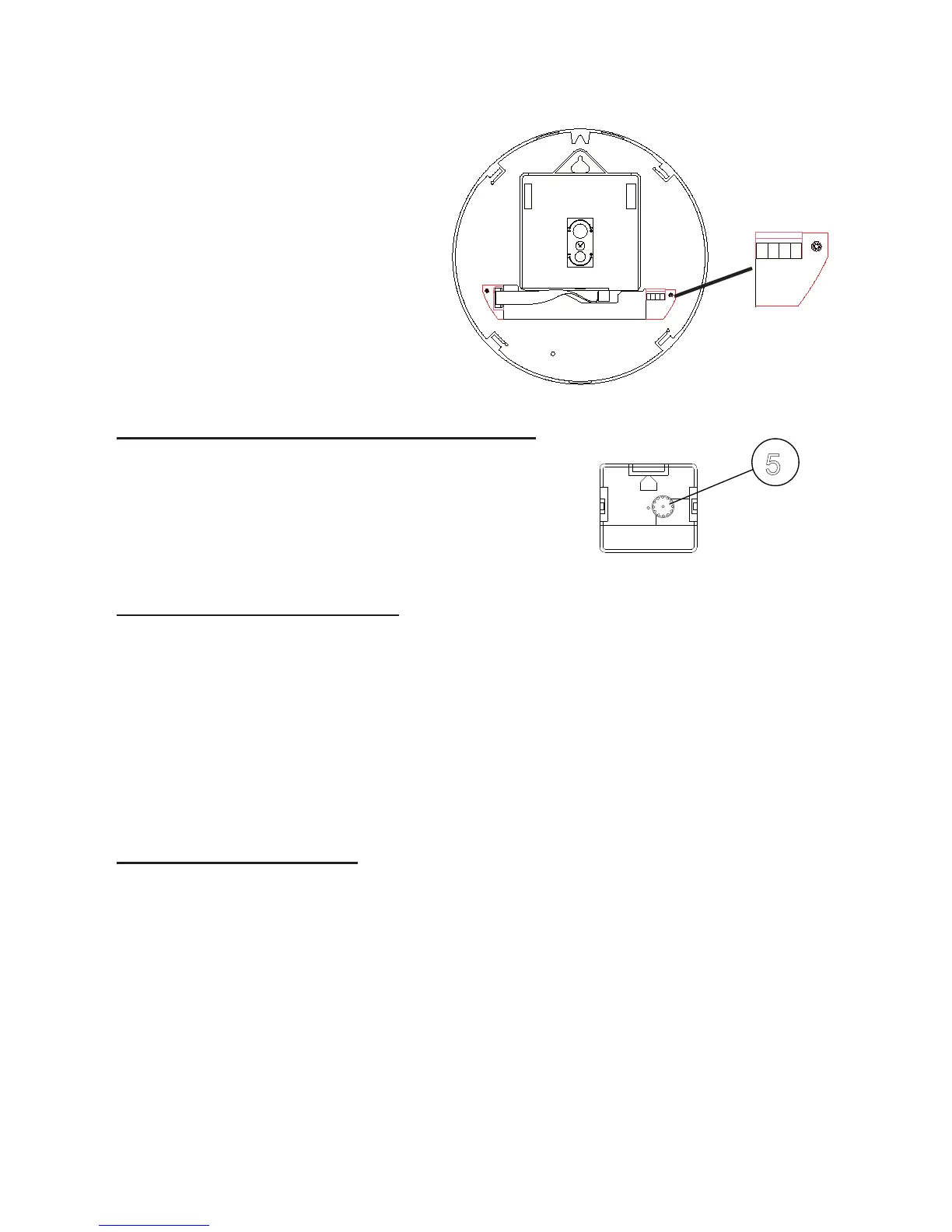
- Connect the afnor line on connectors 3
and 4.
The terminals 1 and 2 are reserved for
power supply (see page 6).
- When receiving the power, the hands are
driven to 12h00 until the clock receives
a radio signal. After controlling the data
(3 coherent messages) the clock is
automatically driven to the current time by
accelerated impulses.
4.3. Independant QUARTZ clock on battery
Insert the battery (1.5 volt LR6 type) matching up the [+] and [-]
symbols.
Immediately, the clock start, set the clock on time with the
wheel (5).
4.4. DCF radio receiver clock
Set the 1,5 V LR6 battery in its location respectful of the polarities.
When inserting the batteries, hands are set at 4h00, 8h00 or 12h00 until the correct reception of
the time signal is achieved.
After the validation of the data, the clock set itself rapidly and automatically.
In normal functioning, the clock will listen to the time message every two hours. To limit the
consumption, the listening is limited to 10 minutes. A correction is made, if necessary (if there is
a difference between the time received and the time displayed), twice a day.
4.5. Radio receiver clock
Set the 1.5 V LR6 batteries in their location respectful of the polarities.
When inserting the batteries, hands are set at 4h00 or 12h00 until the correct reception of the
time signal is achieved. After 3 successive coherent time signals are received, the clock starts
and automatically gets on time with fast impulses.
In case of difcult reception, the clock synchronisation can last several hours keeping in mind
that the signal reception is better during the night.
3
3
1
1
2
2
4
4
5


 To Next Page