1-6
Introduction to MR Conditional Pacing
Conditions for Scanning
scan to be performed. For each condition or requirement, actions to determine eligibility, the
potential clinical consequences of failing to meet the condition(s), and the patient population most
impacted by failure to meet the condition(s) are listed.
Table 1–4. Cardiology Conditions/Patient Conditions
Condition for Scanning
(Rationale)
Actions If Condition is Not Met
Potential Clinical
Consequences
Risk is Highest for
1. Patient is implanted with an
ImageReady MR Conditional
Pacing System (defined as a
Boston Scientific MR
Conditional pulse generator and
lead(s), with all ports occupied
by a lead or port plug).
For model numbers of MR
Conditional components, and to
identify an appropriate
combination, refer to "System
Description" on page 1-2 in this
Guide, http://www.
bostonscientific.com/
imageready, or Boston
Scientific Technical Services.
• Check patient records.
• Interrogate device. (Pulse
generator model number is
provided on PRM screen
and MRI Protection
Settings Report.)
• Check patient ID card.
• Check model numbers in
"System Description" on
page 1-2 of this Guide, at
http://www.bostonscientific.
com/imageready, or by
contacting Boston
Scientific Technical
Services.
• Confirm with physician
responsible for managing
the patient’s Pacing
System.
• Check X-ray or
fluoroscopic images of
pulse generator to assist
identification (see "X-ray or
Fluoroscopic Identification"
on page 1-12).
• Arrhythmia induction
• Clinically significant pacing
threshold changes and
sensing changes as a
result of heating at the
lead/tissue interface
• Damage to pulse generator
and/or lead
• Erratic pulse generator
behavior
• Inappropriate pacing,
inhibition of pacing, or
irregular intermittent
capture or pacing, possibly
resulting in pre-syncope or
syncope
• Physical movement of
pulse generator and/or
leads
• Pocket discomfort due to
pulse generator heating
• Pacing-dependent patients
• Patients prone to sustained
arrhythmias
• Patients with high capture
thresholds
The appropriate Boston Scientific MR Conditional pulse generator and Boston Scientific MR Conditional lead(s) must be used together to
obtain the intended risk reduction needed for MR Conditional scans.
Another manufacturer's MR Conditional pulse generator combined with a Boston Scientific MR Conditional lead (or vice versa) do not
constitute an MR Conditional System, because the components were not designed to work together in the MRI environment.
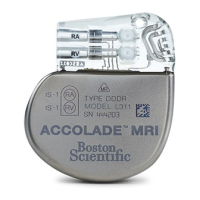
WARNING: Only the combination of INGEVITY MRI lead(s) with an ESSENTIO MRI, PROPONENT MRI, or ACCOLADE MRI pulse
generator is valid to use with either 1.5 T or 3 T scanners. All other allowable combinations of Boston Scientific MR Conditional system
components must use only 1.5 T scanners.
2. Pulse generator in MRI
Protection Mode during scan.
Effects of RF or gradient fields
create the potential for
oversensing, and/or induced
voltages in the pulse generator.
MRI Protection Mode is
designed to mitigate these
effects.
• Program the pulse
generator to MRI
Protection Mode using the
PRM.
• Arrhythmia induction
• Inappropriate pacing,
inhibition of pacing, or
irregular intermittent
capture or pacing, possibly
resulting in pre-syncope or
syncope
• Pacing-dependent patients
• Patients prone to sustained
arrhythmias
3. Bipolar pacing operation or
pacing off.
Unipolar lead configurations
increase the risk of induced
voltages in the lead system.
Bipolar ventricular pacing
operation is required to support
Safety Core operation, if Safety
Core is entered from MRI
Protection Mode.
• Confirm that pacing lead
configuration is bipolar. If
unipolar, program to
bipolar.
Unipolar configuration of
the lead used for pacing in
MRI Protection Mode will
prevent entry into MRI
Protection Mode.
• Arrhythmia induction
• Inappropriate pacing,
inhibition of pacing, or
irregular intermittent
capture or pacing, possibly
resulting in pre-syncope or
syncope
• Pacing will not occur if
Safety Core is entered.
• Pacing-dependent patients
• Patients prone to sustained
arrhythmias
4. Patient does not have an
elevated body temperature or
compromised thermoregulation
at time of MRI scan.
• Check patient’s
temperature prior to scan.
• Clinically significant pacing
threshold changes and
sensing changes as a
• Patients with high capture
thresholds



 To Next Page