Introduction to MR Conditional Pacing
Conditions for Scanning
1-7
Table 1–4. Cardiology Conditions/Patient Conditions (continued)
Condition for Scanning
(Rationale)
Actions If Condition is Not Met
Potential Clinical
Consequences
Risk is Highest for
Pre-existing elevated
temperature is additive with any
scan-induced heating.
result of heating at the
lead/tissue interface
• Pocket discomfort due to
pulse generator heating
5. Pulse generator implant
location restricted to left or right
pectoral region.
Lead trajectories associated
with non-pectoral implant
locations pose risks for heating,
inappropriate stimulation, and
arrhythmia induction.
• Check patient records.
• Check by physical exam or
X-ray.
• Arrhythmia induction
• Clinically significant pacing
threshold changes and
sensing changes as a
result of heating at the
lead/tissue interface
• Inappropriate pacing,
inhibition of pacing, or
irregular intermittent
capture or pacing, possibly
resulting in pre-syncope or
syncope
• Physical movement of
pulse generator in pocket
• Pocket discomfort due to
pulse generator heating
• Pacing-dependent patients
• Patients prone to sustained
arrhythmias
• Patients with high capture
thresholds
6. At least six weeks have
elapsed since implantation and/
or any lead revision or surgical
modification of the MR
Conditional Pacing System.
A six-week period of healing
allows for formation of scar
tissue and capsule maturation,
which reduce the impact of
heating, vibration, and
movement potentially caused
by the magnetic fields of the
MRI scanner.
• Check patient records and/
or patient ID card.
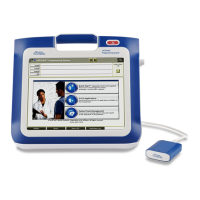
• Check PRM data for the
user-entered Implant Date,
if available.
Upon user request to enter MRI
Protection Mode, the PRM
provides an attention message
if the calculated time since exit
from Storage Mode is less than
or equal to six weeks. (Check
that the PRM is set with the
correct time and date to ensure
accuracy.)
• Arrhythmia induction
• Clinically significant pacing
threshold changes and
sensing changes as a
result of heating at the
lead/tissue interface
• Increased rate of lead
dislodgement due to
incomplete capsule
maturation
• Physical movement of
pulse generator in pocket
• Patients prone to sustained
arrhythmias
• Patients with high capture
thresholds
7. No cardiac-related implanted
devices, components, or
accessories present other than
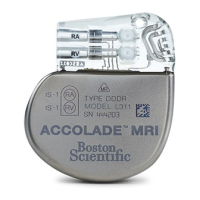
an ImageReady MR Conditional
Pacing System (see "System
Description" on page 1-2).
The presence of other cardiac
implants or accessories such as
lead adaptors, extenders, or
abandoned leads or pulse
generators may significantly
reduce the effectiveness of an
ImageReady MR Conditional
Pacing System in reducing risks
of MRI scanning.
• Check patient records.
• Confirm with physician
responsible for managing
the patient’s Pacing
System.
• Check X-rays.
• Check model numbers in
this Guide ("System
Description" on page 1-2)
or at http://www.
bostonscientific.com/
imageready.
For model numbers of MR
Conditional components, and to
identify an appropriate
combination, refer to "System
Description" on page 1-2 in this
Guide, http://www.
bostonscientific.com/
imageready, or Boston
Scientific Technical Services.
• Arrhythmia induction
• Clinically significant pacing
threshold changes and
sensing changes as a
result of heating at the
lead/tissue interface
• Damage to pulse
generator, lead, or
connection
• Physical movement of
pulse generator and/or
leads
• Pocket discomfort due to
pulse generator heating
• Pacing-dependent patients
• Patients prone to sustained
arrhythmias
• Patients with high capture
thresholds
8. Pacing threshold ≤ 2.0 V in
pace-dependent patients.
Pulse generator pulse
amplitude in MRI Protection
Mode is set to 5.0 V, providing a
minimum two-fold safety margin
• Check patient records for
most recent pacing
threshold values or run a
pacing threshold test.
The device will check the most
recently recorded pacing
• Inappropriate pacing,
inhibition of pacing, or
irregular intermittent
capture or pacing, possibly
resulting in pre-syncope or
syncope
• Pacing-dependent patients



 To Next Page