Introduction to MR Conditional Pacing
Conditions for Scanning
1-9
Table 1–5. Radiology Conditions (continued)
Condition for Scanning (Rationale) Actions If Condition is Not Met
Potential Clinical
Consequences
Risk is Highest for
• RF field of approximately 64 MHz
• Spatial gradient no greater than 50 T/
m (5,000 G/cm)
• Refer to "System
Description" on page 1-
2 to determine which
components are valid
for use with 1.5 T
magnets.
• Clinically significant
pacing threshold
changes and sensing
changes as a result of
heating at the lead/
tissue interface
• Damage to pulse
generator, lead, or
connection
• Physical movement of
pulse generator and/or
leads
• Pocket discomfort due
to pulse generator
heating
• Patients prone to
sustained arrhythmias
• Patients with high
capture thresholds
The ImageReady Pacing Systems mitigate hazards associated with 1.5 T or 3 T MRI scanning. System response to other magnet
strengths has not been evaluated. Refer to "System Description" on page 1-2 to determine which components are valid for use with 1.5 T
scanners.
System response to spatial gradients greater than 50 T/m (5,000 G/cm) has not been evaluated.
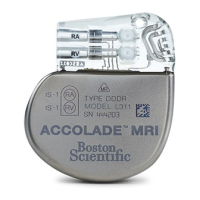
WARNING: Only the combination of INGEVITY MRI lead(s) with an ESSENTIO MRI, PROPONENT MRI, or ACCOLADE MRI pulse
generator is valid to use with either 1.5 T or 3 T scanners. All other allowable combinations of Boston Scientific MR Conditional system
components must use only 1.5 T scanners.
1b.
MRI magnet strength of 3 T:
• RF field of approximately 128 MHz
• Spatial gradient no greater than 50 T/
m (5,000 G/cm)
• Check technical
specifications of MRI
scanner.
• Refer to "System
Description" on page 1-
2 to determine which
components are valid
for use with 3 T
magnets.
• Arrhythmia induction
• Clinically significant
pacing threshold
changes and sensing
changes as a result of
heating at the lead/
tissue interface
• Damage to pulse
generator, lead, or
connection
• Physical movement of
pulse generator and/or
leads
• Pocket discomfort due
to pulse generator
heating
• Pacing-dependent
patients
• Patients prone to
sustained arrhythmias
• Patients with high
capture thresholds
The ImageReady Pacing Systems mitigate hazards associated with 1.5 T or 3 T MRI scanning. System response to other magnet
strengths has not been evaluated. Refer to "System Description" on page 1-2 to determine which components are valid for use with 3 T
scanners.
System response to spatial gradients greater than 50 T/m (5,000 G/cm) has not been evaluated.
WARNING: Only the combination of INGEVITY MRI lead(s) with an ESSENTIO MRI, PROPONENT MRI, or ACCOLADE MRI pulse
generator is valid to use with either 1.5 T or 3 T scanners. All other allowable combinations of Boston Scientific MR Conditional system
components must use only 1.5 T scanners.
2. Horizontal,
1
H proton, closed bore
scanners only.
The ImageReady Pacing Systems
mitigate hazards associated with
horizontal closed bore scanners.
• Check technical
specifications of MRI
scanner.
• Arrhythmia induction
• Clinically significant
pacing threshold
changes and sensing
changes as a result of
heating at the lead/
tissue interface
• Inappropriate pacing,
inhibition of pacing, or
irregular intermittent
capture or pacing,
• Pacing-dependent
patients
• Patients prone to
sustained arrhythmias
• Patients with high
capture thresholds



 To Next Page