2-19
C A U T I O N
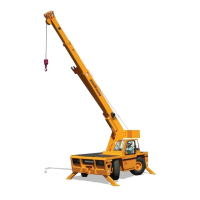
The “ON OUTRIGGER” capacities of this crane are based on all outriggers being
EXTENDED to a FIRM, LEVEL surface with no load on the tires. The crane may tip
at less than capacity loads if operated in the following manner:
A. One or more outriggers not set on firm surface or cribbing with all tires off ground.
B. Crane operated on a hill or sloping surface. Crane will tip at less than rated capacity
when load is lifted on downhill side.
C. Outriggers extended to a surface that appears to be firm, but is unable to support
the outrigger pad at full rated loads. Examples of this type surface are:
1. Thin or cracked blacktop or concrete.
2. Dirt that appears dry and firm but is moist or unpacked beneath the surface.
3. Dirt with a frozen but thin crust.
C A U T I O N
REMEMBER THAT AS THE BOOM IS LOADED, DEFLECTION OF THE BOOM,
TIRES, ETC., WILL INCREASE THE LOAD RADIUS. BE CONSERVATIVE IN YOUR
CAPACITY ESTIMATE.
The boom must sequence properly for the Rated Capacity Limiter to be accurate and for
the load to be supported safely. That is, the second stage must extend completely
before the third and fourth stages begin to extend. Also, the third and fourth stages must
retract completely before the second stage begins to retract. Adjust the sequencing per
the maintenance section of this manual if the boom does not sequence properly.
Do not operate the crane at a load radius where no capacity is listed on the chart. Even
an empty boom may tip the crane on rubber if it is extended over the side past 44 feet
(13.4 m).
CAPACITY EXAMPLE (Also see Boom Extension Capacity Example)
Refer to the RT-300-2G capacity chart on the preceding page. A load 5' X 5' X 5' (1.5m
X 1.5m X 1.5m) and weighing 14000 lbs (6350 kg) is to be lifted for transport to a new
location. The load is next to a narrow aisle, and must be lifted over the side, then swung
over the front for transport. The center of the load is 8 ft (2.4 m) from the side of the
crane. The distance from the center of rotation to the side of the crane is just over 4'
(1.2 m). The load radius is therefore at least 5/2+8+4=14.5' (1.5/2+2.4+1.2=4.35 m).
We must round up to the next higher load radius, rather than interpolate between
numbers on the chart.
We see on the chart that 7500 lbs (3400 kg) is the maximum load on one-part line, so
the sheave block is required. The chart shows the weight of the standard sheave block
to be 440 lbs (200 kg). The rigger says that two slings are required, weighing a total of
50 lbs (23 kg). The total load is 14000+440+50=14490 lbs (6350+200+23=6573 kg).
Courtesy of Crane.Market



 To Next Page