3-24
Swing and slow hoist have spools that bleed pressure from work ports to return galley of
valve. Slow crowd and topping have spools that bleed pressure from the retract side work
port only, to return galley. All other spools are blocked-port spools.
The relief valve pressure setting at the inlet end of the valve is 3000 psi (207 bar). This
pressure is required for all except swing. Two work port relief valves are installed in the
swing circuit. These relief valves are set at 2200 psi (152 bar) as indicated in the
illustration above.
With a pressure gauge attached and the swing valve work ports plugged, the swing circuit
may be checked by actuating the swing control lever. If the pressure is improper, the work
port relief valves can be removed and shims added or removed as needed. Part numbers
for the work port relief valve and shims are listed in the PARTS section. Pressure is
changed approximately 100 to 125 psi (6.9 to 8.6 bar) for each .010" (.25 mm) shim.
BOOM SEQUENCE
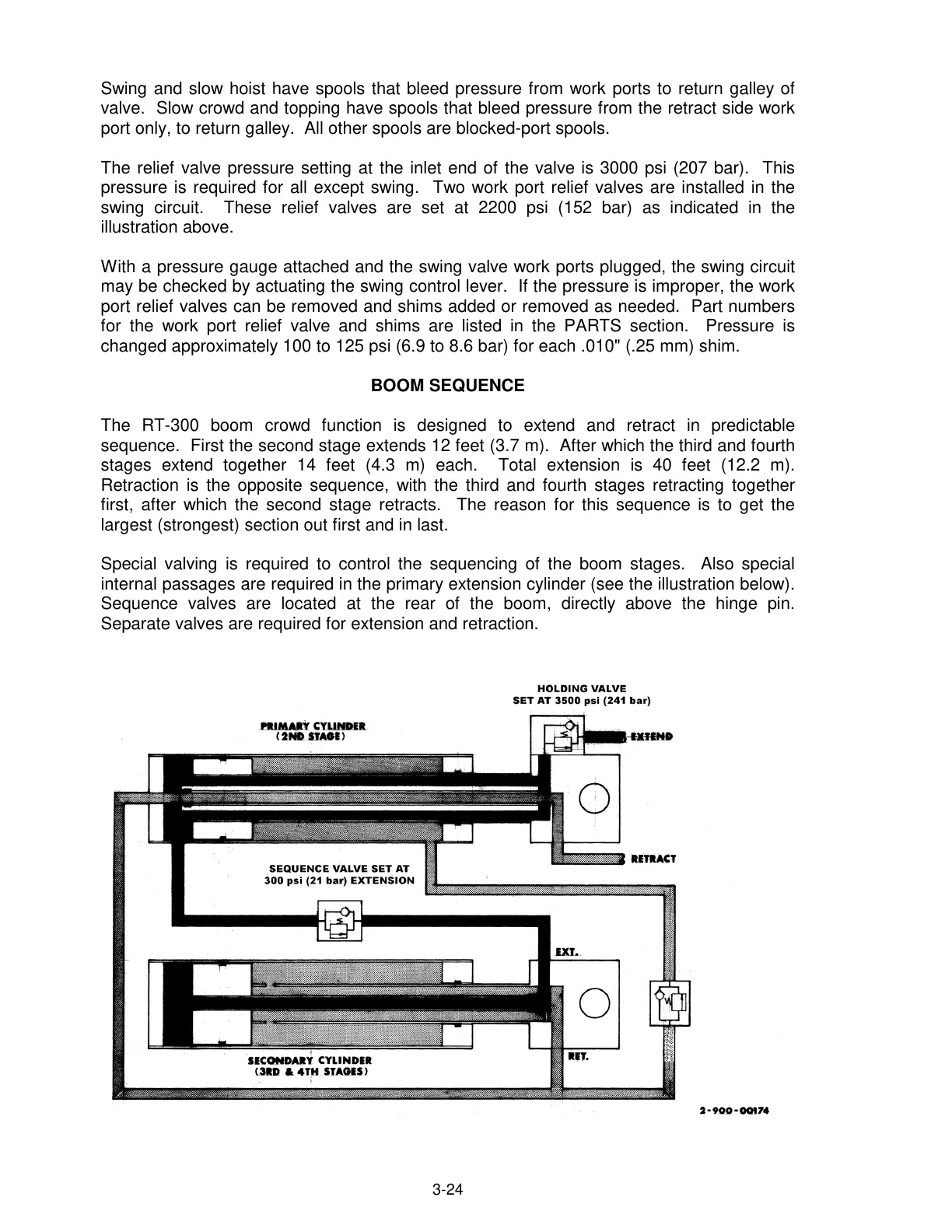
The RT-300 boom crowd function is designed to extend and retract in predictable
sequence. First the second stage extends 12 feet (3.7 m). After which the third and fourth
stages extend together 14 feet (4.3 m) each. Total extension is 40 feet (12.2 m).
Retraction is the opposite sequence, with the third and fourth stages retracting together
first, after which the second stage retracts. The reason for this sequence is to get the
largest (strongest) section out first and in last.
Special valving is required to control the sequencing of the boom stages. Also special
internal passages are required in the primary extension cylinder (see the illustration below).
Sequence valves are located at the rear of the boom, directly above the hinge pin.
Separate valves are required for extension and retraction.
Courtesy of Crane.Market



 To Next Page