AMETEK Brookeld Page 22 Manual No. M15-356-B0916
When comparing data with others, be sure to specify the sample container size and
presence/absence of the guard leg.
Many samples must be controlled to a specic temperature for viscosity measurement.
When conditioning a sample for temperature, be sure to temperature control the container
and spindle as well as the sample.
Please see our publication, “More Solutions to Sticky Problems”, for more details relating
to sample preparation.
III.3SelecngaSpindle/Speed
e DVE has the capability of measuring viscosity over a wide range (for example, the DVERV can
measure uids within the range of 100-13,000,000 cP) (see Appendix A). is range is achieved
through the use of several spindles over many speeds.
e process of selecting a spindle and speed for an unknown uid is normally trial and error. An
appropriate selection will result in measurements between 10-100 on the instrument % torque
scale. Two general rules will help in the trial and error process.
1. Viscosity range is inversely proportional to the size of the spindle.
2. Viscosity range is inversely proportional to the rotational speed.
In other words: to measure high viscosity, choose a small spindle and/or a slow speed. If the chosen
spindle/speed results in a reading above 100%, then reduce the speed or choose a smaller spindle.
Experimentation may reveal that several spindle/speed combinations will produce satisfactory
results between 10-100%. When this circumstance occurs, any of the spindles may be selected.
Non-Newtonian uid behavior can result in the measured viscosity changing if the spindle and/or
speed is changed. See our publication, “More Solutions to Sticky Problems”, for more detail.
When viscosity data must be compared, be sure to use the same test methodology: the same
torque range, spindle, speed, container, temperature and test time.
III.4RunningaTest
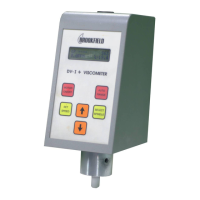
A viscosity test is started by pressing the MOTOR ON/OFF key. Measurement data will be displayed
during the test. When the MOTOR ON/OFF key is pressed to end the test, the nal data will be
displayed on the DVE until the user presses a key. e following procedure outlines the general
steps necessary for making a viscosity measurement in a 600 mL low form Grin beaker using the
standard LV (61-64)/RV/HA/HB (2-7) spindles.
1. Level the DVE Viscometer. Remove any attached spindles.
2. Prepare the sample to be tested and transfer to a 600 mL low form Grin beaker.
3. When using an LV61, LV62, RV1 or RV2 spindle, attach the guard leg. Attach the spindle
to the lower sha. Li the sha slightly, holding it rmly with one hand while screwing the



 To Next Page