BTL-2000
USER'S MANUAL & USER’S GUIDE
Page 34 z 45
4.3.4 Type of beam
• convergent: a point beam
• divergent: a widening beam that allows irradiation of a larger area without the need to move the probe over the
tissue being treated
• laser scanners: devices for irradiation of large areas
4.3.5 Laser class (defined by the output)
Values described bellow are only for user orientation.
• Class 2: less than 1mW
• Class 3A (3R, 3M): less than 5mW, output density less than 25 W/m
2
• Class 3B: less than 500mW
4.3.6 Use
• simple pen lasers: usually feature only a very limited choice of frequency modes. The advantage of this type of
laser is its accuracy.
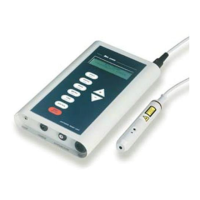
• pocket lasers: designed to fit in the pocket of a physician's gown, and with the probe connected by a cable with
the body. These lasers are most common. They may employ probes of tens of mW output.
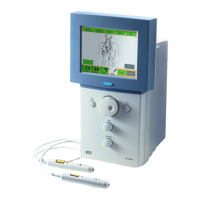
• table devices: usually connected with the mains, and with the probe connected with the device by a cable. The
advantages of this type usually include a wide choice of frequency modes and the possibility to set many different
parameters.
4.4 Basic physical quantities
• wavelength: one of the basic parameters of a laser beam is that it is always monochromatic. Only one
wavelength measured in nanometers (nm).
• output: usually measured in mW. A declared output is either top, i.e. amplitude of pulse, or mean, i.e. average
output of the laser. The use of the optic attachment or light conductor causes approximately a 10% loss of output.
It is always necessary to know the output level at the active point of the probe. In lasers where the beam is
transmitted by a light conductor, final output can markedly differ from source output! Every transference through a
media (air, air-light conductor optic, light conductor optic-air) lowers output.
The mean output also depends on the chosen mode (continuous or pulse). The microprocessor unit checks which
mode is employed when counting the therapy time.
• Modulation frequency: declared in the number of oscillations per second - Hertz (Hz). Sometimes added are the
characteristics of the pulses regarding how much % constitutes the active state time (employed substance or
modulation class) and the width of the pulse. Numeric frequencies are used most commonly (5Hz stimulative,
10Hz analgesic effect), Nogier frequencies are also used often (previously mainly in acupuncture), and Bahr
frequencies (acupuncture) and Voll frequencies are also used.
• Power density (dose): (J/cm
2
) the degree of consistency measured by the quantity of energy emmited per unit
area.
Below you can see a formula for the calculation of emitted dose of energy. (this number is a dose emitted to skin
surface, not deeper structures).
mean radiation output (W) x application time (s)
emitted dose of energy in J/cm
2
= ----------------------------------------------------------
emitted surface area (cm
2
)
4.5 Biologic effects of a low-output laser (non-invasive laser)
Specific physical qualities of a laser beam cause specific clinical effects. The most considerable clinical effects
follow:
• analgesic effect
• myorelaxation effect
• antiflogistic effect
• antiedematous effect
• bactericidal and viricidal effects



 To Next Page