06/23
9
Therefore, as the thickness of the test material is increased, the required voltage also increases, and this
in turn leads to an increase in the Corona Discharge current. As the width of the material is increased,
or the speed of the material is increased, the Material Draw current is also increased. These physical
factors must be considered when specifying an HV system. The sum of the Corona Current and
Material Draw Current is the Total Quiescent Demand Current, Iq for convenience.
Buckleys have material testing capability and are pleased to offer advice on the expected Corona
and Material Draw currents for planned installations, however, due to the nature of discharges and their
very specific dependence on the surroundings and environment, this advice can only ever be general
in nature.
Instrument Output Limits
Buckleys DCCT instruments are designed to provide a limited output current, primarily to ensure that the
output remains within the limits specified by the IEEE to prevent a lethal shock to anyone accidentally
touching the HV electrodes or wiring. This has the effect of limiting the output power at any given
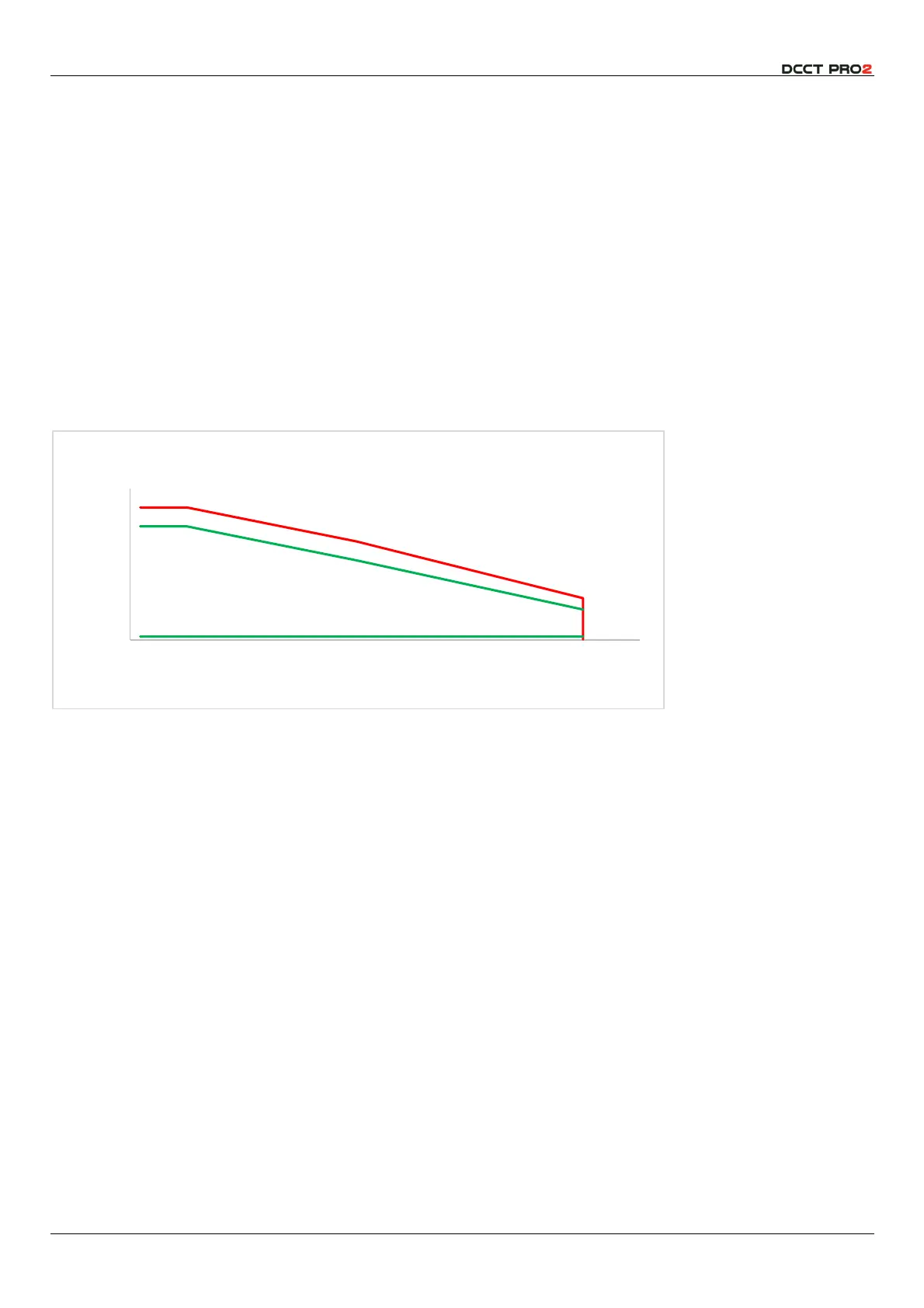
voltage, as can be seen in the graph in Fig 2.
Fig 2 - Typical Output Performance at 40kV
The red line on the graph in Fig 2 shows the performance limit as a limit for continuous current across the
range of output voltage of the DCCT instrument. Ideally, the current demand Iq at the required
voltage will fall in the zone outlined in green. However, if the demand current Iq is sufficiently high, it will
cause the output voltage to drop. Provided that the resultant voltage remains sufficiently high to carry
out the test reliably, this is acceptable. However, if it leads to a voltage below the necessary minimum,
the test may not detect flaws. This inevitably leads to a situation where some combinations of material
thickness, extrusion width, and extrusion speed, will exceed the output of a single instrument.
In order to counteract this constraint, Buckleys have introduced a range of multi-channel instruments in
which a user interface is able to control more than one generator. Each generator can supply sufficient
current to energise an electrode of a given size, and multiple generators can then be used to ensure
the total electrode width is sufficient to carry out the test on the full width of material, at the desired
extrusion speed.
This approach provides economic and ergonomic advantages:
•
It is cheaper than providing several complete instruments.
•
It is considerably simpler to install, particularly if interlocking and remote control are require.
•
It is easier to control, with a single setting process controlling all outputs simultaneously.
•
The instruments each provide individual alarm counters and outputs, and these can be grouped
into a single overall alarm if required.
0
50
100
150
200
250
300
350
400
0 5 10 15 20 25 30 35 40 45
Maximum Output Current
Output Voltage
Continuous Output Current Capability



 To Next Page