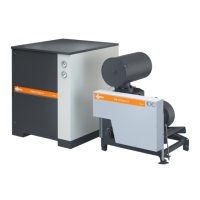
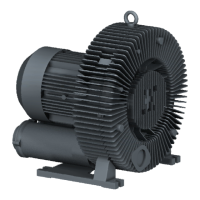
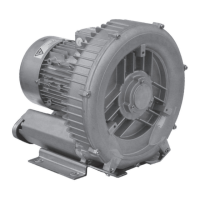
This document is an instruction manual for the Busch TYR Rotary Lobe Blowers, specifically models WT 0100 - 0730 CP/CV. It provides comprehensive information on the product's function, technical specifications, usage, and maintenance.
Function Description
The Busch TYR Rotary Lobe Blowers operate on the principle of oil-free gas transport. They utilize two identical tri-lobe rotors that rotate in opposite directions within a casing. This design allows for the transport of a fixed volume of air with each turn. A key feature is that there is no contact between the rotors themselves, nor between the rotors and the casing, ensuring that the process gas remains oil-free in the working area. The machine transports gas without increasing its pressure; instead, gas is compressed in the machine outlet by gas that has already been transported (blowers with external compression).
These blowers are designed for transporting air and other dry, non-aggressive, non-toxic, and non-explosive gases. They are intended for industrial use and can be placed in non-potentially explosive environments. The machines are suitable for both continuous and intermittent operation.
Important Technical Specifications
The manual provides detailed technical data for various models (WT 0100, WT 0150, WT 0280, WT 0390, WT 0600, WT 0730 CP/CV). Key specifications include:
- Inlet Flow (50Hz): Ranges from 2.5 m³/min (WT 0100 CP/CV) to 73.0 m³/min (WT 0730 CP/CV).
- Nominal Motor Rating (50Hz): Ranges from 1.5 kW (WT 0100 CP/CV) to 90.0 kW (WT 0600 CP/CV and WT 0730 CP/CV).
- Max. Differential Pressure (Pressure Operation): Consistently 1000 hPa (mbar) across all models.
- Max. Differential Pressure (Vacuum Operation): Consistently 500 hPa (mbar) across all models.
- Nominal Motor Speed (50Hz): Ranges from 750 min⁻¹ to 4700 min⁻¹ depending on the model.
- Ambient Temperature Range: -15 to 45 °C.
- Max. Gas Inlet Temperature: 60 °C.
- Relative Humidity: 90% at 30 °C.
- Weight (Pump Stage Approx.): Ranges from 75 kg (WT 0100 CP/CV) to 375 kg (WT 0730 CP/CV).
- Weight (Unit without Cabinet): Ranges from 180 kg (WT 0100 CP/CV) to 750 kg (WT 0730 CP/CV).
- Weight (Unit with Cabinet): Ranges from 295 kg (WT 0100 CP/CV) to 1053 kg (WT 0730 CP/CV).
Oil Capacity:
The oil capacities vary by model and whether the unit includes a cabinet, and are specified for both the motor side and gear side. For example, the WT 0100 CP/CV has 0.4 L (with cabinet) / 0.3 L (without cabinet) for both motor and gear sides. The WT 0730 CP/CV has 1.1 L (with cabinet) / 1.0 L (without cabinet) for both sides.
Recommended oil types are Anderol 6220 (Food grade gear oil, ISO-VG 220) and VS 220 (Standard gear oil, ISO-VG 220).
Usage Features
- Installation: The machine must be set up horizontally on a flat surface with a maximum permissible unevenness/inclination of 0.5°. A 1-meter space around the machine is recommended for maintenance. Anchoring the machine to the floor is crucial to prevent spontaneous movement and damage.
- Electrical Connection: Requires connection by qualified personnel, ensuring compatibility with motor nameplate data and adherence to national/international standards. A lockable disconnect switch and overload protection are mandatory. Correct motor rotation direction is critical and must be verified during start-up; incorrect rotation can destroy the machine.
- Connecting Lines/Pipes: All protective covers must be removed. Connection lines should not stress the machine's connections, and flexible joints should be used if necessary. Line sizes must match or exceed machine connections. Pipe installation on the exhaust side must be made from heat-resistant material, and all piping should be made from conducting material to avoid static electricity buildup.
- Suction Connection: The suction connection must be protected, and a suitable filter (5 micron or less) must be installed upstream if the inlet gas contains dust or foreign solid particles.
- Commissioning: Prior to commissioning, the machine must be filled with oil. Operation without oil will cause rapid damage. The compression chamber of the dry-running machine must not be lubricated with oil or grease. During operation, the machine surface can reach temperatures above 70°C, requiring caution to prevent burns. Ear protection is recommended if persons are present near a non-noise insulated machine for extended periods. Maximum permissible starts per hour are specified (12 starts/hour for 3-11 kW, 6 starts/hour for 15-90 kW).
Maintenance Features
The manual outlines a detailed maintenance schedule to ensure optimal performance and longevity.
- General Maintenance:
- Every 6 months: Visual inspection, cleaning from dust and dirt, checking electrical connections and monitoring devices.
- Every 32000 hours: Recommend planning a preventive overhaul.
- According to motor manual: Check and lubricate the motor if necessary.
- Inlet Filter Maintenance:
- After 10-20 operating hours: Check and clean the inlet filter.
- Monthly (or more often depending on application): Check and clean the inlet filter.
- Half-yearly / Yearly (or more often depending on application): Change the inlet filter.
- The filter must not be washed. Cleaning with compressed air is not 100% effective, so replacement is recommended.
- V-Belt and Pulley Alignment:
- After 10-20 operating hours: Check belt tension and V-belts, check pulley alignments.
- Half-yearly (or more often depending on application): Check belt tension and V-belts, check pulley alignments.
- Once a year: Change the V-belts. V-belt change intervals for higher loads and ambient temperatures (+40°C) range from 4000 to 8000 hours.
- Permissible parallel offset of two pulleys: 10 mm per 1000 mm of strand length.
- Permissible angular offset of two pulleys: max. 0.5°.
- Permissible axial twist of pulleys: max. 0.25°.
- Oil Maintenance:
- After 10-20 operating hours: Check oil level.
- Weekly: Check oil level.
- After 500 operating hours: Change oil for newly operated blowers.
- Every 8000 hours (or min. once a year): Change oil if bearing temperature is 110°C.
- Every 4000 hours (or min. every 6 months): Change oil if bearing temperature is 111-130°C.
- Oil level inspection requires shutting down the machine and waiting 1 minute before checking. Overfilling oil can damage the machine by increasing operating temperature and absorbed power.
- Overhaul and Decommissioning:
- Dismantling beyond what is described in the manual should be performed by a Busch authorized technician.
- If the machine has conveyed hazardous materials, it must be decontaminated, and a 'Declaration of Contamination' must be provided.
- For decommissioning, shut down, lock against start-up, vent lines, disconnect connections, drain oil, separate special waste, and dispose of the machine as scrap metal according to regulations.

 Need help?

 To Next Page
 General